
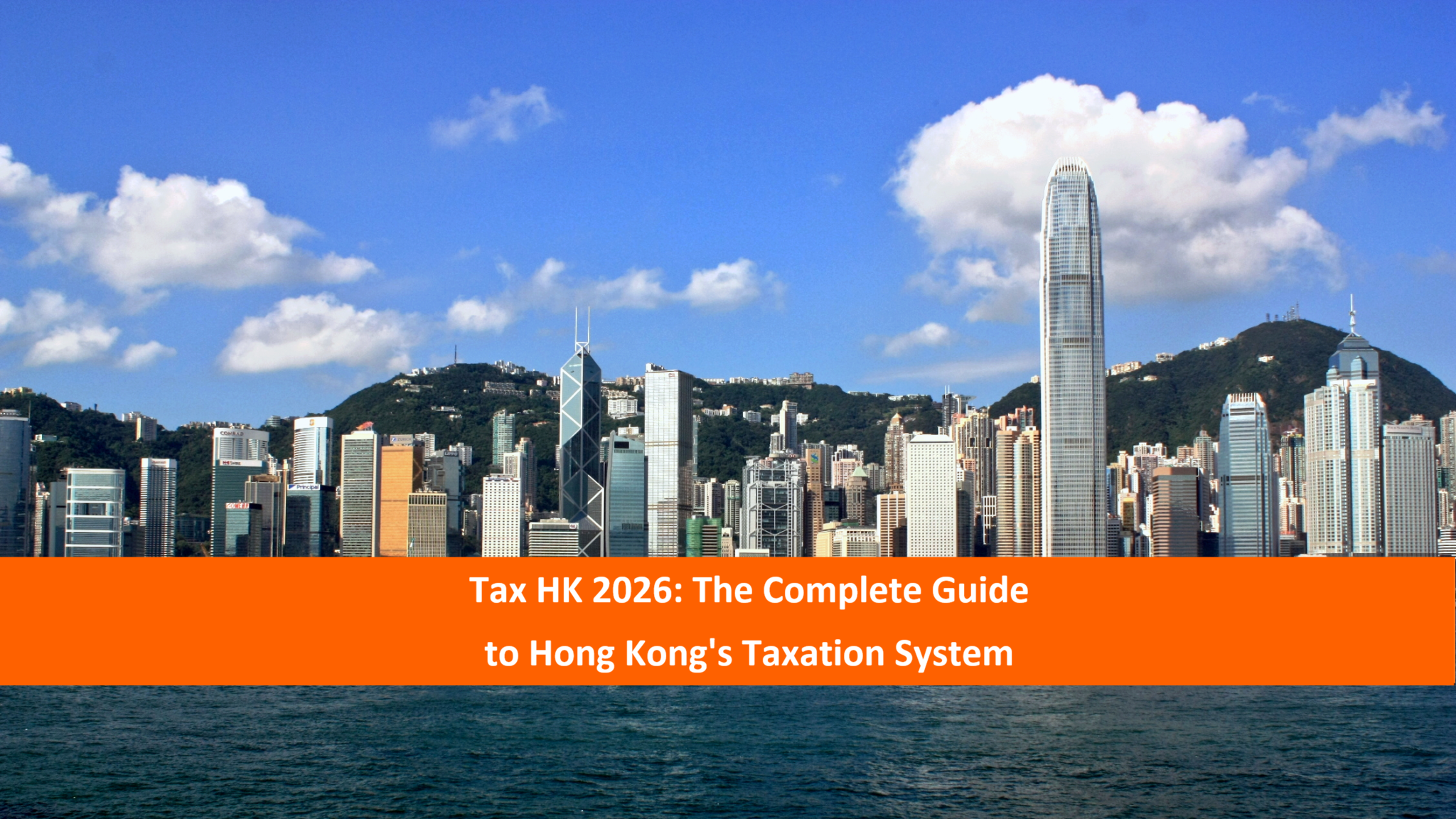
Hong Kong operates one of the world’s simplest and most competitive tax systems. The city follows a territorial basis of taxation: in general, only profits or income arising in or derived from Hong Kong are taxable.
Hong Kong does not levy VAT or GST, does not impose a separate capital gains tax, does not impose withholding tax on dividends, and does not tax individuals on worldwide income merely because they are resident in Hong Kong.
However, these statements are subject to important qualifications:
- gains described as “capital” may still be taxable if they are trading or revenue in nature;
- certain foreign-sourced passive income received in Hong Kong by in-scope multinational enterprise, or MNE, entities may be deemed taxable under the Foreign-Sourced Income Exemption, or FSIE, regime;
- royalties and certain payments to non-residents may give rise to Hong Kong profits tax exposure under deeming provisions, even though Hong Kong does not operate a broad withholding tax system.
For the 2026/27 year of assessment, which runs from 1 April 2026 to 31 March 2027, Hong Kong has introduced higher personal allowances, increased the deduction ceiling for elderly residential care expenses, increased stamp duty on very high-value residential property transactions, continued the implementation of the FSIE regime, and implemented the Hong Kong Minimum Top-up Tax, or HKMTT, for in-scope large MNE groups.
How the Tax System in Hong Kong Is Structured?
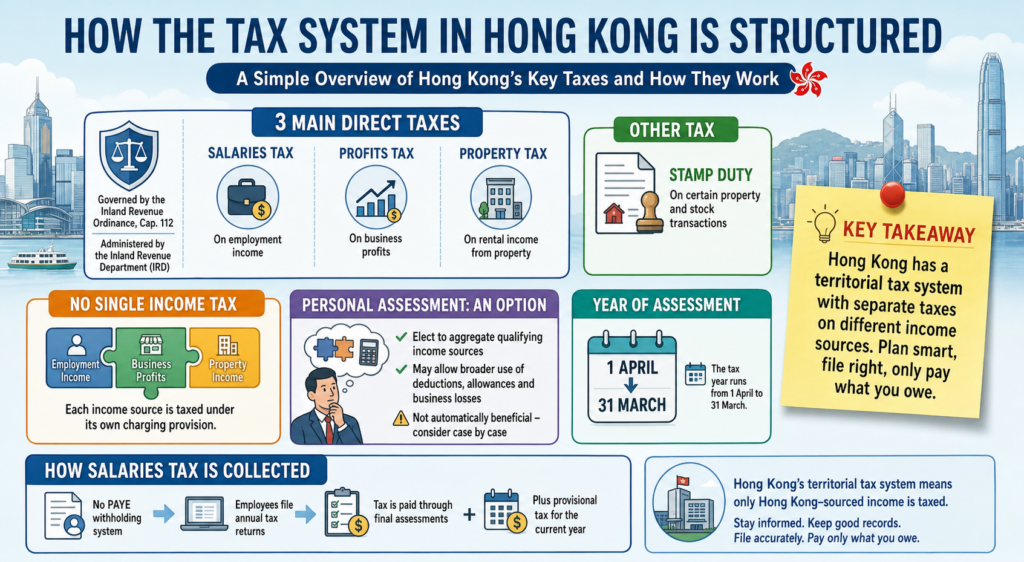
Hong Kong’s tax framework is principally governed by the Inland Revenue Ordinance, Cap. 112. The IRD administers three main direct taxes:
- Salaries tax;
- Profits tax; and
- Property tax.
Hong Kong also levies stamp duty on certain property and stock transactions.
There is no single unified income tax. Instead, each income source is taxed under its own charging provision. Individuals with multiple income sources may elect personal assessment, which aggregates qualifying income and may allow broader use of deductions, allowances and business losses. Personal assessment is not automatically beneficial and should be considered case by case.
The year of assessment runs from 1 April to 31 March. Hong Kong does not use a PAYE withholding system for salaries tax. Employees usually file annual tax returns and pay tax through final assessments, together with provisional tax for the current year.
Salaries Tax 2026/27
Who Is Liable
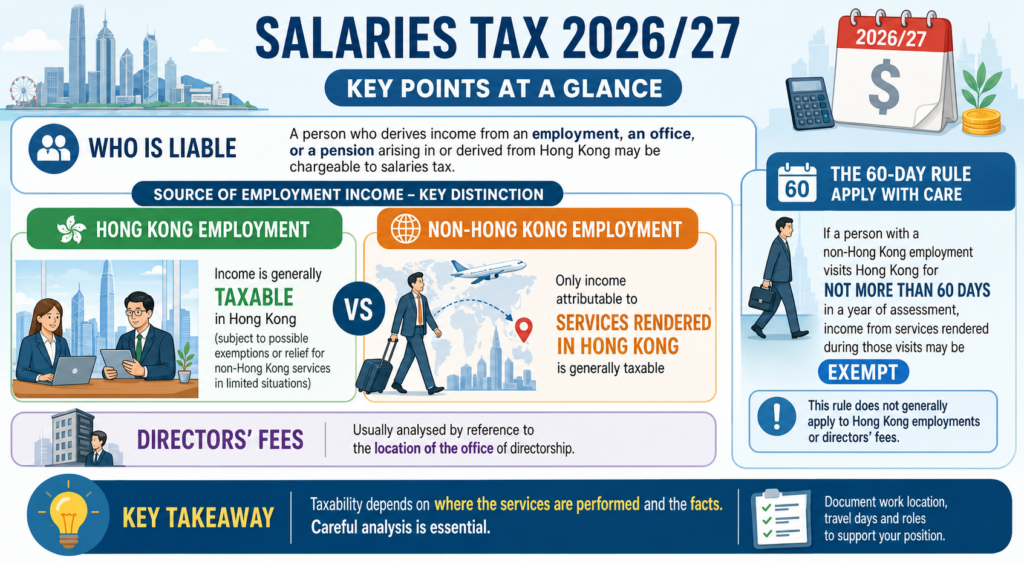
A person who derives income from an employment, an office, or a pension arising in or derived from Hong Kong may be chargeable to salaries tax.
The source of employment income is a fact-sensitive issue. A key distinction is between:
- Hong Kong employment, where income is generally taxable in Hong Kong, subject to possible exemptions or relief for non-Hong Kong services in limited situations; and
- non-Hong Kong employment, where only income attributable to services rendered in Hong Kong is generally taxable.
The commonly cited 60-day rule should be applied with care. Broadly, if a person with a non-Hong Kong employment visits Hong Kong for not more than 60 days in a year of assessment, income from services rendered during those visits may be exempt. This rule does not generally apply to Hong Kong employments or directors’ fees. Directors’ fees are usually analysed by reference to the location of the office of directorship.
Progressive Rates vs. Standard Rates
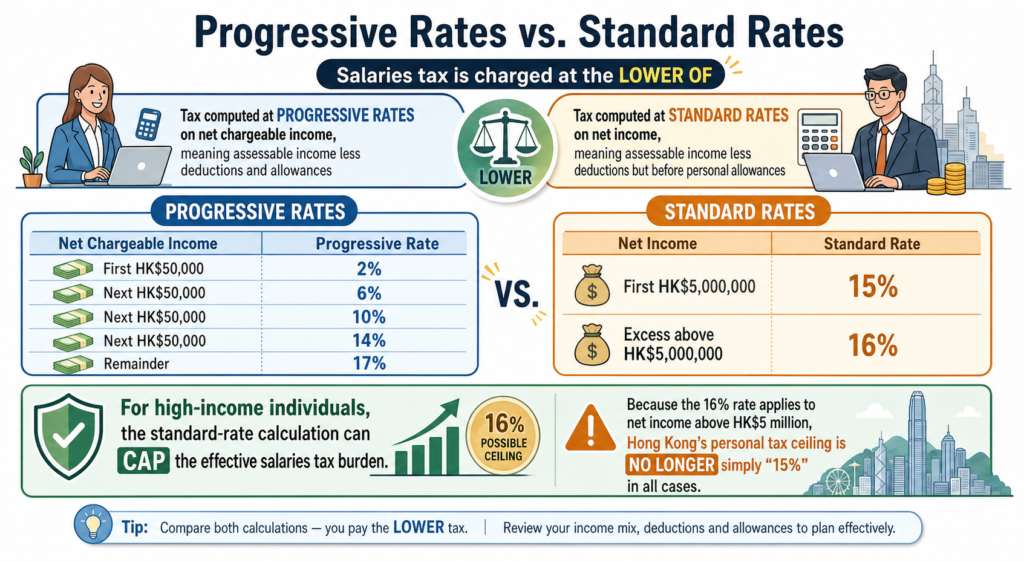
Salaries tax is charged at the lower of:
- tax computed at progressive rates on net chargeable income, meaning assessable income less deductions and allowances; or
- tax computed at standard rates on net income, meaning assessable income less deductions but before personal allowances.
Progressive Rates
| Net Chargeable Income | Progressive Rate |
| First HK$50,000 | 2% |
| Next HK$50,000 | 6% |
| Next HK$50,000 | 10% |
| Next HK$50,000 | 14% |
| Remainder | 17% |
Standard Rates
| Net Income | Standard Rate |
| First HK$5,000,000 | 15% |
| Excess above HK$5,000,000 | 16% |
For high-income individuals, the standard-rate calculation can cap the effective salaries tax burden. However, because the 16% rate applies to net income above HK$5 million, it is no longer fully accurate to describe Hong Kong’s personal tax ceiling simply as “15%” in all cases.
Personal Allowances 2026/27
The following allowances apply from the 2026/27 year of assessment:
| Allowance Type | 2025/26 | 2026/27 |
| Basic allowance | HK$132,000 | HK$145,000 |
| Married person’s allowance | HK$264,000 | HK$290,000 |
| Single parent allowance | HK$132,000 | HK$145,000 |
| Child allowance, per child | HK$130,000 | HK$140,000 |
| Additional child allowance, per child | HK$130,000 | HK$140,000 |
| Dependent parent / grandparent allowance, age 60 or above, or eligible under the Government’s Disability Allowance Scheme | HK$50,000 | HK$55,000 |
| Additional dependent parent / grandparent allowance if living continuously with the taxpayer throughout the year, age 60 or above, or eligible under the Government’s Disability Allowance Scheme | HK$50,000 | HK$55,000 |
| Dependent parent / grandparent allowance, age 55 to below 60 | HK$25,000 | HK$27,500 |
| Additional dependent parent / grandparent allowance if living continuously with the taxpayer throughout the year, age 55 to below 60 | HK$25,000 | HK$27,500 |
For a dependent parent or grandparent aged 60 or above who lives continuously with the taxpayer throughout the year, the maximum combined allowance from 2026/27 is therefore HK$110,000, comprising HK$55,000 ordinary allowance plus HK$55,000 additional allowance.
The additional child allowance is not entirely new in 2026/27. What changes from 2026/27 is that both the child allowance and the additional child allowance are increased to HK$140,000 per child, and the period for claiming the additional child allowance is extended under the revised rules.
Key Deductions
| Deduction | Annual Cap |
| Mandatory MPF contributions | HK$18,000 |
| Self-education expenses | HK$100,000 |
| Home loan interest | HK$100,000, for up to 20 years of assessment |
| Domestic rent deduction | HK$100,000, subject to eligibility conditions |
| Qualifying VHIS premiums | HK$8,000 per insured person |
| Tax-deductible voluntary MPF contributions and qualifying deferred annuity premiums | HK$60,000 combined cap |
| Elderly residential care expenses | HK$110,000, increased from HK$100,000 |
| Approved charitable donations | Generally capped at 35% of assessable income or adjusted profits, subject to conditions |
The domestic rent deduction is subject to conditions. For example, the tenancy must generally relate to qualifying domestic premises, the taxpayer and spouse must not be owners of domestic property in Hong Kong during the relevant period, and the tenancy should be duly stamped. Restrictions may apply where housing benefits or home loan interest deductions are involved.
For 2025/26, the government proposed a one-off 100% reduction of salaries tax, profits tax and tax under personal assessment, capped at HK$3,000 per case. The reduction is reflected in the final tax payable for the year of assessment 2025/26.
Provisional Tax Note
First-time salaries taxpayers should be aware that the first tax demand note may include both:
- final tax for the preceding year of assessment; and
- provisional tax for the current year of assessment.
This can feel like almost two years’ worth of tax being charged at once.
A taxpayer may apply to hold over provisional tax in certain circumstances, including where the taxpayer’s income for the current year is expected to be substantially lower than the previous year. The application must be made within the statutory time limit and supported by relevant estimates and reasons.
Profits Tax: How Businesses Are Taxed
The Territorial Principle
Only profits arising in or derived from Hong Kong from a trade, profession or business carried on in Hong Kong are chargeable to profits tax. Incorporation in Hong Kong is not, by itself, decisive.
A Hong Kong-incorporated company earning profits wholly offshore may, depending on the facts, claim that the profits are not taxable in Hong Kong. Conversely, a foreign company or branch carrying on business in Hong Kong may be taxable on profits sourced in Hong Kong.
The source of profits is determined by looking at what the taxpayer has done to earn the profits and where those profit-producing operations took place. Different rules and case law principles may apply to trading profits, manufacturing profits, service income, commission income, financing income and intellectual property income.
Two-Tiered Profits Tax Rates
| Entity Type | First HK$2,000,000 of Assessable Profits | Remainder |
| Corporations | 8.25% | 16.5% |
| Unincorporated businesses | 7.5% | 15% |
Only one entity within a group of connected entities may generally benefit from the lower first-tier rate.
Depreciation Allowances and R&D Incentives
Hong Kong does not generally allow accounting depreciation as a tax deduction. Instead, it provides statutory depreciation allowances.
| Asset Type | Initial Allowance | Annual Allowance |
| Plant and machinery | 60% | 10%, 20% or 30%, depending on the relevant pool |
| Industrial buildings or structures | 20% | 4% |
| Commercial buildings or structures | Not generally applicable | 4% |
Certain prescribed fixed assets and environmental protection facilities may qualify for accelerated deductions or immediate deductions, subject to statutory conditions.
R&D Expenditure
Enhanced deductions apply only to qualifying research and development expenditure.
| R&D Expenditure Type | Deduction Treatment |
| Type A qualifying R&D expenditure | Generally 100% deduction |
| Type B qualifying R&D expenditure, first HK$2,000,000 | 300% deduction |
| Type B qualifying R&D expenditure, excess over HK$2,000,000 | 200% deduction |
Not all R&D expenditure automatically qualifies for the 300% or 200% enhanced deduction. The expenditure must meet the relevant statutory conditions.
Tax losses may generally be carried forward indefinitely against future profits of the same taxpayer. Hong Kong does not have general tax loss carry-back rules or group loss relief.
Property Tax
Property tax is charged at a flat rate of 15% on the net assessable value of land or buildings situated in Hong Kong.
Broadly, net assessable value is computed by reference to rental income, less permitted deductions such as rates paid by the owner and irrecoverable rent, followed by a statutory 20% allowance for repairs and outgoings.
Corporate owners that include rental income in their profits tax returns may apply for exemption from property tax to avoid double taxation.
Stamp Duty 2026
Residential Property: Ad Valorem Stamp Duty
Following the removal of the major residential demand-side management measures in February 2024, including Special Stamp Duty, Buyer’s Stamp Duty and New Residential Stamp Duty, residential property transactions are generally subject to ad valorem stamp duty, or AVD.
However, it is important not to oversimplify the AVD table. The lower Scale 2 rates do not simply apply to every buyer. Scale 2 generally applies to a Hong Kong permanent resident acquiring a single residential property on his or her own behalf where the purchaser does not own any other residential property in Hong Kong at the time of acquisition, as well as certain other specified cases.
The rate table also contains marginal bands and transitional formulae. Therefore, the following is only a simplified summary and should not be used as a substitute for the official IRD stamp duty computation table.
Simplified Scale 2 Residential AVD Summary, from 26 February 2026
| Property Value or Consideration | Approximate AVD Treatment |
| Up to HK$4,000,000 | HK$100 |
| Above HK$4,000,000 to HK$6,000,000 | Transitional formula / up to 1.5% |
| Above HK$6,000,000 to HK$9,000,000 | Transitional formula / up to 2.25% |
| Above HK$9,000,000 to HK$12,000,000 | Transitional formula / up to 3% |
| Above HK$12,000,000 to HK$20,000,000 | Transitional formula / up to 3.75% |
| Above HK$20,000,000 to HK$100,000,000 | Transitional formula / up to 4.25% |
| Above HK$100,000,000 | 6.5%, with transitional threshold mechanics |
For residential property transactions with consideration or value exceeding HK$100 million, the AVD rate was increased from 4.25% to 6.5%, effective 26 February 2026.
Because the official table contains transition points and formulae, buyers should always use the IRD stamp duty calculator or the official rate table for actual computations.
Stock Transfers
Stamp duty on transfers of Hong Kong stock is charged at 0.1% on each side, meaning 0.1% payable by the buyer and 0.1% payable by the seller, for a combined rate of 0.2%. This rate has applied since November 2023.
Foreign-Sourced Income Exemption, or FSIE, Regime
Why It Exists
The European Union identified Hong Kong’s former foreign-sourced income exemption regime as potentially facilitating double non-taxation in respect of certain passive income. In response, Hong Kong enacted the FSIE regime, effective from 1 January 2023, with expansion from 1 January 2024.
The FSIE regime modifies the territorial principle for certain in-scope taxpayers. It does not abolish Hong Kong’s territorial basis of taxation, but it can deem specified foreign-sourced passive income to be taxable when received in Hong Kong if the relevant exception conditions are not met.
How It Works
The FSIE regime applies to MNE group entities carrying on a trade, profession or business in Hong Kong, regardless of revenue or asset size.
Specified foreign-sourced income may be deemed to be sourced from Hong Kong and chargeable to profits tax if it is received in Hong Kong and no applicable exception is satisfied.
The main categories of specified foreign-sourced income include:
- interest;
- dividends;
- intellectual property income; and
- disposal gains.
The applicable exceptions differ by income type.
| Exception | Main Applicable Income Types | Key Requirement |
| Economic substance requirement | Foreign-sourced interest, dividends and non-IP disposal gains | Adequate qualifying employees, operating expenditure and relevant economic activities in Hong Kong, with modified requirements for pure equity-holding entities |
| Participation requirement | Foreign-sourced dividends and equity interest disposal gains | Generally requires at least 5% equity interest held for at least 12 continuous months, subject to anti-abuse rules and other conditions |
| Nexus requirement | Qualifying IP income and qualifying IP disposal gains | Exemption depends on the nexus ratio linked to qualifying R&D expenditure |
| Intra-group transfer relief | Certain foreign-sourced disposal gains | Defers taxation for qualifying intra-group transfers, subject to anti-abuse conditions |
It is not accurate to say that the economic substance requirement applies equally to all four types of passive income. IP income is mainly dealt with under the nexus requirement.
In practice, companies with substantial operations in Hong Kong may be better placed to satisfy the economic substance requirement, but the analysis must be performed by entity, income type and function. Shell companies, passive holding vehicles, financing companies and IP-holding structures require particular care.
Global Minimum Tax and HKMTT
Who Is Affected
The global minimum tax and Hong Kong Minimum Top-up Tax apply only to large MNE groups with annual consolidated revenue of at least EUR 750 million in at least two of the four fiscal years immediately preceding the current fiscal year.
Most Hong Kong businesses are outside the scope of these rules.
How It Works
| Element | Detail |
| Minimum effective tax rate | 15% |
| In-scope groups | MNE groups meeting the EUR 750 million revenue threshold |
| Mechanism | Top-up tax may arise where the jurisdictional effective tax rate is below 15% |
| HKMTT purpose | Allows Hong Kong to collect top-up tax domestically in priority to other jurisdictions’ rules |
| First applicable fiscal years | Fiscal years beginning on or after 1 January 2025 |
| Practical impact | Mainly relevant to large MNE groups, especially those benefiting from low effective tax rates |
The phrase “second year of operation” should be used carefully. By calendar year 2026, some calendar-year MNE groups may be in their second fiscal year under the regime, but the statutory starting point is fiscal years beginning on or after 1 January 2025.
Substance-based income exclusions for payroll and tangible assets can reduce the amount of top-up tax for groups with real operations, but they do not remove the need for full Pillar Two calculations, data collection and compliance.
Tax Incentives for Funds and Family Offices
Hong Kong has several tax concession regimes designed to support asset management, funds and family offices.
| Incentive | Key Features |
| Unified fund exemption | Profits tax exemption for qualifying funds in respect of qualifying transactions and incidental transactions, subject to conditions |
| Family-owned investment holding vehicles | Profits tax concession for eligible family-owned investment holding vehicles managed by eligible single-family offices in Hong Kong |
| Carried interest concession | Concessionary tax treatment for eligible carried interest distributed by certified investment funds, subject to certification and other conditions |
Hong Kong has continued to refine its fund and family office regimes to improve competitiveness with other wealth management centres such as Singapore and Dubai. However, eligibility is highly technical. Taxpayers should verify the latest statutory provisions, IRD guidance and any 2026 legislative amendments before relying on the exemptions.
In particular, statements such as “expanded in June 2026 to cover funds-of-one structures” should not be used unless the specific amendment ordinance, commencement date and eligibility conditions are cited and verified.
Taxes Hong Kong Does Not Levy
| Tax Type | Status in Hong Kong |
| VAT / GST | Not levied |
| Separate capital gains tax | Not levied |
| Withholding tax on dividends | Not levied |
| Estate duty / inheritance tax | Estate duty abolished in 2006 |
| Worldwide individual income tax | Not levied; Hong Kong generally taxes individuals on a territorial basis |
| Broad social security tax | Not levied; MPF contributions apply instead |
Important Qualifications
Hong Kong does not impose a separate capital gains tax, but gains that are revenue in nature, trading profits, or profits from an adventure in the nature of trade may be chargeable to profits tax.
Hong Kong does not levy withholding tax on dividends or interest. However, royalties and certain payments to non-residents may be taxable under deeming provisions, and the Hong Kong payer may have practical reporting or withholding obligations.
MPF contributions are generally 5% of relevant income for both employer and employee, subject to minimum and maximum relevant income levels. The common monthly maximum mandatory contribution is HK$1,500 for each side, meaning HK$18,000 per year for the employee’s mandatory contribution deduction.
Hong Kong vs. Singapore vs. UAE: Quick Comparison
The following comparison is high-level only. Tax systems differ materially in residence rules, source rules, exemptions, indirect taxes, economic substance requirements and anti-avoidance regimes.
| Feature | Hong Kong | Singapore | UAE |
| Corporate tax rate | 8.25% / 16.5% two-tiered profits tax | 17% headline rate | 9% federal corporate tax above AED 375,000 taxable income, subject to exemptions and special regimes |
| Top personal tax rate | Progressive rates up to 17%, capped by standard rates of 15% / 16% | Up to 24% | No broad federal personal income tax |
| VAT / GST | None | 9% GST | 5% VAT |
| Separate capital gains tax | None, but trading gains may be taxable | None, but revenue gains may be taxable | No general personal capital gains tax; corporate tax treatment depends on taxpayer and asset |
| Dividend withholding tax | None | None | Generally none under domestic rules |
| Territorial system | Yes, subject to FSIE and deeming provisions | Partly territorial and partly remittance-based, with exemptions | Not a Hong Kong-style territorial system; UAE corporate tax is broadly residence-based for resident juridical persons, with exemptions such as participation and foreign permanent establishment relief |
| Legal system | Common law | Common law | Civil law system with common-law financial free zones such as DIFC and ADGM |
| Double tax agreements | 50+ | 90+ | 130+ |
Key takeaway: Hong Kong offers a low and relatively simple tax system, no VAT or GST, no dividend withholding tax, and a common-law framework. It remains particularly attractive for high-earning professionals, regional headquarters, trading businesses, asset managers and family offices in Asia-Pacific. However, Singapore and the UAE may be more attractive in specific cases depending on treaty access, regulatory needs, immigration planning, substance requirements and the taxpayer’s home-country tax position.
Filing Obligations and Deadlines
| Taxpayer | Form | Typical Issue Date | General Filing Deadline |
| Individuals | BIR60 | Usually early May | Generally 1 month from issue; automatic extension may apply for eTAX filing |
| Corporations | BIR51 | Usually first working day of April | Depends on accounting year-end and whether a tax representative extension applies |
| Sole proprietors / partnerships | BIR52 | Usually first working day of April | Depends on year-end and filing arrangement |
Late filing may result in estimated assessments, penalties, additional tax and, in serious cases, prosecution. Additional tax can be up to three times the amount of tax undercharged or that would have been undercharged.
Companies, employers and individuals should also be aware of other reporting obligations, including:
- employer’s returns, such as IR56B;
- commencement of employment notifications, such as IR56E;
- cessation of employment notifications, such as IR56F;
- departure from Hong Kong notifications, such as IR56G;
- business registration obligations;
- transfer pricing documentation where applicable;
- country-by-country reporting for relevant MNE groups.
Practical Tips for Expatriates
First Year in Hong Kong
Your employer must generally notify the IRD of your commencement of employment within the required timeframe. In practice, new arrivals should plan for a potentially large first tax demand because it may include both final tax for the previous year and provisional tax for the current year.
Home Country Interaction
Hong Kong tax does not eliminate home-country tax obligations. This is particularly important for individuals from jurisdictions that tax citizens or residents on worldwide income, such as the United States.
Double tax agreements, foreign tax credits, foreign earned income exclusions, residence tie-breaker rules and domestic exemptions may reduce double taxation, but they must be analysed under the laws of both jurisdictions.
60-Day Rule
If your employment is a non-Hong Kong employment and your visits to Hong Kong do not exceed 60 days during a year of assessment, income from services rendered during those visits may be exempt from Hong Kong salaries tax, subject to detailed IRD rules.
This exemption does not generally apply to Hong Kong employments or directors’ fees. It should not be treated as a simple day-count exemption for all expatriates.
Leaving Hong Kong
Employees leaving Hong Kong permanently or for a substantial period should be aware that employers may have to file departure forms with the IRD and withhold final payments until tax clearance procedures are completed.
Key 2026 Changes at a Glance
| Change | Detail |
| Basic allowance increase | HK$132,000 to HK$145,000 from 2026/27 |
| Married person’s allowance increase | HK$264,000 to HK$290,000 from 2026/27 |
| Child allowance increase | HK$130,000 to HK$140,000 from 2026/27 |
| Additional child allowance increase | HK$130,000 to HK$140,000 from 2026/27, with extended claiming period under revised rules |
| Dependent parent / grandparent allowance increase | For age 60 or above, HK$50,000 to HK$55,000; additional living-with allowance also HK$50,000 to HK$55,000 |
| Elderly residential care expenses deduction increase | HK$100,000 to HK$110,000 from 2026/27 |
| One-off tax reduction for 2025/26 | 100% reduction of final tax, capped at HK$3,000 per case |
| Luxury residential property stamp duty | AVD increased to 6.5% for residential property transactions over HK$100 million, effective 26 February 2026 |
| FSIE regime | Continues to apply to specified foreign-sourced passive income received in Hong Kong by in-scope MNE entities |
| HKMTT | Applies to fiscal years beginning on or after 1 January 2025 for in-scope large MNE groups |
| Hotel accommodation tax | 3% hotel accommodation tax resumed from 1 January 2025 |
| Fund and family office regimes | Continued refinement of concessionary regimes; eligibility should be checked against latest legislation and IRD guidance |
Conclusion
Hong Kong’s tax system in 2026 retains its core strengths: simplicity, territorial taxation, low headline tax rates, no VAT or GST, no dividend withholding tax, and no separate capital gains tax.
The maximum salaries tax burden remains low by international standards, although high-income individuals should note that Hong Kong now applies standard rates of 15% on the first HK$5 million of net income and 16% on the excess. The headline corporate profits tax rate remains 16.5%, with a two-tiered rate of 8.25% for the first HK$2 million of assessable profits for qualifying corporations.
At the same time, the system is becoming more integrated with international tax governance. The FSIE regime, global minimum tax, transfer pricing rules, treaty network and fund and family office concessions all require more careful analysis than Hong Kong’s simple headline rates might suggest.
For individuals and businesses with genuine operations in Hong Kong, the fundamentals remain highly favourable. But taxpayers should avoid relying on simplified slogans such as “no worldwide tax” or “no capital gains tax” without checking the detailed statutory rules, source principles, deeming provisions and anti-avoidance rules.
Why easyCorp
Navigating Hong Kong’s tax landscape—from salaries tax filing to cross-border profit sourcing claims—demands more than textbook knowledge. It requires a partner who has seen the scenarios before.
| What Sets Us Apart | |
| 17 Years of Experience | Founded in 2009, we have handled thousands of complex tax, accounting and business advisory cases across industries and jurisdictions. |
| Bank-Recognised Quality | Awarded “Best Business Partner” by Hang Seng Bank—a testament to our reliability and professionalism. |
| Global Reach, Local Expertise | Our clients span Europe, the United States, the Middle East, Asia and Africa. We understand how Hong Kong’s territorial system interacts with overseas tax regimes. |
| One-Stop Solution | Taxation, accounting, company secretarial and business consulting—all under one roof, so you never fall between the cracks. |
| 24-Hour Response Guarantee | Your emails and calls will be answered within 24 hours. In tax matters, timing is everything. |
| Partnership, Not Transaction | We see every client as a long-term business partner. Your interest is our benefit—and that alignment drives everything we do. |
Whether you are an entrepreneur setting up your first Hong Kong company, a multinational restructuring your Asia-Pacific holding, or an expatriate optimising your salaries tax position, easyCorp provides the experience, speed and strategic thinking to keep you compliant and competitive.
About easyCorp
Founded in 2009, easyCorp provides Hong Kong company incorporation, company secretary, registered address, business bank account opening referral, accounting, taxation, and business consulting services to entrepreneurs and companies from Europe, the United States, the Middle East, Asia, Africa, and other markets.
Contact us now for more details about accounting & audit services: https://www.easycorp.com.hk/en/accounting
Authorship:
This blog article is created by easyCorp business team and audited by chartered experts before publish. We’re dedicated to sharing useful information about setting up business and taxation in Hong Kong.
Founded in 2009, we were awarded as the “Best Business Partner” by HANG SENG Bank; our customers spread throughout Europe, the United States, the Middle East, Asia, Africa and etc.
easyCorp differentiate ourself as a strong incumbent in this market, our problem solving experience and numbers of scenario cases handled are not matchable by other market players. We provide high-quality taxation, accounting, company secretary & business consulting services.