
Foreigners can register a company in Hong Kong with no general residency requirement, no local partner requirement, and usually no need to visit Hong Kong for incorporation itself. A single overseas individual can serve as both the sole director and sole shareholder of a Hong Kong private company limited by shares.
In straightforward cases, once KYC checks are completed and all incorporation documents are accepted, the company incorporation filing can often be completed online within 1–3 business days. However, timing may vary depending on the applicant’s jurisdiction, ownership structure, regulated business activities, document quality, anti-money laundering checks, and any follow-up questions raised by the service provider, bank, or authority.
This guide covers the 2026 incorporation process: eligibility, documents, fees, step-by-step filing, the offshore tax framework, banking options for non-residents, and ongoing compliance.
Why Foreigners Choose Hong Kong
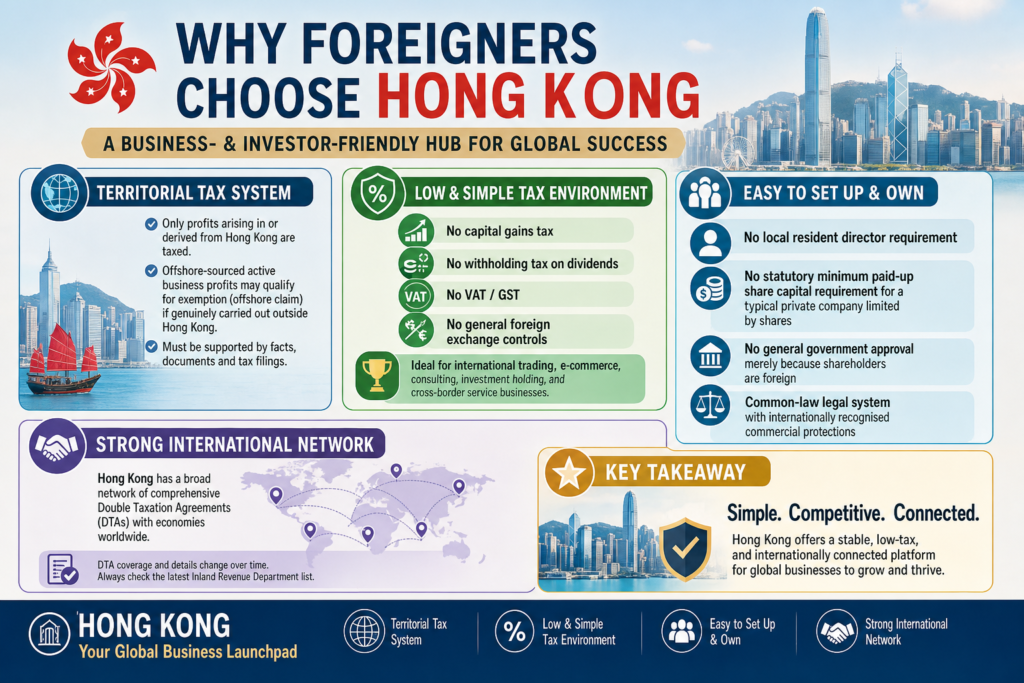
Hong Kong operates a territorial tax system, meaning that, broadly, only profits arising in or derived from Hong Kong are subject to Hong Kong profits tax. If a company’s profit-generating activities are genuinely carried out outside Hong Kong, its offshore-sourced active business profits may qualify for exemption under an offshore claim. This is not automatic and must be supported by facts, documents, and tax filings.
Hong Kong does not impose capital gains tax, withholding tax on dividends, VAT/GST, or general foreign exchange controls. These features make it attractive for international trading, e-commerce, consulting, investment holding, and cross-border service businesses.
Unlike Singapore, Hong Kong does not impose a general local resident director requirement. There is no statutory minimum paid-up share capital requirement for a typical private company limited by shares, no general government approval merely because the shareholders are foreign, and Hong Kong’s common-law legal system provides internationally recognised commercial protections.
Hong Kong also has a broad network of comprehensive double taxation agreements. The exact number and scope of DTAs should always be checked against the latest Inland Revenue Department list, as treaty networks change over time.
Eligibility at a Glance
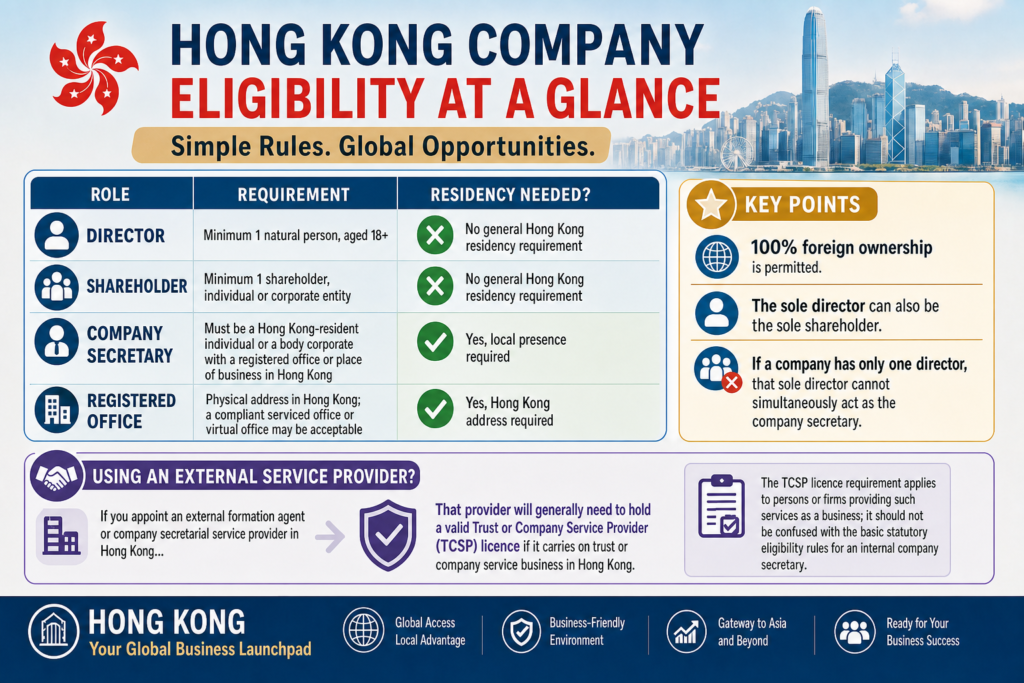
| Role | Requirement | Residency Needed? |
| Director | Minimum 1 natural person, aged 18+ | No general Hong Kong residency requirement |
| Shareholder | Minimum 1 shareholder, individual or corporate entity | No general Hong Kong residency requirement |
| Company Secretary | Must be a Hong Kong-resident individual or a body corporate with a registered office or place of business in Hong Kong | Yes, local presence required |
| Registered Office | Physical address in Hong Kong; a compliant serviced office or virtual office may be acceptable | Yes, Hong Kong address required |
Key points: 100% foreign ownership is permitted. The sole director can also be the sole shareholder. However, if a company has only one director, that sole director cannot simultaneously act as the company secretary.
If you appoint an external formation agent or company secretarial service provider in Hong Kong, that provider will generally need to hold a valid Trust or Company Service Provider, or TCSP, licence if it carries on trust or company service business in Hong Kong. The TCSP licence requirement applies to persons or firms providing such services as a business; it should not be confused with the basic statutory eligibility rules for an internal company secretary.
Documents Required
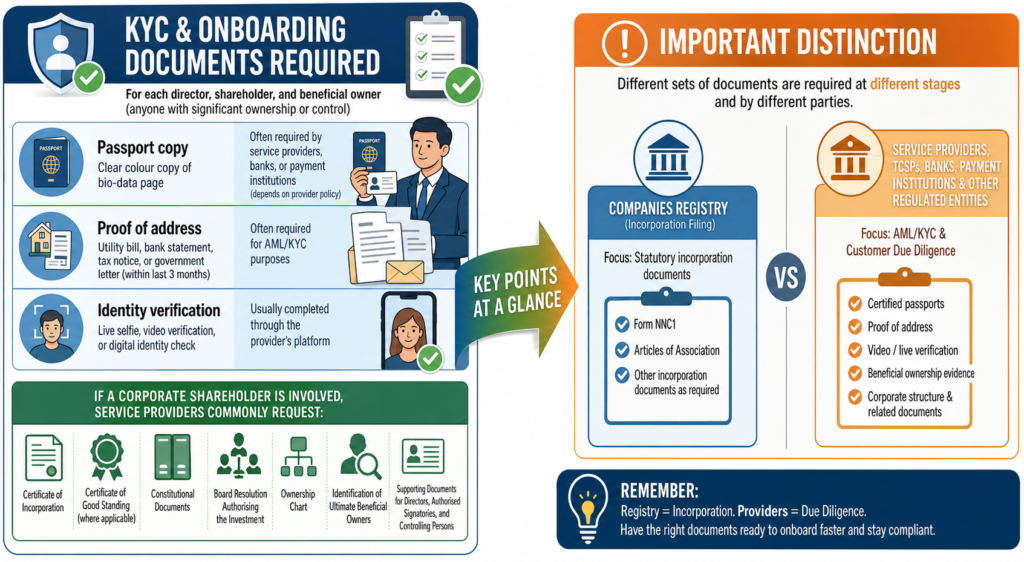
For each director, shareholder, and beneficial owner, usually anyone with significant ownership or control, prepare the following for KYC and onboarding purposes:
| Document | Details | Certification |
| Passport copy | Clear colour copy of bio-data page | Often required by service providers, banks, or payment institutions; certification method depends on provider policy |
| Proof of address | Utility bill, bank statement, tax notice, or government letter, usually dated within the last 3 months | Often required for AML/KYC purposes |
| Identity verification | Live selfie, video verification, or digital identity check | Usually completed through the provider’s platform |
If a corporate shareholder is involved, service providers commonly request:
- certificate of incorporation;
- certificate of good standing or equivalent, where applicable;
- constitutional documents;
- board resolution authorising the investment;
- ownership chart;
- identification of ultimate beneficial owners;
- supporting documents for directors, authorised signatories, and controlling persons.
Important distinction: the Companies Registry incorporation filing itself generally focuses on statutory incorporation documents, such as Form NNC1 and Articles of Association. Certified passports, address proofs, video verification, and beneficial ownership evidence are primarily required by company service providers, TCSPs, banks, payment institutions, and other regulated entities for anti-money laundering and customer due diligence purposes.
Government Fees for 2026/27
| Fee Component | Electronic Filing | Paper Filing |
| Companies Registry incorporation fee, Form NNC1 | HKD 1,545 | HKD 1,720 |
| Business Registration Certificate — 1 year, including PWIF levy where applicable | HKD 2,350 | HKD 2,350 |
| Total minimum government fees | HKD 3,895 | HKD 4,070 |
| Alternative: Business Registration Certificate — 3 years, including levy where applicable | HKD 6,170 | HKD 6,170 |
The Companies Registry incorporation fee for a company limited by shares is HKD 1,545 for electronic submission and HKD 1,720 for hard-copy submission. If an application is unsuccessful, part of the incorporation fee may be refundable under the applicable rules. (cr.gov.hk)
Business registration fees and levies may change under government policy. For local companies, the amount payable for the first Business Registration Certificate depends on the date of delivery of the related incorporation submission to the Companies Registry, and the certificate generally commences on the date of incorporation. Renewal fees depend on the commencement date of the relevant certificate. Always verify the latest Business Registration Fee and Levy Table before filing. (ird.gov.hk)
A realistic first-year budget, including government fees, company secretary, registered office, basic document preparation, and onboarding support, is commonly in the range of HKD 7,000–12,000, depending on provider scope and complexity. Any specific market survey or average-cost claim should be supported by a verifiable source before being presented as fact.
Step-by-Step Registration Process
Step 1: Choose your company name
An English company name must normally end with “Limited”. A Chinese company name must normally end with “有限公司”. A company may have an English name, a Chinese name, or both.
Run a name search through the Companies Registry e-Services Portal before filing. A name may be rejected if it is identical to an existing registered name, too similar to an existing name, misleading, offensive, restricted, or suggests a connection with the government or another public body without proper authority.
Step 2: Appoint a company secretary and registered office
Your company must maintain a company secretary and a registered office address in Hong Kong. Many foreign founders appoint a licensed formation agent or company secretarial firm to provide these services.
Where the provider carries on trust or company service business in Hong Kong, it should hold a valid TCSP licence. TCSPs in Hong Kong are subject to licensing, customer due diligence, and record-keeping requirements. (tcsp.cr.gov.hk)
Step 3: Determine share structure
There is no statutory minimum paid-up share capital for a typical Hong Kong private company limited by shares. Common simple setups include:
- 1 ordinary share at HKD 1 for a solo founder;
- 10,000 ordinary shares at HKD 1 each for more flexibility among multiple shareholders.
These are examples only. The optimal structure depends on ownership, future fundraising, transfer plans, tax considerations, and shareholder arrangements.
Step 4: Prepare Articles of Association
The Companies Registry provides model Articles of Association. Many straightforward private companies adopt the model articles with limited or no modification.
However, if there are multiple founders, investor rights, transfer restrictions, reserved matters, or special governance arrangements, you should consider tailored Articles of Association and a separate shareholders’ agreement.
Step 5: File Form NNC1 electronically
Form NNC1 captures the company name, registered office, director and shareholder details, company secretary details, share capital structure, and other statutory particulars.
Electronic incorporation can be filed through the Companies Registry e-Services Portal at www.e-services.cr.gov.hk.
Step 6: Pay government fees online
For a standard electronic incorporation with a one-year Business Registration Certificate, the minimum government fees are currently expected to be HKD 3,895, subject to the latest official fee table.
Step 7: Receive certificates
Once approved, the Certificate of Incorporation and Business Registration Certificate are issued electronically for online applications.
In straightforward electronic applications, certificates may be issued quickly, sometimes on the same day. However, actual timing depends on correct documents, successful payment, company name clearance, system availability, and whether any additional review is required.
Total timeline: In straightforward cases, expect approximately 1–5 business days from completion of document preparation and KYC to incorporation. More complex ownership structures, high-risk jurisdictions, regulated activities, or incomplete documents can extend the timeline.
Hong Kong Tax Framework for Foreign-Owned Companies
Profits Tax Rates
| Assessable Profits | Tax Rate |
| First HKD 2 million | 8.25% |
| Above HKD 2 million | 16.5% |
The two-tiered profits tax rates are commonly applied to corporations, subject to specific anti-fragmentation and connected-entity rules.
What Hong Kong Generally Does Not Tax
| Tax Type | Hong Kong Position |
| Capital gains tax | No general capital gains tax |
| Withholding tax on dividends | No general withholding tax on dividends |
| VAT / GST | No VAT or GST |
| Offshore-sourced active business profits | Potentially exempt if qualified and accepted by the IRD |
| Foreign exchange controls | No general foreign exchange controls |
Offshore Tax Exemption for Active Business Income
If your Hong Kong company earns profits from activities genuinely conducted outside Hong Kong — for example, products sourced outside Hong Kong, sold to non-Hong Kong customers, with contracts negotiated, concluded, and performed outside Hong Kong — those profits may qualify for offshore treatment under the traditional offshore claim.
However, offshore exemption is not automatic. The company must file a Profits Tax Return, make an offshore claim, and provide supporting evidence. The Inland Revenue Department examines the source of profits based on the facts, including where the profit-generating operations actually take place.
Foreign founders should not assume that revenue from overseas customers is automatically offshore. The IRD may look at factors such as:
- where contracts are negotiated and concluded;
- where sales activities are carried out;
- where services are performed;
- where suppliers and customers are managed;
- where key management and decision-making occur;
- where employees, contractors, platforms, inventory, or logistics functions are located.
Foreign-Sourced Income Exemption, FSIE, Regime
Since January 2023, with refinements from January 2024, Hong Kong’s FSIE regime has applied to certain foreign-sourced passive income received in Hong Kong by multinational enterprise group members. Relevant income categories may include:
- dividends;
- interest;
- income from intellectual property;
- equity interest disposal gains.
Such income may be taxable unless the relevant entity satisfies applicable requirements, such as economic substance, nexus, or participation exemption conditions.
For a small standalone business that is not part of a multinational enterprise group and earns only active trading or service income, FSIE may not be the main tax issue. However, any company receiving foreign-sourced passive income in Hong Kong should obtain tax advice before assuming exemption.
BEPS 2.0 / Global Minimum Tax
The 15% global minimum tax framework under BEPS 2.0 Pillar Two generally targets multinational enterprise groups with consolidated annual revenue of at least EUR 750 million. Most SMEs, owner-managed companies, and early-stage startups are not within this threshold, but groups approaching this size should obtain specialist tax advice.
Opening a Corporate Bank Account as a Non-Resident
Banking is often the biggest practical challenge for foreign founders. Incorporation can be relatively simple; opening and maintaining a bank or payment account requires preparation.
| Option | Remote Opening? | Typical Review Time | Deposit Protection | Best For |
| Traditional banks, such as HSBC, Hang Seng, Standard Chartered | Often require in-person or enhanced verification, although policies vary | 2–4 weeks or longer | Yes, if held with a covered Hong Kong bank, subject to the applicable protection limit | Established businesses needing trade finance, loans, cheque books, or broader banking services |
| Virtual banks, such as ZA Bank, WeLab Bank, livi | Some support digital onboarding, subject to eligibility | 3–14 days or longer | Yes, if the institution is a covered Hong Kong bank, subject to the applicable protection limit | Cost-conscious founders comfortable with app-based banking |
| Fintech and payment providers, such as Airwallex, Statrys, Aspire, Currenxie | Often support remote onboarding | 1–10 business days in simple cases | Usually no statutory bank deposit protection unless funds are held directly with a covered bank account in the customer’s name | New companies needing faster access to multi-currency payment and collection capabilities |
A practical strategy in 2026 is to apply first to a fintech or payment provider after incorporation to start receiving and making payments, then approach a traditional or virtual bank once the company has transaction history, invoices, contracts, website evidence, and demonstrable revenue.
Approval is not guaranteed. It depends on:
- nationality and residence of directors and beneficial owners;
- industry risk;
- sanctions and AML screening;
- source of funds;
- source of wealth;
- business model;
- customer and supplier countries;
- expected transaction volume;
- quality of supporting documents.
Avoid presenting any fixed approval rate, such as “95%+”, unless it is backed by current and verifiable provider data.
Ongoing Compliance Obligations
| Obligation | Frequency | Deadline | Typical Cost / Fee |
| Annual Return, Form NAR1 | Yearly | Within 42 days after the company’s return date, usually the incorporation anniversary | HKD 105 if filed on time |
| Business Registration renewal | Yearly or every 3 years | Before expiry / according to the certificate period | Subject to current IRD fee and levy table |
| Profits Tax Return | Yearly after issued by IRD | Usually 1 month from issue date, extensions may be available | Accountant fees vary |
| Annual audit | Yearly for active companies | Usually prepared for tax filing and shareholder reporting | Commonly HKD 5,000–40,000+, depending on complexity |
| Company secretary | Continuous | Must be maintained at all times | Commonly HKD 3,000–8,000+ per year |
| Significant Controllers Register, SCR | Ongoing | Must be kept current | Often included in company secretarial service |
A Hong Kong private company must normally file an Annual Return within 42 days after its return date. The Companies Registry fee is HKD 105 if filed on time; late fees escalate to HKD 870, HKD 1,740, HKD 2,610, and HKD 3,480 depending on the length of delay. (cr.gov.hk)
Important Audit Clarification
Every active Hong Kong private limited company generally needs annual accounting records and audited financial statements prepared by a Hong Kong Certified Public Accountant for tax and statutory purposes, even if the company is small or has little or no revenue.
However, it is inaccurate to say that there is no exception for dormant companies. A company that has been formally declared dormant under section 447 of the Companies Ordinance may be exempt from certain financial statement and audit requirements during the dormant period.
A company with zero revenue is not automatically dormant. To benefit from dormant status, the company must satisfy the legal conditions and complete the required formalities. Dormant status does not necessarily remove every obligation; the company should still review annual return, business registration, company secretary, SCR, and tax correspondence obligations with a professional adviser.
Hong Kong vs Other Jurisdictions
| Feature | Hong Kong | Singapore | BVI | Delaware, USA |
| Local director required | No general local director requirement | Yes, at least one ordinarily resident director | No | No |
| Headline corporate tax rate | 8.25%–16.5% | 17%, subject to exemptions and incentives | Generally 0% local corporate income tax for many BVI business companies | 21% US federal corporate tax for C corporations; LLC treatment may differ |
| Territorial / offshore tax treatment | Yes, subject to source-of-profits rules and IRD review | Partial / modified territorial system | Generally tax-neutral, subject to economic substance and reporting rules | No general offshore exemption for US federal tax purposes |
| VAT / GST | None | GST applies, currently 9% | None | No federal VAT; state sales tax depends on nexus and transaction profile |
| Annual audit required | Generally yes for active companies; dormant companies may be exempt if properly declared | Yes unless audit exemption applies | Generally no statutory audit for typical BVI business companies, but records and filings still matter | Generally no statutory audit for private companies, unless required by investors, lenders, or regulation |
| Banking infrastructure | Strong | Strong | More limited | Strong |
| China market access | Possible CEPA advantages if eligibility requirements are met | No CEPA access | No CEPA access | No CEPA access |
| Minimum share capital | No statutory minimum paid-up capital for typical private companies | Usually SGD 1 practical minimum | Often USD 1 or another nominal amount | Depends on entity type and charter |
| Remote incorporation | Yes, in many cases | Yes, in many cases | Yes | Yes |
Hong Kong is particularly suitable for:
- international trading companies;
- e-commerce businesses;
- holding companies for Asian investments;
- professional services firms serving clients across Asia;
- technology companies with distributed teams;
- businesses receiving revenue from multiple geographies.
However, the best jurisdiction depends on tax residency, management location, customers, substance, banking needs, investor expectations, exit plans, and regulatory exposure.
Frequently Asked Questions
Do I need a visa?
No, not merely to own shares in or direct a Hong Kong company from abroad. You only need an appropriate visa if you intend to live, work, or physically operate in Hong Kong in a way that requires immigration permission.
Can I be sole director and sole shareholder?
Yes. A single overseas individual can usually be both the sole director and sole shareholder of a Hong Kong private company limited by shares. The main constraint is that if the company has only one director, that sole director cannot also act as the company secretary.
Do I ever need to visit Hong Kong?
For incorporation itself, usually no. Incorporation and ongoing company secretarial compliance can often be managed remotely.
However, you may need to visit Hong Kong, or complete enhanced verification, if required by a traditional bank, business partner, investor, regulator, or professional service provider. Fintech and payment providers often support remote onboarding, but approval is still subject to KYC and risk review.
What is a TCSP licence?
A TCSP licence is a Trust or Company Service Provider licence issued under Hong Kong’s TCSP licensing regime. A person or firm carrying on trust or company service business in Hong Kong generally needs a TCSP licence and must comply with customer due diligence and record-keeping obligations. Carrying on such business without a licence is an offence. (tcsp.cr.gov.hk)
Before engaging a formation agent, check that the firm is properly licensed if it is providing regulated company services in Hong Kong.
What if my application is rejected?
Rejection is uncommon in straightforward cases, but it can happen because of name conflicts, restricted words, incomplete documents, incorrect particulars, payment issues, or compliance concerns.
For a company limited by shares, the Companies Registry fee for Form NNC1 is HKD 1,545 for electronic filing. If the application is unsuccessful, an application may be made for a refund of HKD 1,280. For hard-copy filing, the fee is HKD 1,720 and the potential refund amount is HKD 1,425. (cr.gov.hk)
Business Registration Certificate fees are generally subject to separate rules and may not be refundable in the same way.
Is there a minimum revenue or activity requirement?
There is no minimum revenue requirement merely to keep a Hong Kong company in existence.
However, an inactive company still needs to monitor statutory obligations, including annual returns, business registration, company secretary, registered office, SCR, tax correspondence, and accounting records.
A company with no business activity may consider applying for dormant status if it meets the legal requirements. A properly declared dormant company may be exempt from certain financial statement and audit requirements, but dormant status should be implemented carefully and reviewed with a professional adviser.
Conclusion
Hong Kong company registration for foreigners in 2026 remains a well-defined and internationally recognised process. In straightforward cases, foreign founders can incorporate remotely, with no general local director requirement, no general residency restriction for directors or shareholders, and no statutory minimum paid-up share capital for a typical private company limited by shares.
The minimum government cost for electronic incorporation with a one-year Business Registration Certificate is expected to be around HKD 3,895, subject to the latest Companies Registry and Inland Revenue Department fee tables.
The real work begins after incorporation: selecting the right banking or payment setup, documenting business substance, managing offshore tax claims properly, maintaining accounting records, arranging audit where required, and meeting annual compliance deadlines.
Founders who treat incorporation as the starting point rather than the finish line are the ones most likely to succeed.
Why easyCorp
For foreign founders navigating Hong Kong incorporation remotely, choosing the right formation partner can be just as important as the registration itself. The company secretary appointed on Day 1 becomes the company’s ongoing compliance anchor — handling Annual Returns, coordinating with accountants and auditors, monitoring Companies Registry filings, liaising with the IRD where appropriate, and helping maintain a reliable administrative presence in Hong Kong.
| What Matters | easyCorp’s Edge |
| Experience depth | easyCorp states that it was founded in 2009 and has operated through major regulatory changes, including the new Companies Ordinance, TCSP licensing, and changes to Hong Kong’s tax framework. Prospective clients should verify corporate history and licensing status before engagement. |
| Bank-level credibility | If easyCorp has received awards or recognition from banking partners, such claims should be supported by verifiable evidence, such as award certificates, bank communications, or public announcements. |
| Cross-border service capability | A formation partner serving clients across multiple regions can help with documentation, certification, time-zone coordination, and practical onboarding issues for non-resident founders. |
| Full-spectrum services | Combining company secretary, accounting, tax coordination, and business consulting under one roof can reduce the friction of managing multiple providers. |
| Responsiveness | A clear service-level expectation, such as responding to emails or calls within a defined timeframe, is valuable for overseas clients. Any SLA should be confirmed in the engagement terms. |
| Problem-solving experience | Providers with a long operational history may have handled a wider range of practical issues, such as complex ownership structures, banking questions, document certification problems, and compliance follow-ups. |
easyCorp’s value proposition is based on acting as a long-term compliance and business support partner rather than a one-off incorporation vendor. For foreign founders, the most important due diligence points are:
- confirm the provider’s TCSP licence status, if applicable;
- review its company secretarial scope;
- confirm registered office terms;
- understand accounting and audit coordination fees;
- check response-time commitments;
- ask how KYC, document certification, and bank or fintech introductions are handled;
- confirm what is included and excluded in the first-year package.
Ready to incorporate? Contact easyCorp to begin your Hong Kong company setup. In straightforward cases, clients may receive their Certificate of Incorporation within 1–3 business days after complete documentation and KYC approval, although timing is not guaranteed and depends on the Registry, provider review, payment, name clearance, and any additional compliance checks.
About easyCorp
Founded in 2009, easyCorp provides Hong Kong company incorporation, company secretary, registered address, business bank account opening referral, accounting, taxation, and business consulting services to entrepreneurs and companies from Europe, the United States, the Middle East, Asia, Africa, and other markets.
Contact us now for more details about 1-day company incorporation:
https://www.easycorp.com.hk/en/incorporations
Authorship
This blog article is created by the easyCorp business team and reviewed by qualified professionals before publication. We are dedicated to sharing useful information about setting up businesses and managing taxation and compliance in Hong Kong.
Founded in 2009, easyCorp provides high-quality taxation, accounting, company secretary, and business consulting services. easyCorp differentiates itself through practical problem-solving experience and the number of real-world corporate service scenarios handled across different industries and jurisdictions.