
Any person of any nationality can register and fully own a private company limited by shares in Hong Kong — without a local partner, without a resident director, and without ever setting foot in the territory. This guide covers every step from name approval to post-incorporation compliance, and flags the hidden costs that most guides gloss over.
Can a Foreigner Own and Register a Hong Kong Company?
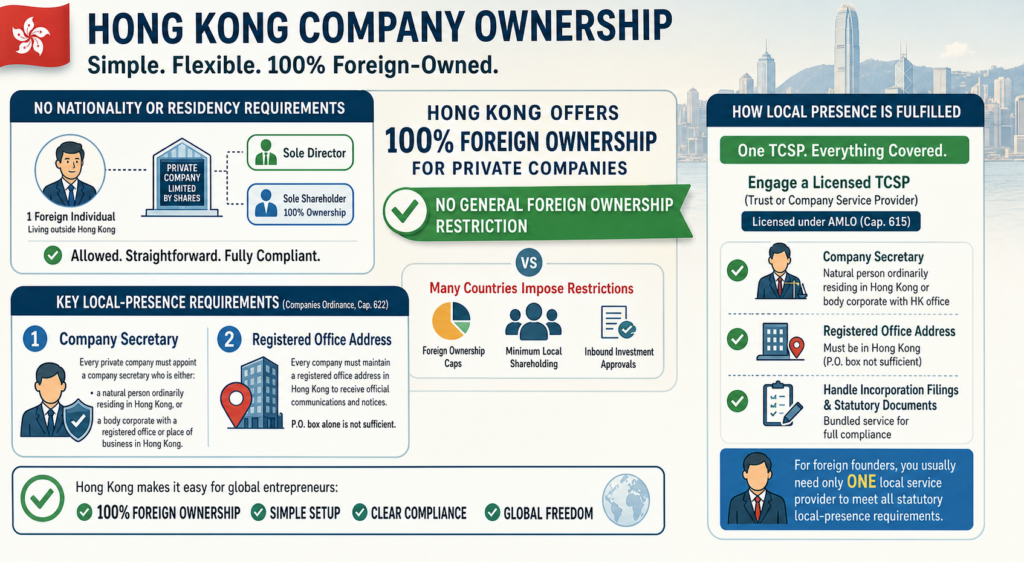
The Companies Ordinance (Cap. 622), which is the principal legislation governing company formation in Hong Kong, imposes no nationality or residency requirements on directors and shareholders of a private company limited by shares. A single foreign individual can simultaneously serve as the sole director and the sole shareholder, holding 100 per cent of the equity, while living permanently outside Hong Kong.
Unlike jurisdictions such as Thailand, Indonesia, or India — which may impose sector-based foreign ownership caps, minimum local shareholding rules, or inbound investment approvals — Hong Kong has no general foreign ownership restriction for a standard private company limited by shares.
The main local-presence requirements under the Companies Ordinance are two. First, every private company must appoint a company secretary who is either a natural person ordinarily residing in Hong Kong or a body corporate with a registered office or place of business in Hong Kong. Second, every company must maintain a registered office address in Hong Kong to which official communications and notices may be sent; a P.O. box alone is not sufficient.
In practice, both requirements are usually fulfilled by engaging a licensed TCSP (Trust or Company Service Provider), which is a firm licensed under the Anti-Money Laundering and Counter-Terrorist Financing Ordinance (Cap. 615) to provide company formation and secretarial services. A TCSP typically supplies the company secretary, the registered office address, and handles the filing of incorporation documents as a bundled service — meaning a foreign founder usually needs only one local service provider to satisfy the statutory local-presence requirements.
What Changed in 2026
Government Fees Rose on 1 April 2026
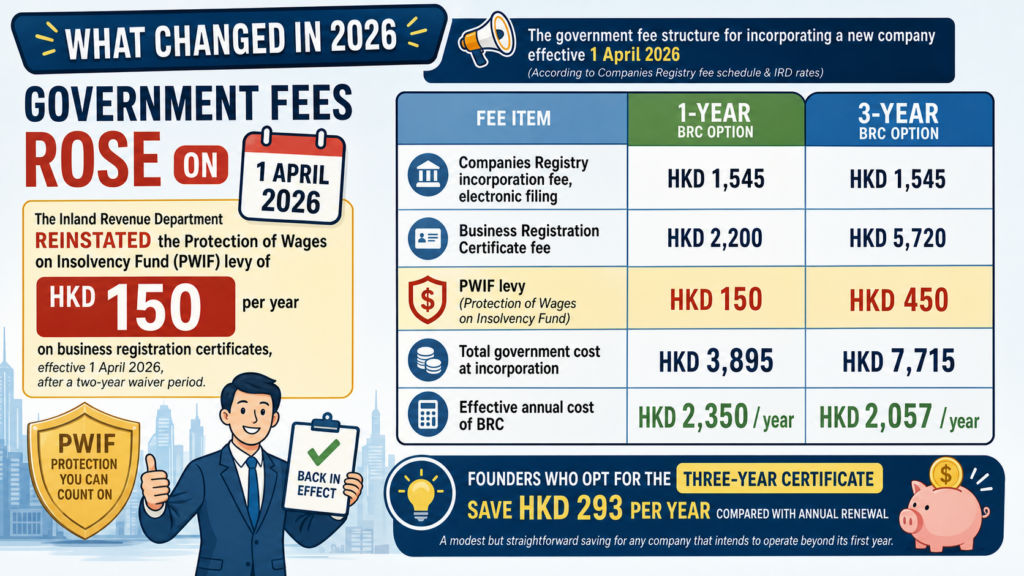
The Inland Revenue Department reinstated the Protection of Wages on Insolvency Fund (PWIF) levy of HKD 150 per year on business registration certificates, effective 1 April 2026, after a two-year waiver period.
According to the Companies Registry’s fee schedule and the Inland Revenue Department’s rates effective 1 April 2026, the current government fee structure for incorporating a new company is as follows:
| Fee Item | 1-Year BRC Option | 3-Year BRC Option |
| Companies Registry incorporation fee, electronic filing | HKD 1,545 | HKD 1,545 |
| Business Registration Certificate fee | HKD 2,200 | HKD 5,720 |
| PWIF levy | HKD 150 | HKD 450 |
| Total government cost at incorporation | HKD 3,895 | HKD 7,715 |
| Effective annual cost of BRC | HKD 2,350 / year | HKD 2,057 / year |
Founders who opt for the three-year certificate save HKD 293 per year compared with annual renewal — a modest but straightforward saving for any company that intends to operate beyond its first year.
Banking Landscape Tightened for Non-Residents
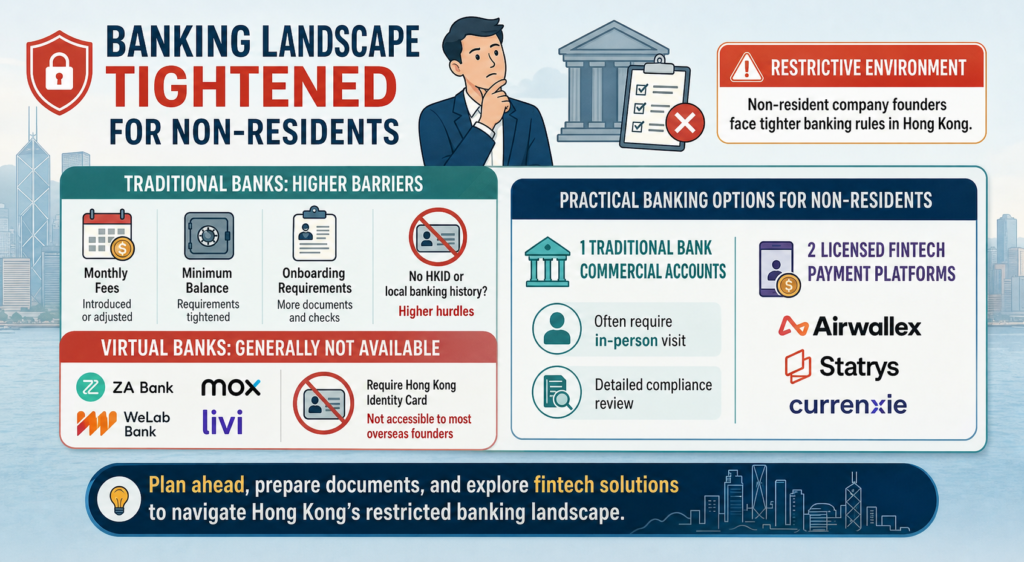
The Hong Kong banking environment for non-resident company founders remains restrictive. Some traditional banks have introduced or adjusted monthly fees, minimum balance rules, and onboarding requirements for customers without a Hong Kong Identity Card or local banking history.
Hong Kong’s licensed virtual banks — including ZA Bank, Mox, WeLab Bank, and livi — generally restrict account opening to holders of a Hong Kong Identity Card, making them unavailable to most overseas founders who have never resided in Hong Kong. The practical banking options for non-residents are therefore traditional bank commercial accounts, which often require an in-person visit and a detailed compliance review, and licensed fintech payment platforms such as Airwallex, Statrys, and Currenxie.
Documents You Need
Director and Shareholder Identification
Every proposed director and shareholder who is a natural person must provide a certified true copy of a valid passport — usually a full-colour copy of the biographical data page, with at least six months’ validity remaining.
A certified true copy means the copy has been signed and stamped by a qualified certifier, such as a notary public, practising lawyer, certified public accountant, or senior bank officer, with a statement confirming it is a true copy of the original.
Each director and shareholder must also provide proof of residential address dated within three months — such as a utility bill, bank statement, or government-issued correspondence showing the person’s name and home address.
Certification Varies by Country
The certification process differs depending on the founder’s country of residence, and this is a frequent source of delay.
| Founder’s Country | Qualified Certifier | Remote Option Available? |
| United States | Notary Public | Yes — some states permit remote online notarisation via video call |
| United Kingdom | Solicitor or Notary Public | Limited — some solicitors accept scanned documents for certification |
| India | Notary Public under the Notaries Act, 1952, or Gazetted Officer | Usually no — typically requires in-person attendance |
Founders should allow at least one to two weeks for the certification process to avoid delaying the incorporation timeline.
Significant Controllers Register
Every Hong Kong company must maintain a Significant Controllers Register (SCR), which records details of every individual or legal entity that has significant control over the company, including persons or entities holding, directly or indirectly, more than 25 per cent of the company’s issued shares or voting rights.
The company must also designate at least one Designated Representative who can assist law enforcement officers in relation to the SCR. The Designated Representative must be either a director, employee or member of the company who is a natural person resident in Hong Kong, or an accounting professional, legal professional, or TCSP licensee in Hong Kong.
Step-by-Step: How to Register
Foreign founders often file through a TCSP because the TCSP can provide the statutory company secretary, registered office address, document preparation, KYC handling, and electronic filing support. Direct electronic filing may be possible in some cases if the founder can complete the Companies Registry’s user registration and signing requirements, including registration with passport or other accepted identity details. In practice, however, most non-resident founders use a TCSP because it is faster and reduces procedural friction.
Step 1 — Choose and Verify a Company Name
A Hong Kong private company limited by shares must have a name ending in “Limited” if in English or “有限公司” if in Chinese. The company may register an English name, a Chinese name, or both.
Before filing, the proposed name should be checked against the Companies Registry’s free Company Search on the ICRIS (Integrated Companies Registry Information System) portal to confirm no identical name is already registered. Names containing words such as “Bank,” “Insurance,” or “Trust” may require prior approval from the relevant regulatory authority.
Step 2 — Prepare the Incorporation Documents
Three documents form the core of every incorporation application.
Form NNC1 (Incorporation Form) captures the company’s proposed name, registered office address, details of every first director, the company secretary, every founder member and their shareholding, and the share capital structure.
The Articles of Association set out the company’s internal governance rules. Most private companies adopt the model articles prescribed under the Companies Ordinance, either as-is or with modifications.
Form IRBR1 (Notice to Business Registration Office) is submitted simultaneously and triggers the issuance of the Business Registration Certificate.
Step 3 — File Electronically and Pay
The TCSP usually submits the completed NNC1, Articles of Association, and IRBR1 through the Companies Registry’s e-Services Portal, together with payment of HKD 3,895 for electronic incorporation with a one-year Business Registration Certificate. This consists of the HKD 1,545 incorporation fee plus HKD 2,350 for the one-year Business Registration Certificate and levy.
For a straightforward private company, the Companies Registry typically processes the electronic application and issues the Certificate of Incorporation and Business Registration Certificate in PDF form within the same day, often within one hour during business hours. Hard-copy filing costs more and takes longer.
Step 4 — Post-Incorporation Actions
Upon receiving the Certificate of Incorporation, the company legally exists and can begin transacting.
Several actions should be taken immediately: ordering a company chop, although a common seal has not been mandatory for many companies since the modernisation of the Companies Ordinance; establishing the Significant Controllers Register and appointing a Designated Representative; approving the first board resolutions; and — most critically — beginning the bank account application process, which is the step most likely to cause delay.
The Real Cost of Your First Year
Government incorporation fees are only the starting point. The total first-year cost is usually substantially higher than the HKD 3,895 figure quoted in many guides, and underestimating this cost is one of the most common mistakes foreign founders make.
Layer 1: Government Fees
The mandatory government cost for electronic incorporation with a one-year Business Registration Certificate is HKD 3,895 for the period 1 April 2026 to 31 March 2027, comprising HKD 1,545 payable to the Companies Registry and HKD 2,350 payable to the Inland Revenue Department.
Founders who prefer a three-year certificate pay HKD 7,715 at incorporation, which works out HKD 293 cheaper per year than renewing annually.
Layer 2: Service Provider Fees
Every Hong Kong company must have a company secretary and a registered office address. For a foreign-owned company, these are almost always supplied by a TCSP.
Annual company secretary fees from reputable providers typically range from HKD 2,000 to HKD 8,000. Annual registered address fees typically range from HKD 1,500 to HKD 5,000. Some providers bundle incorporation, the first year of company secretarial services, and a registered address into a single package, with market prices in 2026 ranging from approximately USD 500 to USD 1,500.
Layer 3: Audit and Accounting
Hong Kong companies generally must prepare annual financial statements and have them audited by a Hong Kong practising CPA, unless a statutory exemption applies.
The most important exception is a company that has formally become dormant under the Companies Ordinance. A company with no transactions is not automatically dormant simply because it has no revenue or little activity. To obtain dormant status under the Companies Ordinance, the company must pass and deliver the required special resolution to the Companies Registry. Once properly dormant, it may benefit from exemptions from certain accounting, audit and annual return requirements while it remains dormant.
This distinction is critical:
- A statutory dormant company may be exempt from annual audit and annual return filing while it remains dormant.
- An inactive or minimal-transaction company that has not formally become dormant is still generally treated as an ordinary company and may need audited financial statements and tax filing support.
In practice, audit fees for an inactive or very small Hong Kong private company commonly range from approximately HKD 2,000 to HKD 4,000 per year, while an active small business with straightforward accounts may pay HKD 5,000 to HKD 15,000 or more per year. If a company is formally dormant, the annual audit cost may be avoided, although the company may still incur company secretarial, registered office, business registration, and tax correspondence costs.
Realistic First-Year Budget
The following table consolidates the main cost layers into a single view. Because dormant status has a specific legal meaning in Hong Kong, the table distinguishes between a statutory dormant company and a small active company.
| Cost Item | Statutory Dormant Company | Active Small Company |
| Government incorporation fee | HKD 1,545 | HKD 1,545 |
| Business Registration Certificate, 1-year | HKD 2,350 | HKD 2,350 |
| Company secretary, annual | HKD 2,000 – 4,000 | HKD 3,000 – 8,000 |
| Registered address, annual | HKD 1,500 – 3,000 | HKD 1,500 – 5,000 |
| Statutory audit | Usually exempt while properly dormant | HKD 5,000 – 15,000+ |
| Tax filing / tax correspondence support | HKD 500 – 2,000 | HKD 1,000 – 3,000 |
| Estimated first-year total | HKD 7,895 – 12,895 | HKD 14,395 – 34,895 |
| Approximate USD equivalent | USD 1,000 – 1,700 | USD 1,800 – 4,500 |
In total, a foreign founder should budget approximately HKD 8,000 to HKD 13,000 for a properly dormant company’s first year, or HKD 15,000 to HKD 35,000 for an active small company — well above the HKD 3,895 government fee that many incorporation guides present as the headline cost.
The ongoing annual cost from year two onward depends heavily on whether the company is dormant, inactive but not dormant, or actively trading. A small active company should usually budget for Business Registration Certificate renewal, annual return filing, company secretary, registered office, audit, and tax filing. For a small active company, ongoing annual costs commonly range from HKD 15,000 to HKD 30,000.
Opening a Business Bank Account as a Non-Resident
What are a foreign founder’s real options for getting a working bank account after incorporating a Hong Kong company?
Bank account opening is the single biggest practical obstacle for foreign founders. The company can be incorporated quickly; securing a functioning bank account can take weeks, and approval is not guaranteed.
| Traditional Bank | Virtual Bank | Fintech Platform | |
| Examples | HSBC, Hang Seng, Standard Chartered, BOCHK, DBS | ZA Bank, Mox, WeLab, livi | Airwallex, Statrys, Currenxie |
| Available to non-residents? | Yes, but with difficulty | Generally no, because HKID is usually required | Yes |
| Can open remotely? | Rarely — most require an in-person branch visit | Usually not applicable to non-HKID holders | Yes — fully online |
| Typical approval time | 2 – 8 weeks | N/A | 1 – 5 business days |
| Multi-currency support | Yes | Limited | Yes |
| Regulatory status | Licensed bank regulated by the HKMA | Licensed bank regulated by the HKMA | Usually payment or money service operator structure, depending on provider |
| Best for | Long-term primary banking and larger transactions | Hong Kong residents | Immediate post-incorporation operations |
Traditional Banks: Possible but Difficult
Hong Kong’s major commercial banks do accept corporate account applications from companies with non-resident directors, but the approval process is materially more demanding than for locally based businesses.
Most traditional banks require at least one director to attend an in-person meeting at a Hong Kong branch for identity verification and a face-to-face interview about the company’s business nature, expected transaction patterns, source of funds, and expected counterparties. The review period typically ranges from two to eight weeks, and the bank may request supplementary documents during that period.
Rejection rates for newly incorporated companies with no operating history and no Hong Kong substance can be significant. Founders from jurisdictions on the FATF grey list, or whose business models involve high-risk indicators such as cryptocurrency, third-party payments, complex cross-border flows, or regulated financial activity, face heightened scrutiny and a higher probability of rejection.
Virtual Banks Are Not an Option for Most Non-Residents
Hong Kong’s licensed virtual banks offer streamlined digital account opening, but nearly all require the applicant to hold a Hong Kong Identity Card. Non-resident founders who have never lived in Hong Kong are therefore usually ineligible.
Licensed Fintech Platforms: The Practical Alternative
The most accessible banking solution for foreign founders in 2026 is often a licensed fintech or electronic money platform. Platforms such as Airwallex, Statrys, and Currenxie offer multi-currency business accounts, international transfers, company cards, and integration with accounting software — often opened entirely online, with no requirement to visit Hong Kong.
These accounts are not always bank accounts in the strict regulatory sense. Depending on the provider and account structure, they may be payment accounts or client money accounts operated under money service, payment institution, or equivalent licensing frameworks. However, they are often functionally sufficient for receiving client payments, paying suppliers, and managing day-to-day treasury.
A practical strategy is to open a fintech payment account immediately after incorporation to begin operations, then apply for a traditional bank account three to six months later once the company has a transaction history, contracts, invoices, and financial records. A track record of real commercial transactions can improve the probability of approval at a traditional bank.
Tax Essentials for Foreign-Owned Companies
Foreign founders often ask whether Hong Kong is truly “tax-free” — the short answer is no, but the effective tax burden is among the lowest of any major financial centre, and profits sourced entirely outside Hong Kong may not be taxed in Hong Kong.
Territorial Source Principle
Hong Kong’s Inland Revenue Ordinance (Cap. 112) taxes only profits that arise in or are derived from Hong Kong. There is no simple distinction based purely on whether the shareholder is resident or non-resident: the key question is where the profit-generating activities take place.
A Hong Kong company with profits sourced entirely outside Hong Kong may be able to claim that those profits are offshore and not chargeable to Hong Kong profits tax. Conversely, a company earning Hong Kong-sourced profits may be taxable even if its owner lives overseas.
Two-Tiered Profits Tax Rates
Hong Kong’s profits tax for corporations operates on a two-tiered system. The following table illustrates how the two tiers apply in practice using a company with HKD 3 million in assessable profits:
| Assessable Profit Band | Tax Rate | Tax Payable |
| First HKD 2,000,000 | 8.25% | HKD 165,000 |
| Remaining HKD 1,000,000 | 16.5% | HKD 165,000 |
| Total on HKD 3,000,000 | Effective rate: 11% | HKD 330,000 |
There is no VAT, no GST, no capital gains tax, and no withholding tax on dividends paid to shareholders — making Hong Kong’s overall tax burden comparatively low among major financial centres.
Offshore Profits Exemption Is Not Automatic
A foreign founder whose company conducts all profit-generating activities outside Hong Kong may apply for an offshore profits claim. However, this exemption is not automatic or guaranteed.
The Inland Revenue Department reviews each claim on a case-by-case basis, examining where contracts are negotiated and concluded, where services are performed, where goods are bought and sold, where customers and suppliers are located, and where key income-producing operations occur.
The IRD may issue detailed supplementary questions requiring point-by-point written responses before granting or denying the claim. Adequate documentation must be maintained to support the claim, and a company that fails to substantiate it may find its full profits assessed to Hong Kong tax.
Your Home Country May Still Tax You
Incorporating a Hong Kong company does not eliminate tax obligations in the founder’s country of tax residence.
United States citizens and green card holders are taxed on worldwide income and may need to file Form 5471, Information Return of U.S. Persons With Respect to Certain Foreign Corporations, if they meet the relevant ownership thresholds. The penalty for failure to file can be severe.
Founders who are tax residents of the United Kingdom, Germany, France, Australia, Canada, or other countries with CFC rules should evaluate whether undistributed profits of the Hong Kong company may be attributed to the founder’s personal tax return.
Consulting a cross-border tax adviser before incorporation is not optional — it is a necessary step to avoid penalties and double taxation.
A Company Does Not Give You a Visa
Registering a Hong Kong company does not confer any right to live or work in Hong Kong. A foreign national can own, direct, and profit from a Hong Kong company while residing permanently overseas without needing a Hong Kong visa.
However, if the founder wishes to physically relocate to Hong Kong, a separate immigration application is required.
Foreign entrepreneurs may apply for entry under the Immigration Department’s General Employment Policy (GEP), which requires a business plan and evidence that the applicant’s business can make a substantial contribution to the Hong Kong economy. Factors assessed may include business turnover, capital investment, local job creation, business premises, and the applicant’s background.
Alternatively, the Top Talent Pass Scheme (TTPS) offers a separate pathway for eligible high-income individuals and graduates of specified universities. Each immigration pathway is assessed independently of any company the applicant may own.
Frequently Asked Questions
What ongoing obligations does a Hong Kong company have after incorporation?
Incorporating a Hong Kong company is the beginning of recurring filings and fees. These obligations differ depending on whether the company is active, inactive, or formally dormant under the Companies Ordinance.
| Obligation | Deadline | Fee | Penalty for Non-Compliance |
| Annual Return, Form NAR1 | Usually within 42 days of incorporation anniversary for a private company, unless a statutory dormant exemption applies | HKD 105 if filed on time | Escalating late filing fees; possible prosecution |
| Business Registration Certificate renewal | Before certificate expiry date | HKD 2,350/year or HKD 6,170/3 years, based on current 2026/27 rates | Criminal offence; fines may apply |
| Statutory audit by HK-registered CPA | Required for ordinary active companies before Profits Tax Return filing; statutory dormant companies may be exempt while dormant | HKD 5,000 – 15,000+ for many active small companies | Profits Tax Return may not be properly supported without required accounts |
| Profits Tax Return, Form BIR51 | Per IRD notice; first return is commonly issued around 18 months after incorporation, then annually or as issued | Nil government filing fee | Estimated assessment, penalty tax, or prosecution |
| Significant Controllers Register update | Within the statutory timeframe after relevant changes | Nil | Fines and continuing daily penalties may apply |
Foreign founders who budget only for incorporation and neglect ongoing compliance risk penalties, prosecution, and compulsory striking off by the Companies Registry.
Mandatory Audit: What are dormant company exception?
Every ordinary Hong Kong private company must generally have its financial statements audited annually by a Hong Kong practising CPA and file its Profits Tax Return with supporting accounts when required.
However, the statement “every company must be audited regardless of activity” is too broad. A company that has formally become dormant under the Companies Ordinance may be exempt from certain accounting and audit requirements while it remains dormant.
The key point is that zero revenue does not automatically mean dormant. A company must formally declare dormant status in accordance with the Companies Ordinance. If it has merely had little or no business activity but has not become legally dormant, it may still be treated as an ordinary company for audit and compliance purposes.
Even where a company is dormant, it should still monitor correspondence from the Inland Revenue Department and respond to any Profits Tax Return or enquiry issued by the IRD.
What are provisional tax? – A cash-flow surprise
Foreign founders filing their first Profits Tax Return should be aware of Hong Kong’s provisional tax system.
When the IRD issues a tax assessment, it may also issue a provisional tax demand for the following year, estimated by reference to the current year’s assessable profits. The practical effect is that the first tax payment may include both final tax for the assessed year and provisional tax for the following year — a significant cash-flow impact for a small business that should be planned for in advance.
How easyCorp Can Help
easyCorp is a licensed Trust or Company Service Provider (TCSP) in Hong Kong that specialises in serving foreign founders from incorporation through to ongoing compliance. easyCorp’s all-in-one packages cover every local-presence requirement discussed in this guide — company secretary, registered Hong Kong address, incorporation filing, and Significant Controllers Register setup — so that overseas founders deal with a single provider rather than coordinating multiple vendors.
For the pain points this guide highlights — the mandatory annual audit, bank account opening difficulty, and annual compliance filings — easyCorp offers an integrated solution: in-house CPA (Certified Public Accountant) partners handle the statutory audit and Profits Tax Return preparation, the team provides assisted bank account introductions to both traditional banks and fintech platforms, and all annual filings (NAR1, Business Registration renewal, and Profits Tax Return) are tracked and submitted on the founder’s behalf with deadline reminders.
To discuss your incorporation or request a quote tailored to your business structure, visit easycorp.hk or contact the team directly.
This guide reflects the law, government fee schedules, and practical conditions as of October 2026. Founders should verify current fees on the Companies Registry and Inland Revenue Department websites before filing, and obtain professional legal and tax advice tailored to their individual circumstances.
Learn more:
- Companies Registry – FAQs on e-Services – Electronic Company Incorporation and Business Registration
- Companies Registry – Companies Ordinance (Cap. 622) – Accounts and Audit
- Circular Letter to Tax Representatives
- Companies Registry – FAQ – Local Limited Companies – Annual Returns
- Companies Registry – FAQ – Local Limited Companies – Significant Controllers Register
About easyCorp
Founded in 2009, easyCorp provides Hong Kong company incorporation, company secretary, registered address, business bank account opening referral, accounting, taxation, and business consulting services to entrepreneurs and companies from Europe, the United States, the Middle East, Asia, Africa, and other markets.
Authorship
This blog article is created by the easyCorp business team and reviewed by qualified professionals before publication. We are dedicated to sharing useful information about setting up businesses and managing taxation and compliance in Hong Kong.
Founded in 2009, easyCorp provides high-quality taxation, accounting, company secretary, and business consulting services. easyCorp differentiates itself through practical problem-solving experience and the number of real-world corporate service scenarios handled across different industries and jurisdictions.