
Running a Hong Kong limited company means meeting a fixed set of statutory obligations every year. Whether your company is actively trading or merely inactive, statutory filings must still be monitored, fees must be paid where applicable, and deadlines must be met.
However, it is important to distinguish between an inactive company and a company that has formally registered as dormant under the Hong Kong Companies Ordinance. A company with no business activity is not automatically exempt from compliance obligations, while a formally dormant company may be exempt from certain accounting and audit requirements during its dormant period.
This guide separates every cost component with practical figures, legal context, and scenario-based budgets so you can plan your 2026-27 compliance with full clarity.
Your 2026 Annual Cost at a Glance
Before examining each fee in isolation, here is what companies may actually pay in total. These figures combine fixed government levies with typical professional service fee ranges for the 2026-27 financial year.
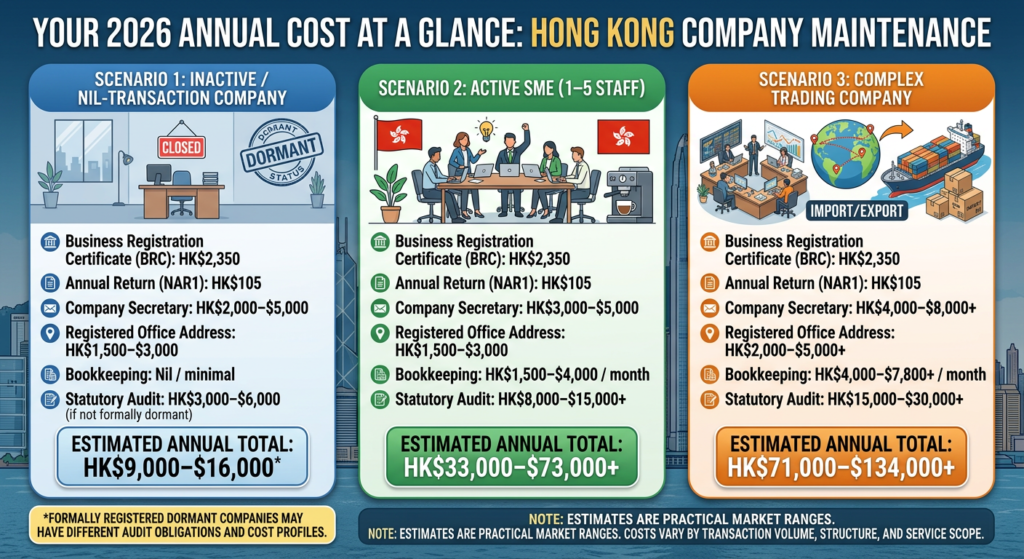
| Cost Component | Inactive / Nil-Transaction Company | Active SME (1–5 Staff) | Complex Trading Company |
| Business Registration Certificate (BRC) | HK$2,350 | HK$2,350 | HK$2,350 |
| Annual Return (NAR1) | HK$105 | HK$105 | HK$105 |
| Company Secretary | HK$2,000–$5,000 | HK$3,000–$5,000 | HK$4,000–$8,000+ |
| Registered Office Address | HK$1,500–$3,000 | HK$1,500–$3,000 | HK$2,000–$5,000+ |
| Bookkeeping | Nil / minimal | HK$1,500–$4,000/month | HK$4,000–$7,800+/month |
| Statutory Audit | HK$3,000–$6,000 if not formally dormant | HK$8,000–$15,000+ | HK$15,000–$30,000+ |
| Estimated Annual Total | HK$9,000–$16,000 if not formally dormant | HK$33,000–$73,000+ | HK$71,000–$134,000+ |
These figures are practical market ranges for common Hong Kong private company maintenance scenarios. Your specific cost depends on transaction volume, corporate structure, whether the company has formally registered dormant status, and the scope of services included by your provider.
A company that has formally registered as dormant may have a different cost profile because certain accounting and audit obligations may not apply during the dormant period.
What Changed in 2026 Compared to Last Year
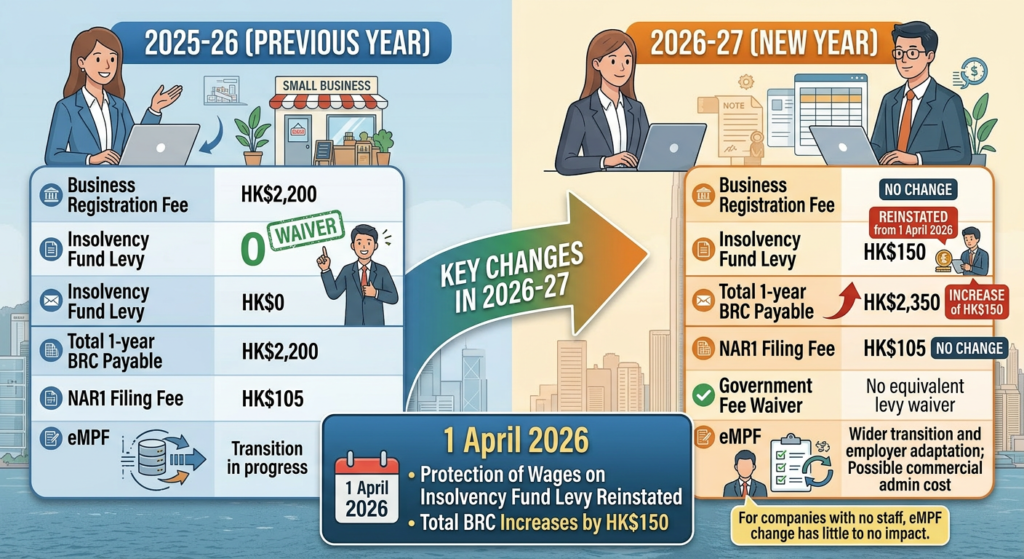
If you maintained a company in 2025, the most relevant question is whether your costs have increased. The short answer: the business registration fee itself remains unchanged, but the levy for the Protection of Wages on Insolvency Fund is reinstated from 1 April 2026.
The eMPF transition may also introduce practical administrative work for employers with staff, although any service provider migration or data-sync fee is a commercial charge rather than a statutory government levy.
| Item | 2025-26 | 2026-27 | Change |
| Business Registration Fee | HK$2,200 | HK$2,200 | No change |
| Protection of Wages on Insolvency Fund Levy | HK$0 | HK$150 | Levy reinstated from 1 April 2026 |
| Total 1-year BRC Payable | HK$2,200 | HK$2,350 | Increase of HK$150 |
| NAR1 Filing Fee | HK$105 | HK$105 | No change |
| Government Fee Waiver | Levy waiver applied in 2025-26 | No equivalent levy waiver for 2026-27 | BRC total increases |
| eMPF Platform | Transition in progress | Wider transition and employer adaptation | Possible commercial admin cost for employers |
No general business registration fee waiver has been announced for the 2026-27 period. For companies with employees, the eMPF transition may require payroll data alignment, record checking, and provider-side administrative support. If your company has no staff, this change has little or no impact on your maintenance budget.
Mandatory Government Fees: The Non-Negotiable Baseline
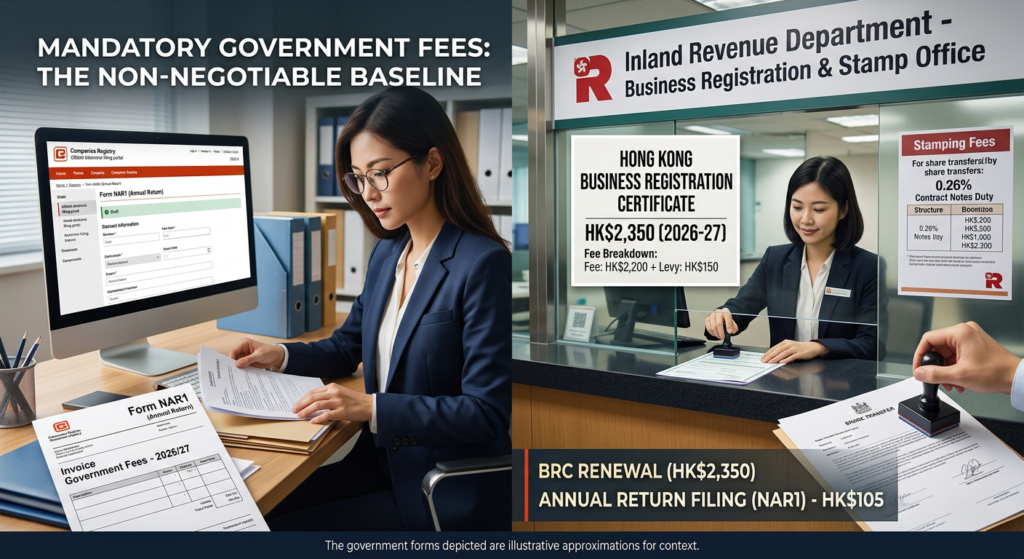
Every Hong Kong private limited company generally pays two core government fees annually regardless of revenue or activity level. These are set by statute and cannot be negotiated by any service provider.
Business Registration Certificate (HK$2,350/year)
Issued by the Inland Revenue Department under the Business Registration Ordinance (Cap. 310), the BRC functions as your company’s official business registration and tax-related identity.
For the 2026-27 period, the one-year BRC payable amount is HK$2,350, comprising a HK$2,200 business registration fee and a HK$150 levy for the Protection of Wages on Insolvency Fund. A three-year certificate is also available for companies that prefer to reduce annual renewal administration.
The IRD generally sends renewal notices before expiry. If your registered address is outdated and you miss this notice, late renewal may result in penalty or surcharge. Keeping your registered office address current is therefore not merely administrative housekeeping — it protects you from avoidable cost and compliance risk.
Annual Return — Form NAR1 (HK$105)
Filed with the Companies Registry under Section 662 of the Companies Ordinance (Cap. 622), the NAR1 confirms your current directors, secretary, shareholders, share capital, and registered office.
The HK$105 filing fee applies only if the Annual Return is delivered within 42 days after the company’s incorporation anniversary. This obligation applies to every company on the register, including companies with little or no activity, unless a specific exemption applies.
Other Government Charges
Changes to directors or secretary, usually reported by Form ND2A, and changes to registered office address, usually reported by Form NR1, generally do not carry a Companies Registry filing fee if filed properly and on time. However, service providers may charge handling fees for preparing and submitting these forms.
Special resolution filings may attract a government filing fee, commonly HK$65.
Share transfers of Hong Kong company shares generally attract stamp duty. In a typical sale and purchase of shares, contract notes are charged at 0.13% on each side, resulting in an aggregate rate of 0.26% of the consideration or net asset value, whichever is higher, plus nominal fixed duty where applicable.
The Penalty Escalation System
The Companies Registry imposes substantially higher registration fees for late Annual Return filings. These late fees are generally applied mechanically and should not be assumed to be waivable.
| Filing Timeframe | Fee / Penalty |
| Within 42 days after incorporation anniversary | HK$105 |
| More than 42 days but within 3 months | HK$870 |
| More than 3 months but within 6 months | HK$1,740 |
| More than 6 months but within 9 months | HK$2,610 |
| More than 9 months | HK$3,480 |
A single overlooked date can cost 33 times the original filing fee. The most common cause is not intentional non-compliance but administrative friction: the responsible person left the company, the registered address was outdated, or the incorporation anniversary was confused with the financial year-end.
Beyond the NAR1, the Inland Revenue Department may penalise late Profits Tax Return filing with estimated assessments, surcharges, or prosecution in serious cases. Where tax has been undercharged because of incorrect returns, omissions, or failure to comply, penalties can be significant and may include fines and additional tax.
Persistent non-compliance may ultimately lead to striking-off or dissolution-related consequences. After dissolution, remaining property may vest in the government as bona vacantia. Restoration may require administrative or court procedures and can be costly.
If you are already overdue, file immediately. The applicable late filing fee is determined by the date of actual filing, so continued delay may push the company into a higher penalty tier.
Professional Service Fees: What the Market Actually Charges
The Companies Ordinance imposes structural requirements that generate ongoing professional service costs. These are legal prerequisites, not optional extras, although the amount charged depends on provider scope and service level.
Company Secretary (HK$2,000–$5,000/year)
Every Hong Kong company must appoint a company secretary. The secretary must be either a Hong Kong resident individual or a body corporate having its registered office or place of business in Hong Kong.
A sole director cannot also act as the company secretary. Therefore, many non-resident founders and single-director companies appoint a professional corporate service provider.
Market packages commonly range from around HK$2,000 to HK$5,000 per year, but the scope varies materially. When evaluating providers, examine what is excluded. Common additional charges may include document certification, ad-hoc statutory filings, significant controllers register maintenance, consultation beyond a capped number of hours, and courier handling.
Registered Office Address (HK$1,500–$3,000/year)
A physical Hong Kong registered office address is mandatory. P.O. boxes are not sufficient for this purpose.
Virtual office or registered address services commonly provide a compliant address with mail receipt, forwarding, or scanning. These are significantly cheaper than maintaining a dedicated commercial lease, which may cost many thousands of Hong Kong dollars per month depending on district and office size.
Significant Controllers Register (HK$500–$1,500/year if charged separately)
All Hong Kong companies must maintain a Significant Controllers Register identifying persons who have significant control over the company, such as individuals holding more than 25% of shares or voting rights, subject to statutory rules.
Companies must also designate a representative to provide assistance relating to the register when required by law enforcement officers.
Non-compliance can result in a fine of HK$25,000 and a further daily fine of HK$700 for continued default. In practice, many company secretary packages include basic SCR maintenance, while some providers charge separately, typically in the range of HK$500–$1,500 per year depending on complexity.
Audit and Tax Compliance
The statutory audit is often the single largest variable in your annual budget. Hong Kong companies are generally required to prepare annual financial statements and have them audited by a practising CPA, unless an exemption applies.
The most important practical distinction is this:
- A company that is merely inactive, has no revenue, or has a bank account with little or no movement is not automatically dormant.
- A company that has formally registered dormant status under the Companies Ordinance may be exempt from preparing audited financial statements during the dormant period.
- If the IRD issues a Profits Tax Return, the company must still respond properly and should seek advice on what supporting documents are required.
| Company Type | Typical Audit Cost | Key Cost Drivers |
| Inactive / nil-transaction company not formally dormant | HK$3,000–$6,000 | Bank account verification, confirmation of no activity, basic financial statements |
| Active, simple operations | HK$6,000–$12,000+ | Transaction count, number of bank accounts, quality of bookkeeping |
| Active with employees | HK$12,000–$30,000+ | Payroll, MPF records, multi-currency activity, inventory, related-party transactions |
| Offshore profit claim | Additional HK$5,000–$20,000+ | Supporting documentation, management explanation, IRD scrutiny |
Bookkeeping is normally a prerequisite for the audit. Monthly costs range from around HK$1,200 for minimal volumes to HK$7,800 or more for daily multi-account transactions. Maintaining clean books throughout the year — rather than reconstructing records at audit time — meaningfully reduces your total accounting expenditure.
Under Hong Kong’s two-tiered profits tax system, corporations generally pay 8.25% on the first HK$2 million of assessable profits and 16.5% thereafter. The concessionary rate applies to only one nominated entity within a group of connected entities.
Low revenue does not automatically mean that a company does not need to file a Profits Tax Return. If the Inland Revenue Department issues a Profits Tax Return, the company must respond within the required timeframe. Smaller corporations may in some cases be exempted from submitting certain supporting documents together with the return, but this is not the same as being exempt from filing.
Non-Resident Directors: Additional Costs to Expect
Most Hong Kong companies searched for in English are owned or managed by non-residents. If this applies to you, your maintenance cost includes practical considerations beyond statutory fees.
You cannot serve as your own company secretary unless you are a Hong Kong resident and the company structure allows it. In particular, a sole director cannot also act as company secretary.
Your registered office provider must reliably forward government correspondence. Missing a filing notice due to postal delay, address change, or poor mail handling does not normally excuse non-compliance.
Budget approximately HK$500–$1,500 annually for courier logistics if physical document handling is required, especially where original board resolutions, bank documents, audit confirmations, or certified documents must move across borders.
Hong Kong banks conduct periodic KYC reviews of company accounts, particularly where ownership or management is non-resident. While not technically a government maintenance cost, failure to respond can trigger account restriction or suspension and create indirect compliance complications.
Work from a compliance calendar with at least 60 days’ lead time before each statutory deadline to account for time zone differences, courier transit, document signing, and bank or auditor requests.
Should You Keep or Close Your Company?
Not every company should be maintained indefinitely. If your entity has been inactive for years with no reactivation plan, compare the numbers honestly.
| Option | Cost | Timeline |
| Maintain inactive company, not formally dormant | HK$9,000–$16,000 per year | Ongoing |
| Maintain formally dormant company | Lower recurring cost may be possible, depending on provider and tax position | Ongoing |
| Deregistration | HK$4,500–$8,000 total in typical service-provider packages | Usually several months |
| Re-incorporate later if needed | HK$5,000–$10,000+ and setup time | Commonly 1–2 weeks depending on provider and bank needs |
Keep the company if: you expect to resume operations within 2–3 years, need to retain the company name, hold assets or contracts under the entity, maintain a bank account, or require the established incorporation date for credibility.
Close the company if: you have been inactive for 3+ years with no reactivation plan, hold no assets or contractual obligations, have no ongoing bank or contractual need, and the annual fee serves no strategic purpose.
Third option: apply for or maintain formal dormant status where appropriate. This may preserve the entity at a lower recurring compliance cost, but it must be done properly and should not be confused with simply having no business activity.
2026 Compliance Calendar
| Deadline | Action Required | Consequence of Missing |
| 42 days after incorporation anniversary | File Annual Return Form NAR1 | Late fee escalation from HK$870 to HK$3,480 |
| Before BRC expiry / upon renewal notice | Renew Business Registration Certificate | Late penalty or surcharge may apply |
| Around April, depending on IRD issue date | File Employer’s Return if issued or applicable | Potential fine, estimated assessment, or prosecution risk |
| Usually 1 month after Profits Tax Return issue, subject to extension arrangements | File Profits Tax Return | Estimated assessment, surcharge, or enforcement action |
| Within the statutory timeframe, unless validly dispensed with | Hold AGM or validly dispense with AGM where permitted | Corporate compliance risk |
| Periodically for employers | Check payroll, MPF, and eMPF-related records | Prevents year-end payroll and MPF discrepancies |
Set reminders at least 30 days before each deadline. Do not rely solely on postal notifications from the government. If your registered address is outdated or mail is not forwarded promptly, you may not receive important notices in time.
Frequently Asked Questions
What happens if I miss the 42-day deadline for the Hong Kong Annual Return?
Missing the 42-day window for your Annual Return (NAR1) triggers substantially higher filing fees from the Companies Registry. The standard HK$105 filing fee increases to HK$870 for delays of more than 42 days but within 3 months, HK$1,740 for more than 3 months but within 6 months, and HK$2,610 for more than 6 months but within 9 months. If you exceed 9 months, the fee reaches HK$3,480.
These late fees are generally enforced regardless of whether your company is active or inactive.
Can I act as my own Company Secretary to save on maintenance costs?
You can only serve as your own company secretary if you satisfy the statutory requirements. The secretary must be a Hong Kong resident individual or a Hong Kong body corporate. A sole director cannot also act as the company secretary.
Most non-resident founders and single-director companies therefore appoint a professional company secretary. Professional fees commonly range from HK$2,000 to HK$5,000 annually, depending on what is included.
Do dormant companies still need to pay for an annual audit in 2026?
You must distinguish between a company that is merely inactive and a company that has formally registered dormant status under the Companies Ordinance.
A company with no business activity is not automatically exempt from audit. If it has not formally registered as dormant, it may still need to maintain proper accounts and prepare audited financial statements.
However, a company that has formally registered dormant status may be exempt from preparing audited financial statements during the dormant period. If the Inland Revenue Department issues a Profits Tax Return, the company must still respond properly and should confirm what tax filing or supporting documents are required.
How much should I budget for a total maintenance package in Hong Kong?
For an inactive or nil-transaction company that has not formally registered as dormant, a practical annual maintenance budget is often around HK$9,000 to HK$16,000, depending on the company secretary, registered address, and audit arrangement.
For an active SME, a more realistic budget is approximately HK$33,000 to HK$73,000+ per year when bookkeeping and audit are included. For more complex trading companies, especially those with multi-currency transactions, employees, inventory, or related-party transactions, annual costs may exceed HK$70,000 to HK$130,000.
Selecting a bundled package can help control the cost to maintain a limited company in Hong Kong in 2026, but always check what is excluded before engagement.
What is the difference between the BRC and the Certificate of Incorporation?
The Certificate of Incorporation is a one-time document issued when your company is incorporated. It proves that the company exists as a legal entity.
The Business Registration Certificate (BRC) is different. It is issued by the Inland Revenue Department and must be renewed periodically. For the 2026-27 period, the one-year BRC payable amount is HK$2,350, comprising the HK$2,200 business registration fee and the HK$150 Protection of Wages on Insolvency Fund levy.
Does the 2026 eMPF platform change increase my annual company costs?
The eMPF transition primarily affects administrative workflows rather than statutory government filing levies. Employers may need to check payroll data, MPF records, employee information, and provider arrangements.
Some service providers may charge a commercial administrative fee for migration, payroll data alignment, or system setup. This is not a statutory government fee. If your company has no employees, the eMPF transition is unlikely to materially affect your annual maintenance cost.
Streamline Your 2026 Compliance with EasyCorp
EasyCorp was established in 2009 to eliminate the administrative friction that turns routine compliance into a source of financial anxiety. Our model is built on three commitments that directly address the cost unpredictability described throughout this guide.
Transparent Fee Disclosure
The price we quote is the price you pay for the agreed scope of work. Before engagement, every potential cost, exclusion, or optional add-on is disclosed clearly, so your annual budget can be planned with confidence.
Fast Filing Turnaround
In an environment where delay can push a company into the next late-fee tier, processing speed is financial protection. Routine filings — from NAR1 submissions to director or registered office changes — are handled promptly once complete documentation is received.
One Provider, One Relationship, One Fee
We consolidate company secretarial services, registered address, government filing support, compliance calendar management, and audit coordination into a single point of contact. This reduces the communication gaps that often occur when multiple providers handle different pieces of your compliance puzzle.
Whether you are maintaining an inactive company, applying for formal dormant status, or managing an active company across time zones, EasyCorp delivers a predictable maintenance experience with clear scope, clear pricing, and practical compliance support.
Contact us today for a transparent same-day quotation covering the obligations outlined in this guide.
About easyCorp
Founded in 2009, easyCorp provides Hong Kong company incorporation, company secretary, registered office, accounting, taxation, and business consulting services.
We support clients from Europe, the United States, the Middle East, Asia, Africa, and other regions with Hong Kong company setup and ongoing compliance.
Contact us now for more details about 1-day company incorporation:
https://www.easycorp.com.hk/en/incorporations
Authorship
This blog article is created by the easyCorp business team and reviewed by professional advisers before publication. We are dedicated to sharing practical information about setting up, maintaining, and managing companies in Hong Kong.
Founded in 2009, easyCorp provides taxation, accounting, company secretary, and business consulting services for entrepreneurs, SMEs, and international business owners operating through Hong Kong companies.