
Every Hong Kong limited company — regardless of size, revenue, or whether it has commenced trading — must generally have its annual financial statements audited by a Hong Kong Certified Public Accountant (Practising) or Hong Kong practice unit qualified to conduct statutory audits. This statutory audit requirement arises under the Companies Ordinance (Cap. 622), and Hong Kong has no small-company audit exemption of the kind available in Singapore, the United Kingdom, or Australia. Companies Registry guidance confirms that audit of financial statements is required for all companies, except dormant companies under section 447.
Does Every Hong Kong Company Need an Audit? Yes — Here’s What the Law Says
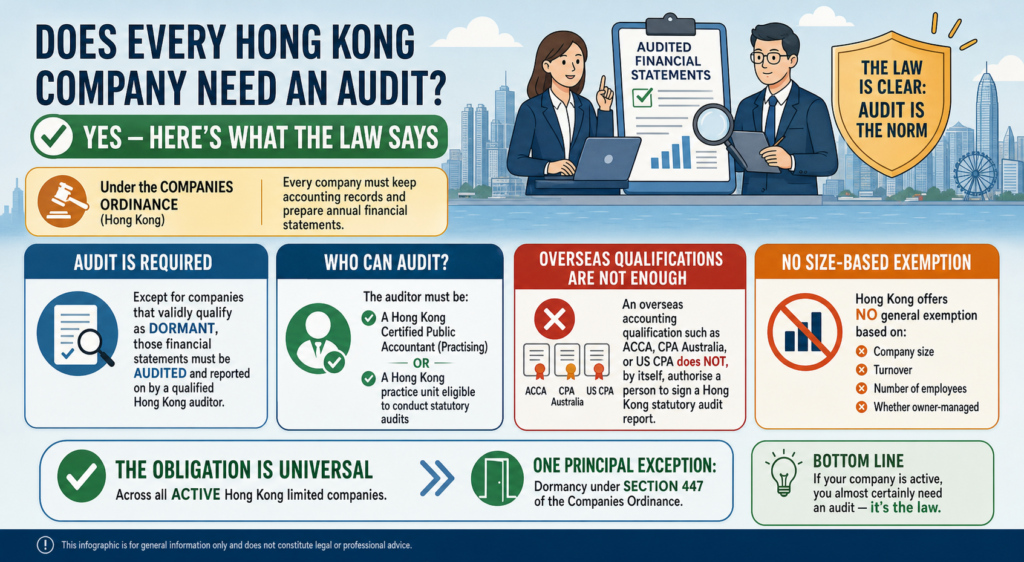
For founders who have previously operated companies in jurisdictions with small-company audit exemptions — such as Singapore, where a qualifying private company may be exempt if it satisfies prescribed size criteria — Hong Kong’s approach to statutory auditing can seem unexpectedly rigid.
Under the Companies Ordinance, a Hong Kong company must maintain accounting records and prepare annual financial statements. Except for companies that validly qualify as dormant, those financial statements must be audited and reported on by a qualified Hong Kong auditor. The auditor must be a Hong Kong Certified Public Accountant (Practising) or a Hong Kong practice unit eligible to conduct statutory audits. An overseas accounting qualification such as ACCA, CPA Australia, or US CPA does not, by itself, authorise a person to sign a Hong Kong statutory audit report.
Hong Kong offers no general exemption based solely on company size, turnover, number of employees, or whether the company is owner-managed. The statutory audit obligation is therefore universal across active Hong Kong limited companies, with the principal exception being dormancy under section 447.
The Dormancy Test Under Section 447: Common Assumptions vs Legal Reality
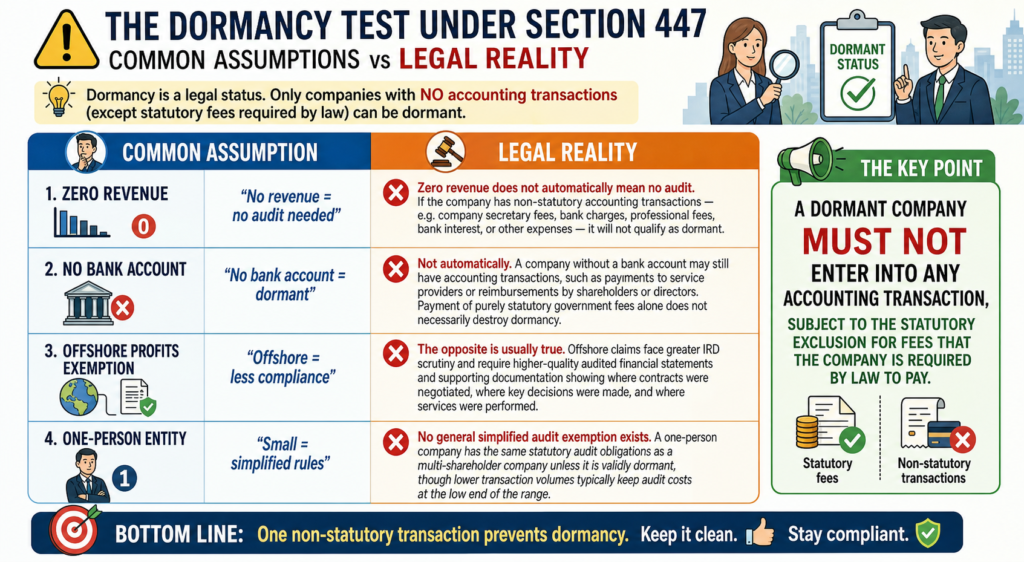
Three scenarios cause particular confusion among newly incorporated companies regarding when a company qualifies as dormant. Dormancy is a legal status under the Companies Ordinance. A company that has validly become dormant is exempt from certain financial reporting, audit and annual return obligations during the period of dormancy. However, the threshold is far narrower than most non-resident directors assume.
The key point is that a dormant company must not enter into an accounting transaction, subject to the statutory exclusion for fees that the company is required by law to pay.
| Scenario | Common Assumption | Legal Reality |
| Company has zero revenue | “No revenue = no audit needed” | Zero revenue does not automatically mean no audit. If the company has non-statutory accounting transactions — for example company secretary fees, bank charges, professional fees, bank interest, or other expenses — it will not qualify as dormant. |
| Company has not opened a bank account | “No bank account = dormant” | Not automatically. A company without a bank account may still have accounting transactions, such as payments to service providers or reimbursements by shareholders or directors. However, payment of purely statutory government fees alone does not necessarily destroy dormancy. |
| Company claims offshore profits exemption | “Offshore = less compliance” | The opposite is usually true. Offshore claims face greater IRD scrutiny and require higher-quality audited financial statements and supporting documentation showing where contracts were negotiated, where key decisions were made, and where services were performed. |
| Company is a one-person entity | “Small = simplified rules” | No general simplified audit exemption exists. A one-person company has the same statutory audit obligations as a multi-shareholder company unless it is validly dormant, though lower transaction volumes typically keep audit costs at the low end of the range. |
Bookkeeping vs Statutory Audit: Two Distinct Obligations
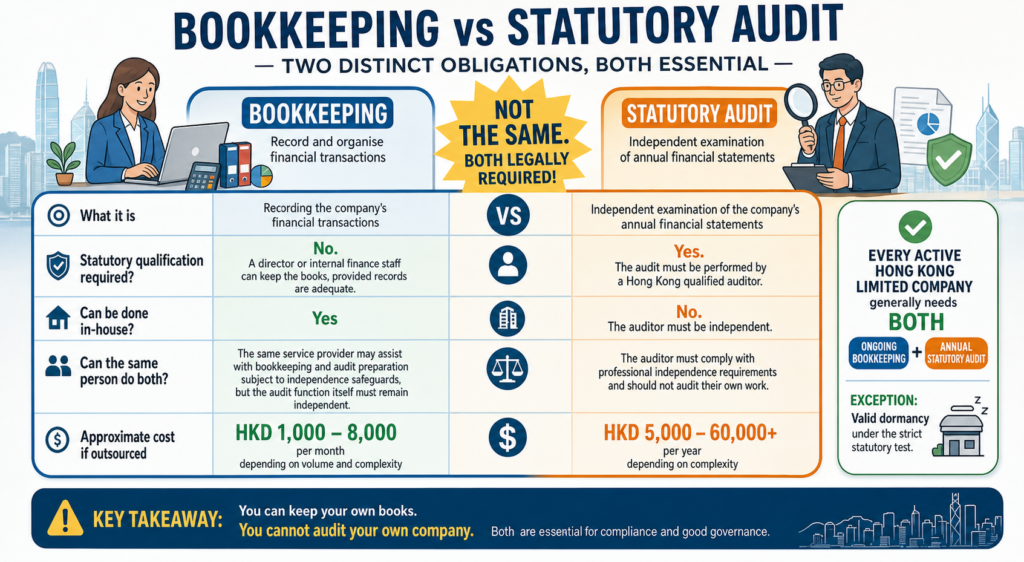
New founders frequently conflate two related but legally separate obligations: bookkeeping and statutory audit. Bookkeeping is the recording and organisation of financial transactions. Statutory audit is the independent examination of the company’s annual financial statements by a qualified external auditor.
Understanding the distinction is critical because a company can handle bookkeeping internally, but it cannot conduct its own statutory audit.
| Dimension | Bookkeeping | Statutory Audit |
| What it is | Recording the company’s financial transactions | Independent examination of the company’s annual financial statements |
| Statutory qualification required? | No. A director or internal finance staff can keep the books, provided records are adequate. | Yes. The audit must be performed by a Hong Kong qualified auditor. |
| Can be done in-house? | Yes | No. The auditor must be independent. |
| Can the same person do both? | The same service provider may assist with bookkeeping and audit preparation subject to independence safeguards, but the audit function itself must remain independent. | The auditor must comply with professional independence requirements and should not audit their own work. |
| Approximate cost if outsourced | HKD 1,000 – 8,000 per month depending on volume and complexity | HKD 5,000 – 60,000+ per year depending on complexity |
Every active Hong Kong limited company generally needs both ongoing bookkeeping and an annual statutory audit. The only commonly available exception is valid dormancy under the strict statutory test described above.
Compliance Timeline: What to Do in the First 18 Months After Incorporation
Understanding the key milestones from incorporation through the first Profits Tax Return filing is the most effective way to avoid missed deadlines and unexpected penalties. The first 18 months usually involve six distinct milestones — from choosing a financial year-end date, through record-keeping and MPF arrangements, to the first Annual Return, statutory audit, and Profits Tax Return filing.
| Timeframe | Milestone | Action Required | Key Deadline / Notes |
| Month 0 | Incorporation | Choose financial year-end date, commonly 31 March or 31 December | Affects accounting period, audit timing and tax filing workflow |
| Day 1 onward | Record-keeping begins | Maintain accounting records sufficient to prepare true-and-fair financial statements | Business records must generally be retained for at least 7 years under the Inland Revenue Ordinance |
| Within 60 days of first relevant employee | MPF arrangements | Enrol employees, including salaried directors where applicable, into a registered MPF scheme and make contributions | No exemption merely because the company is small |
| Around Month 12 | First Annual Return, NAR1 | File NAR1 with the Companies Registry unless the company is validly dormant | Due within 42 days of incorporation anniversary; basic fee HKD 105 if on time |
| Month 12–18 | First financial year ends | Prepare financial statements and engage auditor | Audit should commence promptly after year-end |
| Around Month 18 | First Profits Tax Return, BIR51, issued by IRD | File with required supporting documents, including audited financial statements where required | Normally one month to file, subject to possible extension through tax representative / e-filing arrangements |
| 4 months after year of assessment ends | Self-notification duty | If assessable profits exist but no BIR51 is received, notify IRD proactively | Section 51(2), Inland Revenue Ordinance |
Month 0: Incorporation and the Year-End Date Decision
On the date of incorporation, the Companies Registry issues a Certificate of Incorporation and the Business Registration Office issues a Business Registration Certificate. Directors should choose a financial year-end date early because the choice directly determines the first accounting period, audit timetable, and filing workflow under the IRD’s Block Extension Scheme.
| Dimension | 31 March Year-End | 31 December Year-End |
| Alignment | Aligns with Hong Kong’s tax year of assessment, 1 April to 31 March | Aligns with calendar year |
| Best suited for | Standalone Hong Kong companies and local SMEs | Subsidiaries of overseas parent entities requiring calendar-year consolidation |
| Block Extension treatment | Typically associated with later filing under the IRD’s annual block extension timetable | Typically associated with an earlier extended filing deadline than 31 March year-end companies |
| First-year period length | Depends on incorporation date | Depends on incorporation date |
| Prevalence | Common among local SMEs | Common among foreign-owned subsidiaries |
A 31 March year-end aligns the accounting period with Hong Kong’s tax year of assessment and often gives a longer practical filing window under the Block Extension Scheme. A 31 December year-end simplifies consolidation with overseas parent entities but usually brings an earlier extended filing deadline. The choice is consequential for both administration and cash-flow planning.
Months 1–12: Record-Keeping, MPF, and the First Annual Return
From the first day of operations, every Hong Kong company is legally required under section 51C of the Inland Revenue Ordinance to keep sufficient business records to enable its assessable profits to be readily ascertained. These records include invoices, receipts, bank statements, contracts, payroll records and supporting documents, and must generally be retained for at least seven years.
The Companies Ordinance also requires companies to keep proper accounting records. Failure to keep adequate accounting records can expose the company and responsible persons to criminal penalties.
If the company employs staff — including a director receiving salary as an employee — the employer must arrange MPF enrolment and contributions in accordance with the Mandatory Provident Fund rules. There is no exemption simply because the company is small or has only one employee.
Around the first anniversary of incorporation, the company must file its first Annual Return, form NAR1, with the Companies Registry unless it is validly dormant and exempt during that period. For a private company, the filing fee is HKD 105 if delivered within 42 days after the incorporation anniversary. Late filing triggers escalating registration fees.
| Time Elapsed After Anniversary Date | Filing Fee |
| Within 42 days | HKD 105 |
| More than 42 days but not more than 3 months | HKD 870 |
| More than 3 months but not more than 6 months | HKD 1,740 |
| More than 6 months but not more than 9 months | HKD 2,610 |
| More than 9 months | HKD 3,480, plus prosecution and strike-off risk |
Missing the 42-day window for the first Annual Return is one of the most common and avoidable compliance failures among newly incorporated Hong Kong companies.
Months 12–18: First Year-End, Audit, and First Profits Tax Return
The first financial year ends on the chosen year-end date. A company incorporated on 15 June 2025 that chose 31 March as its year-end would usually have a first accounting period running from 15 June 2025 to 31 March 2026.
Once the first financial year closes, the company should begin preparing financial statements and engaging a Hong Kong auditor promptly. The IRD generally issues the first Profits Tax Return, form BIR51 for corporations, approximately 18 months after incorporation. Where supporting documents are required, audited financial statements and tax computations should be ready before filing.
Upon receiving the BIR51, the company normally has one month to file. A tax representative may apply for an extended deadline under the IRD’s Block Extension Scheme, depending on the year-end date and annual IRD timetable. Separately, voluntary e-filing may provide a further one-month extension where the IRD’s conditions are satisfied. (ird.gov.hk)
A critical obligation that many non-resident directors overlook is the self-notification duty under section 51(2) of the Inland Revenue Ordinance. If the company is chargeable to profits tax but has not received a Profits Tax Return, it must notify the IRD in writing within four months after the end of the relevant year of assessment. Not receiving a tax return is not a defence if the company had assessable profits and failed to notify.
2026 Regulatory Updates: What Changed and What Doesn’t Affect Most SMEs
For the 2025/26 year of assessment and beyond, the most impactful filing change for small and medium-sized Hong Kong companies is the withdrawal of the HKD 2 million concession. Any company with gross income during the basis period must submit its Profits Tax Return together with supporting documents, including financial statements and tax computation. (ird.gov.hk)
The core obligations — annual statutory audit, Profits Tax Return filing, record-keeping and Annual Return filing — remain structurally unchanged. However, several additional regulatory changes have taken effect or are approaching.
| Regulatory Change | Effective From | Applies to SMEs? | Applies to Large MNEs? | Action Required |
| Electronic filing of applicable supplementary forms | Year of assessment 2025/26 | Yes, where relevant forms apply | Yes | File relevant supplementary forms electronically through IRD channels |
| End of HKD 2 million concession | Year of assessment 2025/26 | Yes | Yes | Ensure required financial statements and tax computations are ready |
| Pillar Two Global Minimum Tax | Year of assessment 2025/26 | Generally no | Yes, if in-scope | No direct action for ordinary SMEs unless part of an in-scope MNE group |
| Mandatory electronic filing / iXBRL for first-phase entities | Year of assessment 2025/26 | Generally no | Yes, for in-scope MNE group entities | In-scope entities must e-file with iXBRL supporting documents |
| Voluntary iXBRL e-filing | Available to eligible taxpayers | Optional | Optional or mandatory depending on status | Consider for additional one-month filing extension where available |
| HKFRS 18 | Periods beginning on or after 1 Jan 2027 | Applies if using full HKFRS | Yes, if using full HKFRS | Consult auditor on presentation changes |
| HKFRS for Private Entities / SME reporting framework updates | Monitor HKICPA updates | Yes, if using those standards | Usually not applicable to listed or full-HKFRS groups | Confirm applicable reporting framework with auditor |
| FSIE regime | In effect since 1 Jan 2023; expanded from 1 Jan 2024 | Only if entity is part of an MNE group and receives specified foreign-sourced income | Yes, where conditions met | Assess economic substance, participation exemption, nexus requirement or other relief as applicable |
Electronic Supplementary Forms and the End of the HKD 2 Million Concession
Two filing changes affect many Hong Kong companies filing a Profits Tax Return for the 2025/26 year of assessment onward.
First, where applicable supplementary forms or other prescribed forms are required to be furnished with the Profits Tax Return, they must be filed electronically through the IRD’s e-filing services. This does not mean every company must file all forms S1 through S22. It means the relevant forms that apply to the company’s circumstances must be filed electronically.
Second, the previous administrative concession allowing small corporations and businesses with gross income not exceeding HKD 2 million to file without supporting documents has been withdrawn. Companies with any gross income during the basis period must submit their Profits Tax Return together with supporting documents, including financial statements and tax computation. (ird.gov.hk)
This makes it essential to have accounts and audit work finalised before the filing deadline, rather than treating the audit as something that can be deferred until after the tax return has been filed.
Pillar Two Global Minimum Tax — Likely Irrelevant to Your Company
The Inland Revenue (Amendment) (Minimum Tax for Multinational Enterprise Groups) Ordinance 2025 implements the OECD/G20 Pillar Two global minimum tax framework in Hong Kong.
The rules apply only to multinational enterprise groups with consolidated annual revenue of at least EUR 750 million in at least two of the four fiscal years immediately preceding the tested fiscal year. For a typical founder-owned company, trading SME, or single-entity Hong Kong company, the Pillar Two rules generally have no direct effect. The threshold is designed to capture only very large multinational groups. (ird.gov.hk)
Mandatory iXBRL E-Filing — Not Yet Applicable to Ordinary SMEs
The first phase of mandatory electronic filing of Profits Tax Returns has come into effect from the 2025/26 year of assessment. It applies to Part 4AA entities of in-scope MNE groups, not ordinary SMEs. In-scope entities must electronically file their Profits Tax Returns together with supporting documents in iXBRL format. (ird.gov.hk)
Small and medium-sized companies are not currently within the first phase of mandatory iXBRL filing unless they form part of such an in-scope MNE group. However, the IRD offers voluntary e-filing to more corporations and businesses. Companies that voluntarily e-file may enjoy a further one-month extension of the filing deadline where the relevant conditions are met. (ird.gov.hk)
Accounting Standards Changes on the Horizon
Two accounting standards developments are relevant for companies preparing financial statements during 2026 and 2027.
First, HKFRS 18 will replace HKAS 1 as the primary standard governing presentation and disclosure in financial statements for entities applying full HKFRS. It is effective for financial periods beginning on or after 1 January 2027, with earlier application permitted. HKFRS 18 introduces significant changes to how the statement of profit or loss is structured, including new required categories and subtotals. (hkicpa.org.hk)
Second, companies using HKFRS for Private Entities, SME-FRF and SME-FRS, or another permitted reporting framework should confirm with their auditor which standards apply to their financial statements and whether any HKICPA updates affect periods beginning on or after 1 January 2027.
Companies preparing financial statements for periods beginning on or after 1 January 2027 should discuss presentation and disclosure changes with their auditor during 2026 rather than waiting until the first audit under the new standard.
FSIE Regime — Relevant Only for MNE Group Members
The Foreign-Sourced Income Exemption regime, in effect since 1 January 2023 and expanded from 1 January 2024, applies to Hong Kong entities that are members of a multinational enterprise group and receive specified categories of foreign-sourced income in Hong Kong.
The relevant categories include dividends, interest, intellectual property income and disposal gains. Where the regime applies, such income may be deemed taxable in Hong Kong upon receipt unless the company meets an applicable exception, such as the economic substance requirement, participation exemption, nexus requirement for qualifying IP income, or intra-group transfer relief where applicable.
The FSIE regime does not affect companies that are not part of an MNE group. It also does not change the ordinary territorial source analysis for active business income such as trading or service profits. For a standalone Hong Kong company earning only ordinary active business revenue, the FSIE regime may be irrelevant. For a Hong Kong company with overseas subsidiaries or passive foreign-sourced income, it should be reviewed carefully.
Your Situation, Your Requirements: A Scenario-Based Guide
Hong Kong’s compliance obligations apply broadly, but the practical implications — particularly audit cost, IRD scrutiny level, and non-compliance risk — vary significantly across three common scenarios: a company that has not yet commenced trading, a company with a bank account but zero revenue, and a company whose revenue is claimed to be entirely offshore.
| Dimension | Scenario 1: Incorporated, Not Yet Trading | Scenario 2: Bank Account Open, Zero Revenue | Scenario 3: Entirely Offshore Revenue |
| Statutory audit required? | Yes, unless validly dormant | Yes, because bank transactions generally prevent dormancy | Yes, and usually to a higher evidentiary standard |
| Profits Tax Return required? | Yes if issued by IRD; nil filing may be required | Yes if issued by IRD; nil or minimal assessable profits may be reported | Yes, with offshore profits claim if applicable |
| Common disqualifying transactions | Company secretary fees, accounting fees, reimbursements, professional fees | Bank fees, interest, FX movements | Revenue transactions plus all supporting activity |
| Typical audit fee range | HKD 5,000 – 8,000 | HKD 5,000 – 12,000 | HKD 15,000 – 55,000+ |
| IRD scrutiny level | Low | Low | High |
| Key risk if non-compliant | Late filing, estimated assessment or inability to support nil filing | Bank KYC issues and tax filing penalties | Offshore claim rejected; Hong Kong tax assessed plus penalties |
Scenario 1: Company Incorporated but Not Yet Trading
A Hong Kong company that has been incorporated but has not commenced trading still has compliance obligations that many founders mistakenly assume do not apply. The company will generally receive a Profits Tax Return from the IRD approximately 18 months after incorporation and must respond if a return is issued.
Whether the company requires a statutory audit depends on whether it has validly become dormant and remained dormant under the Companies Ordinance. In practice, many “not yet trading” companies have incurred non-statutory expenses such as company secretary fees, accounting fees, bank charges, professional fees or shareholder reimbursements, and therefore cannot rely on dormant status.
A one-person company has the same legal obligations as a multi-shareholder company unless it is validly dormant. Audit fees for a not-yet-trading but non-dormant company generally fall at the lowest end of the range, around HKD 5,000 to HKD 8,000 per year.
Scenario 2: Company with a Bank Account but Zero Revenue
A Hong Kong company that has opened a bank account but generated no revenue is usually not dormant, because bank charges, bank interest and foreign-exchange movements are accounting transactions. The company must prepare audited financial statements for each financial year and file its Profits Tax Return when issued, reporting nil or minimal assessable profits where appropriate.
Audit fees for a company with a bank account but zero revenue typically range from HKD 5,000 to HKD 12,000 per year depending on the audit firm, the number of bank accounts and the number of transactions. This is usually a simple audit engagement, but it cannot be skipped without risking IRD penalties and bank KYC difficulties.
Scenario 3: Company with Entirely Offshore Revenue
A Hong Kong company whose revenue is generated entirely from activities conducted outside Hong Kong may claim that its profits are not sourced in Hong Kong and are therefore not subject to profits tax under Hong Kong’s territorial source principle. However, claiming offshore status does not reduce the company’s audit obligation — it increases the documentation burden.
The IRD scrutinises offshore profits claims by examining, among other things, where contracts were negotiated and concluded, where key business decisions were made, where services were performed, where goods were purchased and sold, and where profit-generating operations took place. Audited financial statements of high quality are the evidentiary foundation of any serious offshore claim.
Companies pursuing an offshore profits claim should budget for audit fees in the range of HKD 15,000 to HKD 55,000 or more, because the auditor and tax representative must review more extensive documentation and prepare a claim capable of withstanding IRD inquiry.
What Happens If You Don’t Comply: Penalties, Estimated Assessments, and Bank Account Risks
The consequences of non-compliance with Hong Kong’s audit and tax filing obligations operate on three escalating levels: statutory penalties imposed by the IRD, estimated assessments that create legally binding tax bills based on the IRD’s own estimate, and loss of bank or payment-account access during routine KYC reviews.
| Non-Compliance Type | Legal Basis | Penalty / Consequence | Escalation |
| Failure to file Profits Tax Return | Section 80(2), Inland Revenue Ordinance | Fine up to HKD 10,000 and possible further fine linked to tax undercharged | Prosecution in Magistrates’ Courts |
| Additional penalty tax | Section 82A, Inland Revenue Ordinance | Additional tax up to treble the amount of tax undercharged | Assessed by Commissioner |
| Estimated assessment | Section 59(3), Inland Revenue Ordinance | Legally binding tax bill based on IRD estimate | Objection requires timely action and proper accounts |
| Failure to keep proper accounting records | Companies Ordinance and Inland Revenue Ordinance | Criminal penalties may apply to company and responsible persons | Prosecution risk |
| Late filing of Annual Return | Companies Ordinance | HKD 870 – HKD 3,480 escalating registration fee | Prosecution and possible strike-off |
| Failure to notify IRD of chargeability | Section 51(2), Inland Revenue Ordinance | Penalties may apply | Can compound with late filing and under-reporting issues |
| Bank or payment-account closure | Bank / provider KYC policy | Suspension or closure of account | No guaranteed appeal; replacement account may be difficult |
Tax Penalties Under the Inland Revenue Ordinance
Under section 80(2) of the Inland Revenue Ordinance, failing to file a Profits Tax Return without reasonable excuse is an offence punishable by a fine of up to HKD 10,000 and, where tax has been undercharged, a further fine linked to the amount of tax undercharged.
Under section 82A, the Commissioner may assess additional tax of up to three times the amount of tax undercharged in cases such as incorrect returns, omissions, understatements or failure to comply with filing obligations.
If a company fails to file and does not respond to reminders, the IRD may issue an estimated assessment under section 59(3). Once issued, the estimated assessment has legal force and the assessed tax becomes payable unless the company lodges a valid objection within the statutory time limit, normally supported by proper accounts and tax computation.
Unpaid tax may attract surcharges. The longer the company delays, the harder and more expensive it becomes to regularise the position.
Companies Ordinance Penalties
Failure to keep proper accounting records under the Companies Ordinance can expose the company and responsible persons to criminal penalties. Failure to file the Annual Return, NAR1, attracts late filing fees ranging from HKD 870 to HKD 3,480 depending on the length of delay, and persistent non-filing can lead to prosecution and ultimately strike-off.
If a company is struck off, it loses its legal capacity to operate, its assets may vest in the Government as bona vacantia, and restoration may be required before the company can properly deal with its property, contracts or legal rights.
The Most Immediate Risk: Bank Account Closure
For non-resident directors operating remotely, the single most consequential outcome of failing to maintain audited accounts is often not a government penalty but the loss of the company’s Hong Kong bank account or payment account.
Hong Kong banks — including traditional institutions such as HSBC, Standard Chartered, Bank of China and Hang Seng — conduct periodic KYC reviews and may request audited financial statements. Fintech and payment account providers such as Airwallex, Statrys and Neat may also request financial statements or tax filings as part of account monitoring.
A company that cannot produce audited accounts when requested risks account restriction, suspension or closure. For a company whose sole operating account is in Hong Kong, account closure means an immediate inability to receive customer payments, pay suppliers, meet payroll or fund operations.
How Much Does It Cost? A 2026 Fee Breakdown
Understanding the cost structure of Hong Kong’s annual compliance requirements is essential for founders budgeting their first year of operations. The figures below are approximate market ranges among small to mid-sized accounting firms and corporate service providers in Hong Kong as of 2026.
Founders should confirm whether a quoted fee includes bookkeeping review, audit coordination, tax computation, Profits Tax Return filing, supplementary forms, offshore claim support, IRD enquiries, and bank KYC responses.
Statutory Audit Fees
| Company Profile | Annual Revenue | Typical Audit Fee, HKD | Approximate USD Equivalent |
| Dormant / zero-transaction or very simple non-trading company | Nil | 5,000 – 8,000 | 640 – 1,025 |
| Small active company | Under HKD 1 million | 8,000 – 15,000 | 1,025 – 1,925 |
| Growing SME | HKD 1 million – 10 million | 15,000 – 35,000 | 1,925 – 4,490 |
| Mid-sized / complex structure | Above HKD 10 million | 35,000 – 60,000+ | 4,490 – 7,700+ |
| Add-on: offshore profits claim | Any | +5,000 – 20,000 | +640 – 2,565 |
Bookkeeping Fees
| Method | Monthly Transaction Volume | Typical Monthly Cost, HKD |
| Outsourced — small company | Fewer than 50 transactions | 1,000 – 3,000 |
| Outsourced — higher volume / multi-currency | 50+ transactions | 3,000 – 8,000 |
| In-house — cloud software | Any | 150 – 600 subscription only |
Total Annual Compliance Cost Estimate
| Company Type | Bookkeeping | Audit | Tax Filing | Company Secretary + BR | Total, HKD/year | Approx. USD/year |
| One-person company, self-bookkeeping | ~2,400 software | 8,000 – 12,000 | Included in audit or 2,000 – 3,000 | 3,000 – 5,000 | 15,000 – 22,000 | 1,925 – 2,820 |
| Small active company, outsourced bookkeeping | 12,000 – 36,000 | 10,000 – 20,000 | 2,000 – 5,000 | 3,000 – 5,000 | 25,000 – 45,000 | 3,200 – 5,800 |
| SME with offshore claim | 24,000 – 60,000 | 20,000 – 55,000 | 5,000 – 10,000 | 3,000 – 5,000 | 52,000 – 130,000 | 6,670 – 16,670 |
For a small active company with annual revenue under HKD 1 million, total annual compliance costs — encompassing bookkeeping, statutory audit, tax filing and company secretary services — commonly fall between HKD 25,000 and HKD 45,000. This is higher than an audit-exempt Singapore company, but the comparison should also account for tax rates, GST exposure, banking credibility and the value of independently audited accounts.
How Hong Kong Compares to Singapore on Audit Requirements
The most significant difference between Hong Kong and Singapore in annual company compliance is that Singapore provides a statutory audit exemption for qualifying small private companies, while Hong Kong does not offer an equivalent exemption based solely on company size or revenue.
| Dimension | Hong Kong | Singapore |
| Statutory audit required for all companies? | Yes, except valid dormant companies | No, if qualifying small company exemption applies |
| Small company audit exemption criteria | Not available | Generally, private company meeting prescribed size criteria |
| Corporate tax rate | 8.25% on first HKD 2 million of assessable profits; 16.5% thereafter | 17%, with partial exemptions and incentives where applicable |
| VAT / GST | None | 9% GST, with registration threshold |
| Capital gains tax | None | Generally none |
| Dividend withholding tax | None | None |
| Territorial taxation | Hong Kong-sourced profits taxed; FSIE may apply to certain foreign-sourced passive income of MNE entities | Singapore-sourced income taxed; foreign-sourced income received in Singapore may be taxed unless exemption applies |
| Annual return filing | NAR1 to Companies Registry | Annual Return to ACRA |
| Accounting records retention | Generally 7 years for tax records | Generally 5 years |
| Audit cost for small active company | HKD 8,000 – 15,000+ | Exempt if qualifying criteria met |
| Estimated total annual compliance cost, small company | HKD 25,000 – 45,000 | Often lower if audit-exempt |
The comparison is incomplete without the tax dimension. Hong Kong’s two-tiered profits tax system charges 8.25% on the first HKD 2 million of assessable profits and 16.5% thereafter. Hong Kong also has no GST, no capital gains tax and no dividend withholding tax.
The audit is a real and recurring cost, but it is a known, budgetable cost that produces independently verified financial statements. Those statements can support bank relationships, investor due diligence, cross-border credibility and the company’s internal governance.
Frequently Asked Questions
Do I need an audit if my Hong Kong company has no revenue?
A Hong Kong company with no revenue still requires a statutory audit unless it validly qualifies as dormant under the Companies Ordinance. Dormancy requires that the company has not entered into an accounting transaction, subject to the statutory exclusion for fees the company is required by law to pay.
Expenses such as bank charges, company secretary fees, accounting fees, professional fees or shareholder reimbursements generally prevent dormant status. All compliance procedures — including audit coordination and Profits Tax Return filing — can normally be completed remotely without the director being physically present in Hong Kong.
When will I receive my first Profits Tax Return?
The Inland Revenue Department generally issues the first Profits Tax Return, form BIR51 for corporations, approximately 18 months after incorporation.
If a newly incorporated company becomes chargeable to profits tax before receiving a Profits Tax Return, it must notify the IRD under section 51(2) of the Inland Revenue Ordinance within four months after the end of the relevant year of assessment. Not having received a return is not a valid excuse if the company had assessable profits and failed to notify.
What is the penalty for filing my Profits Tax Return late?
Late filing without reasonable excuse can result in prosecution, a fine of up to HKD 10,000, and further penalties where tax has been undercharged. The Commissioner may also impose additional tax under section 82A of up to three times the amount of tax undercharged.
The IRD may issue an estimated assessment under section 59(3), which becomes a legally binding tax bill unless the company lodges a valid objection within the statutory time limit and provides proper accounts and tax computation.
Does Hong Kong have a small company audit exemption?
No. Unlike Singapore, the United Kingdom and Australia, Hong Kong does not provide a general statutory audit exemption based on company size, revenue or number of employees. The main exception applies to dormant companies under section 447 of the Companies Ordinance, and the dormancy test is narrow.
How much does an audit cost for a small Hong Kong company in 2026?
Audit fees for a small active Hong Kong company with annual revenue under HKD 1 million typically range from HKD 8,000 to HKD 15,000 per year. Very simple non-trading companies may fall around HKD 5,000 to HKD 8,000, while companies with bank accounts, multi-currency transactions, higher transaction volume or offshore profits claims should budget more.
Companies claiming offshore profits should expect higher audit and tax-support costs, often an additional HKD 5,000 to HKD 20,000 or more, because the documentation burden is significantly greater.
Can my bank close my account if I don’t have audited accounts?
Yes. Hong Kong banks conduct periodic KYC reviews and may request audited financial statements, tax filings, business records or proof of operations. Fintech and payment account providers may impose similar requirements.
A company that fails to produce audited accounts or credible financial records when requested risks account suspension, restriction or closure. This can immediately disrupt customer receipts, supplier payments, payroll and day-to-day operations.
Next Steps
Managing Hong Kong’s annual compliance obligations remotely — from bookkeeping and audit coordination to Profits Tax Return filing and company secretarial services — requires a reliable local partner who understands the specific needs of non-resident directors. Based on our experience coordinating statutory audits and annual filings for companies ranging from dormant single-entity structures to active SMEs with offshore claims, the most common cause of compliance failure is not complexity but delay: directors who wait until the Profits Tax Return arrives to begin engaging an auditor consistently face tighter timelines, higher rush fees, and greater risk of missed deadlines.
How easyCorp Can Help?
easyCorp provides an all-in-one compliance package covering statutory audit coordination, annual accounts preparation, Profits Tax Return filing, and company secretary services, all handled remotely through a single point of contact with transparent, upfront pricing and no hidden charges for IRD queries or bank KYC responses. If you are looking for a straightforward way to keep your Hong Kong company fully compliant without navigating multiple service providers, get in touch with the easyCorp team to request a quote.
This article was last updated in October 2026. Hong Kong’s tax and corporate compliance rules are subject to change through legislative amendments, IRD practice notes, and annual budget measures. Readers should verify current requirements with the Inland Revenue Department, the Companies Registry, and the HKICPA, or consult a qualified Hong Kong CPA for advice specific to their circumstances.
Learn more:
- Companies Registry – FAQ – Companies Ordinance – Accounts and Audit
- Companies Registry – FAQ – Local Limited Companies – Dormant Companies
- IRD : Warm Reminder on Profits Tax Return Filing Requirements
- NOTES AND INSTRUCTIONS – FORM BIR52
- HKFRS 18 Presentation and Disclosure in Financial Statements
- Circular Letter to Tax Representatives
About easyCorp
Founded in 2009, easyCorp provides Hong Kong company incorporation, company secretary, registered address, business bank account opening referral, accounting, taxation, and business consulting services to entrepreneurs and companies from Europe, the United States, the Middle East, Asia, Africa, and other markets.
Authorship
This blog article is created by the easyCorp business team and reviewed by qualified professionals before publication. We are dedicated to sharing useful information about setting up businesses and managing taxation and compliance in Hong Kong.
Founded in 2009, easyCorp provides high-quality taxation, accounting, company secretary, and business consulting services. easyCorp differentiates itself through practical problem-solving experience and the number of real-world corporate service scenarios handled across different industries and jurisdictions.