
This guide compares BVI, Seychelles, and the Cayman Islands from a Hong Kong perspective — covering formation costs, ongoing obligations, 2026 regulatory changes, bank account practicalities, and the FSIE implications that most international guides overlook. Forming an offshore company in any of these jurisdictions is entirely legal for Hong Kong residents, provided the company is used for legitimate business purposes and all applicable reporting and tax obligations are met in both the offshore jurisdiction and Hong Kong. It becomes problematic only when used to evade taxes, launder money, conceal beneficial ownership unlawfully, or circumvent sanctions.
BVI, Seychelles, and Cayman Islands at a Glance — A 2026 Comparison
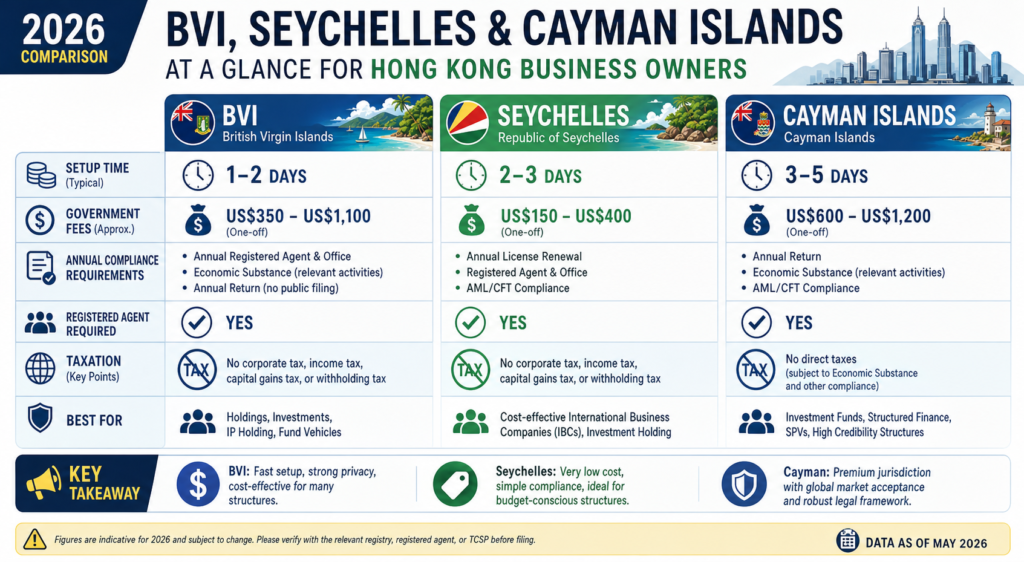
Hong Kong business owners comparing BVI, Seychelles, and the Cayman Islands in 2026 need a side-by-side view of costs, timelines, and compliance obligations before reading further detail. The table below summarises the key dimensions. All dollar figures are in United States dollars unless stated otherwise. Government fee data and service-cost ranges should be verified with the relevant registry, registered agent, or TCSP before filing because fee schedules and provider pricing can change.
| Dimension | BVI Business Company | Seychelles IBC | Cayman Exempted Company |
| Typical first-year all-in cost | USD 1,750 – 2,500 | USD 950 – 1,500 | USD 2,950 – 5,000+ |
| Annual government fee | Commonly USD 550 for companies authorised to issue up to 50,000 shares; higher for larger share structures | Commonly USD 150 for a standard IBC licence | Varies by authorised share capital; commonly higher than BVI and Seychelles |
| Typical annual renewal, including registered agent | USD 1,600 – 2,450 | USD 850 – 1,200 | USD 2,500 – 4,000 |
| Incorporation speed | 1 – 3 business days | 1 – 3 business days | 3 – 7 business days |
| Beneficial ownership reporting threshold | 10% reporting threshold | 10% reporting threshold under Seychelles BO rules | Commonly 25% threshold under Cayman BO framework, subject to entity type and exemptions |
| Annual financial filing / record obligations | Unaudited annual financial return, generally a balance sheet and profit-and-loss statement, to registered agent | Accounting records and supporting documents must be maintained, with accounting information provided to the registered agent periodically | No public financial filing for ordinary exempted companies, but proper books and records must be kept |
| Economic substance rules | Yes — relevant activities | Yes — relevant activities | Yes — relevant entities and relevant activities |
| CRS / AEOI participation | Yes | Yes | Yes; CARF and amended CRS effective from 1 January 2026 |
| EU list status, February 2026 | Annex II grey-list status should be checked before use | Removed from Annex II in February 2026 | Not listed |
| OECD Global Forum rating | Largely Compliant | Largely Compliant, upgraded January 2026 | Largely Compliant |
| HK bank acceptance | Moderate-to-high | Low-to-moderate | High for institutional use cases; less common for SMEs |
| Typical use cases | Holding, asset protection, intermediate group layer, trading | Low-cost trading, e-commerce, simple holding | IPO vehicle, fund structure, institutional holding |
The single most important takeaway from this comparison is that the cheapest jurisdiction to incorporate is not necessarily the cheapest to operate over three years. The table below projects the estimated cumulative cost of a straightforward single-entity structure over its first three years, before any banking, accounting, audit, legal, tax, FSIE, or restructuring advisory fees.
Estimated Three-Year Holding Cost
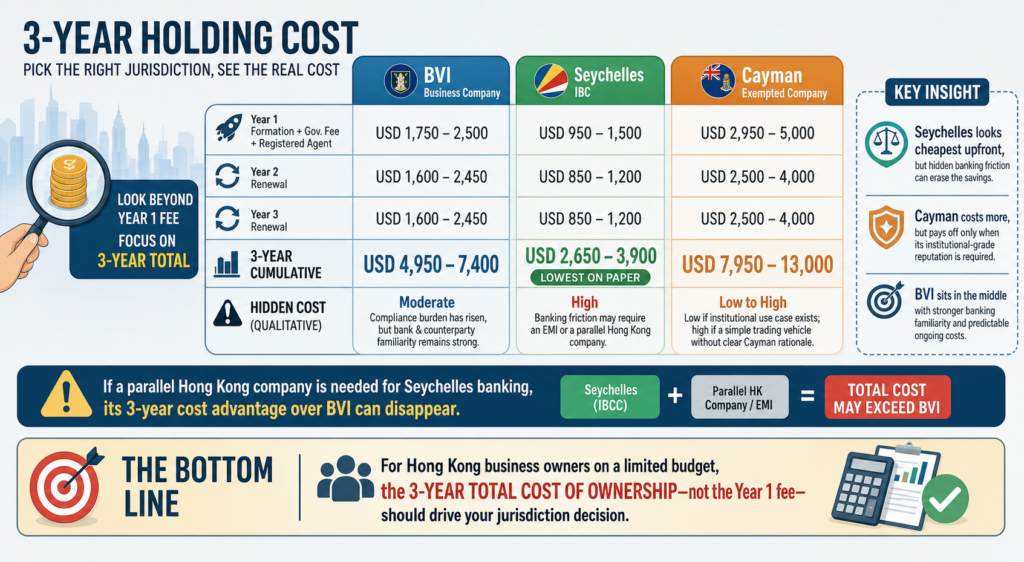
| Cost component | BVI Business Company | Seychelles IBC | Cayman Exempted Company |
| Year 1, formation + government fee + registered agent | USD 1,750 – 2,500 | USD 950 – 1,500 | USD 2,950 – 5,000 |
| Year 2 renewal | USD 1,600 – 2,450 | USD 850 – 1,200 | USD 2,500 – 4,000 |
| Year 3 renewal | USD 1,600 – 2,450 | USD 850 – 1,200 | USD 2,500 – 4,000 |
| Three-year cumulative | USD 4,950 – 7,400 | USD 2,650 – 3,900 | USD 7,950 – 13,000 |
| Hidden cost variable | Moderate — compliance burden has risen, but bank and counterparty familiarity remains relatively strong | High — banking friction may require an electronic money institution or a parallel Hong Kong company | Low if an institutional use case exists; high if the company is a simple trading vehicle without a clear Cayman rationale |
When the potential need for a parallel Hong Kong company to solve Seychelles banking difficulties is factored in, the Seychelles’ three-year cost advantage over BVI can evaporate entirely. Conversely, a Cayman entity is cost-efficient only when its institutional-grade reputation is actively required by investors, listing rules, fund documents, or counterparties — otherwise the premium buys capability the business does not use.
For Hong Kong business owners on a limited budget, the three-year total cost of ownership — not the Year 1 formation fee — is the number that should drive the jurisdiction decision.
What Changed in 2026: The Regulatory Snapshot
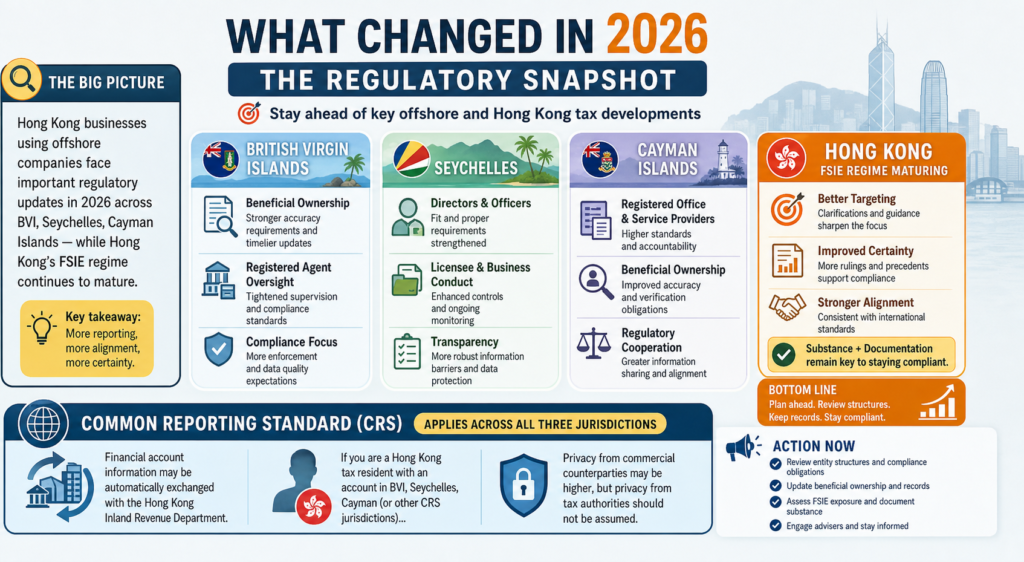
Hong Kong business owners and advisers asking what changed in offshore company regulation need to track simultaneous shifts across BVI, the Seychelles, and the Cayman Islands, while also accounting for the continued maturation of Hong Kong’s own FSIE tax framework. The timeline below provides a consolidated view of the key developments.
2023 – 2027 Regulatory Timeline
| Date | Jurisdiction | Development | Practical impact |
| 1 Jan 2023 | Hong Kong | FSIE regime takes effect | Specified foreign-sourced passive income of MNE entities received in Hong Kong may become taxable unless exemption conditions are met |
| 2023 onward | BVI | Annual financial return requirement introduced | BVI companies must provide prescribed unaudited financial information to their registered agent within the applicable deadline |
| 1 Jan 2024 | Hong Kong | FSIE scope expands to disposal gains beyond equity-interest disposal gains | Asset sales by offshore subsidiaries or offshore group companies may need FSIE analysis |
| 2 Jan 2025 | BVI | Beneficial ownership reporting threshold lowered from 25% to 10% | BVI companies must identify and report owners or controllers meeting the lower threshold |
| 1 Jan 2026 | BVI | Transition period for existing companies to update BO information under the new threshold | Non-compliant companies may face penalties and practical difficulties obtaining good standing or completing bank KYC |
| 1 Jan 2026 | Cayman | CARF and amended CRS take effect | Cayman Reporting Financial Institutions face updated due diligence, reporting and contact requirements |
| 21 Jan 2026 | Seychelles | OECD Global Forum upgrades Seychelles to “Largely Compliant” | Reputational improvement, but continued monitoring and specific recommendations remain relevant |
| Feb 2026 | Seychelles | Removed from the EU Annex II grey list | May ease compliance screening with European counterparties; limited immediate impact on HK bank acceptance |
| 2026–2027 | Cayman | New CRS/CARF timetable and local contact requirements take effect | Existing Cayman Reporting Financial Institutions must ensure their CRS status, reporting calendar and Cayman contact arrangements are updated |
| 30 Jun 2027 | Cayman | CRS reporting and CRS Compliance Form deadline for the 2026 reporting period | First reporting cycle under the new 30 June deadline |
The Common Reporting Standard (CRS) — the OECD’s multilateral framework for the automatic exchange of financial account information between tax authorities — operates across all three jurisdictions. For a Hong Kong tax resident holding or controlling an offshore company with an account at a Reporting Financial Institution in BVI, Seychelles, Cayman, or another CRS-participating jurisdiction, information may be reportable to the Hong Kong Inland Revenue Department if the CRS due-diligence rules identify Hong Kong as the relevant tax residence. Privacy from commercial counterparties may remain higher than in some onshore jurisdictions, but privacy from tax authorities should not be assumed.
BVI: The 10 Per Cent Beneficial Ownership Threshold and Controlled Access
The British Virgin Islands reduced its beneficial ownership reporting threshold from 25 per cent to 10 per cent with effect from 2 January 2025. Under the revised framework, any natural person who directly or indirectly owns or controls 10 per cent or more of the shares, voting rights, or capital of a BVI company, or who exercises ultimate effective control through board appointment rights, trust arrangements, nominee arrangements, or other means, may qualify as a reportable beneficial owner.
The use of nominee directors or nominee shareholders does not eliminate the reporting obligation. The ultimate beneficial owner behind the nominee must still be identified and disclosed to the registered agent and, where applicable, through the relevant BVI filing system.
All BVI companies must ensure their beneficial ownership information is filed or updated through the relevant BVI electronic filing framework. Entities incorporated before the new threshold took effect had a transition period to update their records. A company that fails to update its beneficial ownership information may face penalties and practical consequences, including difficulty obtaining a Certificate of Good Standing or satisfying bank and counterparty KYC requests.
A critical distinction that many service-provider websites obscure is the difference between the 10 per cent reporting threshold and any controlled-access or legitimate-interest regime for third-party access to beneficial ownership information. The 10 per cent rule concerns information that must be filed or made available to the BVI authorities. It does not mean that every 10 per cent owner becomes visible to the public or to ordinary commercial counterparties.
BVI Beneficial Ownership: Filing Threshold vs External Access
| 10% reporting threshold | Controlled-access / legitimate-interest disclosure | |
| Who must comply | BVI companies and their registered agents | External applicants seeking access under the applicable access regime |
| Direction of information flow | Company / registered agent → BVI authorities | Registrar or competent authority → approved applicant |
| Scope | Natural persons meeting the reporting threshold | Limited information, subject to statutory access conditions and safeguards |
| Trigger | Incorporation, ownership change, control change, or statutory update requirement | Request by an applicant with a qualifying purpose and supporting evidence |
| Public access? | No | No general public register; access is controlled |
| Practical example | A BVI company with five investors each holding 12% may need to report all five | Those investors would not necessarily be visible to an external applicant merely because they exceed 10% |
BVI companies are also required to prepare prescribed unaudited financial information, typically including a balance sheet and profit-and-loss statement, and submit it to their registered agent within the statutory deadline after the end of the relevant financial period. They must also complete economic substance classification and, where applicable, reporting. A company that claims it is out of scope should still document the basis for that classification.
Zero tax does not mean zero obligations, and the cumulative compliance burden for a BVI company in 2026 is materially heavier than it was five years ago.
Cayman Islands: CARF, Amended CRS and the Principal Point of Contact
The Cayman Islands brought the OECD’s Crypto-Asset Reporting Framework and amended Common Reporting Standard into effect from 1 January 2026. This is the most significant update to the Cayman automatic exchange of information framework since the islands first adopted CRS. (ditc.ky)
The most operationally significant new requirement for many Cayman Reporting Financial Institutions is the Principal Point of Contact (PPoC) obligation. A Cayman Reporting Financial Institution must designate a named individual or entity located in the Cayman Islands to serve as the primary liaison with the Department for International Tax Cooperation (DITC), the Cayman government body responsible for administering CRS, FATCA and related international tax compliance frameworks.
This requirement is relevant only if the Cayman entity is a Reporting Financial Institution for CRS purposes. Not every Cayman exempted company is a Reporting Financial Institution. A simple trading or holding company may be a non-financial entity, depending on its activities, assets, income and management arrangements. However, many Cayman funds, investment entities and professionally managed vehicles will need to analyse the PPoC requirement carefully.
A P.O. box or overseas-only correspondence arrangement is not sufficient for the Cayman local contact requirement. Existing Cayman Reporting Financial Institutions should review the deadline for updating PPoC details and confirm the current filing timetable with Cayman counsel or their service provider.
For the 2026 reporting period, Cayman CRS annual returns and CRS Compliance Forms are due by 30 June 2027, rather than the previous 31 July timetable. Public professional guidance and DITC updates confirm the move to the 30 June deadline for the 2026 reporting cycle. (mourant.com)
The standard architecture for many Hong Kong IPOs — a Cayman Exempted Company as listing vehicle, one or more BVI intermediaries, a Hong Kong operational entity, and mainland Chinese WFOEs or VIE arrangements where applicable — remains common in 2026. Founders considering an HKEX listing should plan their offshore structure with this end state in mind from the outset, because retrofitting a BVI- or Seychelles-headed structure into a Cayman top-company after the fact is possible but involves additional cost, legal complexity, and time.
For Hong Kong-connected Cayman entities, the combined effect of earlier deadlines, mandatory Cayman contact arrangements for Reporting Financial Institutions, and increased AEOI scrutiny means that passive compliance — relying on service providers to flag obligations without active internal monitoring — is no longer a viable strategy.
Seychelles: From Grey List to Largely Compliant — But With Caveats
The Seychelles achieved two significant milestones in early 2026, both of which improved its international standing but neither of which eliminated all compliance concerns. On 21 January 2026, the OECD Global Forum on Transparency and Exchange of Information for Tax Purposes published its Second Round In-Depth Review of the Seychelles, rating the country overall as “Largely Compliant.” In February 2026, the EU removed the Seychelles from Annex II of the EU list of non-cooperative jurisdictions for tax purposes. (oecd.org)
The Seychelles’ improved rating and EU grey-list removal are genuine achievements, but context is essential for Hong Kong users evaluating a Seychelles IBC. The Global Forum’s conclusion does not mean that every transparency, beneficial ownership, accounting-information, or exchange-of-information issue has disappeared. Certain areas remain subject to recommendations, continued monitoring, or practical implementation concerns.
For Hong Kong users, the practical implication is nuanced: removal from the EU grey list may ease some compliance-screening friction with European counterparties, but it does not automatically raise the Seychelles to the same tier of acceptance as BVI or Cayman among Hong Kong’s major banks. Banks conduct their own risk assessments independently of the EU list, and historical reputation carries considerable inertia.
A Seychelles IBC can still be a sensible low-cost vehicle for simple international trading, e-commerce, intellectual-property holding, or non-bank payment flows. But users should assume that Hong Kong bank onboarding will be more difficult than for a comparable BVI or Cayman vehicle, especially where the company has no audited financial statements, no clear operating history, and no demonstrable commercial substance.
How Hong Kong’s FSIE Regime Affects Your Offshore Structure
Hong Kong’s Foreign-sourced Income Exemption regime, enacted on 23 December 2022 under Ordinance No. 24 of 2022 and effective from 1 January 2023, fundamentally altered the tax calculus for Hong Kong-connected offshore structures. Under the FSIE regime, specified foreign-sourced income received in Hong Kong by an MNE entity may be deemed to arise in or be derived from Hong Kong and become chargeable to profits tax unless an exception applies. The regime initially covered foreign-sourced dividends, interest, IP income and equity-interest disposal gains, and was expanded from 1 January 2024 to cover disposal gains from other property. (ird.gov.hk)
A Hong Kong company that owns a single BVI subsidiary may already form part of an MNE group under the FSIE regime, because the group has constituent entities in more than one jurisdiction. This means the FSIE regime can apply to structures as simple as a Hong Kong parent and one offshore subsidiary — a configuration covering many Hong Kong businesses using offshore companies.
Standalone local companies with no overseas group members remain outside the MNE-group scope of the FSIE regime, although ordinary Hong Kong profits-tax source principles still apply. It is also worth noting that the FSIE regime interacts with transfer pricing rules — the arm’s-length pricing requirements under Hong Kong’s Inland Revenue Ordinance governing transactions between associated enterprises. A Hong Kong parent that pays management fees to, or receives dividends or other income from, an offshore subsidiary should ensure that intercompany transactions are properly documented and priced.
FSIE Exemption Pathways at a Glance
Three key exemption or relief pathways exist under the FSIE regime, depending on the income type.
| Economic Substance Requirement | Participation Exemption | Nexus Requirement | |
| Applies to | Interest, dividends and non-IP disposal gains | Dividends and equity-interest disposal gains | Qualifying general IP income and qualifying IP disposal gains |
| Core condition | The MNE entity conducts substantial economic activities in Hong Kong, with adequate qualified employees and adequate operating expenditure, in relation to the relevant income | The MNE entity holds at least 5% of the equity interests in the investee entity for a continuous period of at least 12 months, subject to anti-abuse rules | The exempt portion of IP income is determined by the nexus ratio, broadly linked to qualifying R&D expenditure |
| Where substance must exist | In Hong Kong, at the entity receiving the income | Not a separate substance test, but anti-abuse conditions such as the subject-to-tax rule, switch-over rule and main-purpose rule may apply | R&D activities and expenditure must satisfy the statutory nexus formula |
| Typical user | HK holding or treasury company managing offshore income with real Hong Kong activities | HK parent receiving dividends or equity disposal gains from a long-held subsidiary | HK entity earning royalties or IP disposal gains from qualifying IP |
| Advance ruling available? | Yes | Yes | Yes |
Consider a concrete scenario: a Hong Kong company (“HK Co”) wholly owns a BVI company (“BVI Hold Co”), which holds a London property. BVI Hold Co sells the property at a gain and later distributes proceeds to HK Co as a dividend.
Under the pre-2023 position, many advisers would have focused mainly on whether the dividend was foreign-sourced. Under the FSIE regime, the analysis is more complex. If the dividend is foreign-sourced and received in Hong Kong by HK Co as an MNE entity, it may be deemed chargeable to Hong Kong profits tax unless HK Co satisfies an applicable exception, such as the economic substance requirement or participation exemption. The participation exemption itself is subject to detailed conditions and anti-abuse rules, including the subject-to-tax and switch-over rules.
The practical takeaway for every Hong Kong business owner with an offshore entity is this: a zero-tax offshore company does not guarantee zero tax in Hong Kong. The total tax cost must be assessed at the group level, considering both the offshore jurisdiction’s obligations and Hong Kong’s FSIE rules. Any offshore structure connected to a Hong Kong entity should be stress-tested against the FSIE conditions before formation, not after. The Inland Revenue Department offers advance rulings on the application of the FSIE regime, and obtaining one before implementing a significant new structure may be prudent.
Choosing by Use Case: Which Jurisdiction Fits Your Business?
The optimal offshore jurisdiction for a Hong Kong business owner depends less on headline tax rates — all three jurisdictions charge little or no local corporate income tax for many ordinary offshore structures — and more on the specific commercial purpose, budget, banking requirements, investor expectations, counterparty risk tolerance, and Hong Kong tax implications.
Use Case Decision Matrix
| Use case | Recommended jurisdiction | Why | Key trade-off |
| Cross-border trading / e-commerce, limited budget, no immediate HK bank need | Seychelles IBC | Lowest cost of entry; straightforward for simple operating models; often acceptable to payment processors and EMIs | Banking friction — may need an EMI rather than a licensed HK bank; some institutional counterparties may view Seychelles sceptically |
| Holding company / asset protection / intermediate group layer | BVI Business Company | Widely accepted among HK banks, advisers and counterparties; flexible corporate law; familiar to Hong Kong practitioners | Compliance burden rising — 10% BO reporting, financial return and economic substance classification all need active management |
| IPO vehicle / fund structure / institutional financing | Cayman Exempted Company | Familiar to HKEX, VC, PE and fund investors; deep legal precedent for fund and listing structures | Cost premium — justified only when institutional-grade reputation is actively required |
| Family office / HNW wealth preservation and succession | BVI Business Company plus trust or foundation structure, depending on advice | Proven combination for asset protection and intergenerational transfer | Must manage BO reporting, CRS, estate planning, tax residency and CFC issues |
| Primarily HK / mainland China-focused business; easy banking is critical | Hong Kong limited company, with no offshore entity unless needed | Easiest bank account opening; no offshore registered agent fees; HK profits tax rates remain competitive | FSIE may reduce or eliminate the expected tax advantage of an offshore layer |
| HK-listed group or pre-IPO company needing intermediate layers | Cayman top company plus BVI middle layer plus HK / PRC operating entities where appropriate | Common listing architecture for many HKEX structures | Retrofitting a BVI- or Seychelles-headed structure into Cayman later can be costly and time-consuming |
For Hong Kong business owners whose clients, suppliers, and banking relationships are all in Hong Kong and mainland China, the last two rows of the table above deserve the most attention.
It is also worth considering whether the business needs a tax residency certificate. A Hong Kong limited company with genuine Hong Kong management and operations may be able to apply for a Hong Kong tax residency certificate where treaty benefits are relevant. By contrast, a BVI, Seychelles, or Cayman company with no substantive local management, no local tax liability, and no clear treaty objective may find tax-residence certification unavailable, impractical, or commercially less useful.
The operational simplicity of a Hong Kong limited company is a genuine competitive advantage that should not be dismissed in pursuit of a zero-tax headline.
Bank Account Opening: The Unspoken Challenge
Opening a bank account for an offshore company in Hong Kong is the single largest source of frustration reported by business owners who have recently formed BVI, Seychelles, or Cayman entities. Anti-money laundering and know-your-customer standards enforced by banks and overseen by the Hong Kong Monetary Authority have significantly raised the threshold for acceptance of offshore companies at local banks.
Hong Kong’s major banks — HSBC, Standard Chartered, Hang Seng, Bank of China (Hong Kong), and others — generally apply enhanced due diligence to offshore company account applications. Documentation commonly required includes a Certificate of Incumbency, certified copies of director and shareholder registers, beneficial ownership declarations, recent financial statements or management accounts, a detailed business model description with expected transaction types and volumes, and source of funds and source of wealth evidence.
Processing times range from several weeks to several months, and approval is not guaranteed — particularly where the bank’s internal risk-scoring model flags the applicant’s jurisdiction, industry sector, ownership structure, lack of operating history, use of nominees, or unclear commercial rationale.
Hong Kong Banking Access by Jurisdiction
| Dimension | BVI Business Company | Seychelles IBC | Cayman Exempted Company |
| Overall HK bank acceptance | Moderate-to-high — still one of the most widely accepted offshore jurisdictions among HK banks | Low-to-moderate — some banks may decline or impose enhanced requirements | High for institutional / fund use; less common for simple SME trading accounts |
| Typical rejection triggers | Complex multi-layered structures; use of nominees without clear rationale; unclear business purpose | Jurisdiction-level risk classification by some banks; lack of audited financials; vague business model | Absence of clear institutional purpose; simple trading use without counterparty evidence |
| Estimated processing time | 4 – 8 weeks | 6 – 12 weeks if accepted | 3 – 6 weeks for institutional channels; longer for non-standard applications |
| Minimum initial deposit, indicative | HKD 50,000 – 200,000 | HKD 200,000 – 500,000 where accepted | Varies by bank and relationship; often linked to AUM, fund commitments or broader banking relationship |
| EMI alternative viability | Available but less commonly needed | Often the most realistic option | Available but rarely the primary channel for institutional Cayman vehicles |
| Key limitation of EMI route | An EMI is not a licensed deposit-taking bank; funds may not be covered by a deposit protection scheme; trade finance and CNY settlement may be limited | Same limitations, and the EMI may be the only realistic option for some Seychelles IBCs | Same limitations, though institutional Cayman entities usually prefer banking channels |
For businesses whose primary banking needs are in Hong Kong, the honest assessment is that a Hong Kong limited company opens doors that no offshore entity can match. If banking access is the overriding priority, this factor alone may justify choosing a Hong Kong company over an offshore alternative — or at minimum, incorporating a Hong Kong company alongside the offshore entity to serve as the primary banking vehicle.
Frequently Asked Questions
Is offshore company formation still legal in 2026 with new tax rules?
Yes, offshore company formation remains a legal and legitimate corporate strategy in 2026 when executed with full transparency. Jurisdictions like the BVI and Seychelles have updated their laws to align with OECD international compliance standards. You must ensure your entity files its Economic Substance Notification by the January 31 deadline and maintains an accurate Significant Controllers Register (SCR) to avoid administrative penalties.
How long does it actually take to set up a BVI or Seychelles company?
Setting up a BVI or Seychelles company typically takes 1 to 3 business days for initial incorporation. We utilize digital filing portals to expedite the process; often achieving name approval within 60 minutes. Once the registrar issues the Certificate of Incorporation, we provide digital copies immediately so you can begin the bank account opening process without waiting for physical couriers.
Can I open a Hong Kong bank account for a Seychelles or BVI entity?
You can open a Hong Kong bank account for offshore entities, though traditional banks have a higher rejection rate compared to fintech alternatives. Success requires “Certified True Copies” of all corporate documents and proof of business substance. We provide complimentary referrals to EMI and fintech platforms that specialize in offshore structures, typically offering a decision within 7 to 10 business days.
What are the annual maintenance requirements for an offshore company?
Annual maintenance includes paying government renewal fees, maintaining a Registered Office Address, and filing Economic Substance reports. For example, BVI companies must file their register of members with the FSC by March 31, 2026, or face a HK$4,680 penalty. Seychelles IBCs must also lodge accounting records bi-annually with their registered agent to remain in good standing with the FSA.
What is the difference between a shelf company and a new offshore incorporation?
A shelf company is a pre-registered entity with a Certificate of Incorporation already issued; a new incorporation allows you to choose a custom name. Shelf companies are selected when you need a registration number within hours for an urgent contract. New incorporations are preferred for long-term branding and ensure a 100% clean history with no prior liabilities or appointments.
Do I need to visit the jurisdiction (e.g., BVI) to register the company?
You don’t need to visit the BVI, Seychelles, or Cayman Islands to register your company. All registration tasks are managed remotely from our Hong Kong office through authorized registrar channels. We handle the KYC verification and document filings digitally. You only need to provide certified identification and proof of address to complete the offshore company formation process from your desk.
Next Steps
Choosing between BVI, Seychelles, and the Cayman Islands in 2026 requires balancing formation costs against ongoing compliance costs, banking access against headline savings, and offshore simplicity against Hong Kong tax reality. The regulatory changes described in this guide — BVI’s 10 per cent BO threshold, Cayman’s CARF and amended CRS changes, the Seychelles’ improved but still imperfect international standing, and Hong Kong’s FSIE regime — make it clear that the decision can no longer be made on price alone.
For readers uncertain which jurisdiction is right, a structured assessment of the intended use case, budget, banking requirements, investor expectations, counterparty requirements and FSIE exposure is the logical starting point.
For those who already own an offshore company, a compliance review against the 2026 requirements is time-sensitive and should not be deferred. BVI companies should confirm beneficial ownership reporting, financial-return and economic-substance obligations. Cayman entities should confirm whether they are Reporting Financial Institutions, whether CARF or amended CRS obligations apply, and whether a Cayman-based PPoC is required. Seychelles IBCs should review accounting-record, beneficial-ownership and bankability issues in light of their intended use.
For those ready to proceed, obtaining a detailed quotation from a licensed Trust or Company Service Provider (TCSP, the regulated intermediary authorised under Hong Kong’s Anti-Money Laundering and Counter-Terrorist Financing Ordinance (AMLO) to form and administer companies on behalf of clients) will ensure the total cost and obligation profile is understood before commitment. Based on 2025–2026 market rates, initial TCSP consultation fees for a straightforward single-entity offshore structure typically range from USD 500 to USD 1,500, with the higher end reflecting structures that require FSIE impact assessment or multi-jurisdictional advice.
Why Businesses Choose easyCorp
easyCorp is a Hong Kong-based, TCSP-licensed corporate services provider headquartered in Wan Chai. Over nearly two decades, the firm has helped thousands of clients across Europe, the United States, the Middle East, Asia, and Africa set up and maintain companies in Hong Kong, the British Virgin Islands, the Seychelles, the Cayman Islands, and other major offshore jurisdictions. easyCorp was recognised by Hang Seng Bank as a “Best Business Partner” — a distinction that reflects the quality and reliability of its client referrals for business bank account opening, one of the most friction-heavy steps in the offshore company lifecycle, as this guide has documented in detail.
If you have read this guide and are ready to take the next step — whether that is forming a new BVI, Seychelles, or Cayman entity, opening a Hong Kong bank account for an existing offshore company, or reviewing your current structure against the 2026 compliance requirements — easyCorp can help.
Disclaimer
This guide is published for general informational purposes only and does not constitute legal, tax, or financial advice. The regulatory landscape for offshore companies is subject to change, and the information reflects the position as understood at the date of publication. Readers should consult a qualified legal or tax adviser — and, where applicable, a licensed TCSP under AMLO — before making decisions based on this content.
Learn more:
- IRD : Foreign-sourced Income Exemption
- CRS | OFFICIAL SITE: Department for International Tax Cooperation
- Common Reporting Standard and Economic Substance – Cayman Islands updates
- Global Forum on Transparency and Exchange of Information for Tax Purposes: Seychelles 2026 (Second Round, In-depth Review) (EN)
About easyCorp
Founded in 2009, easyCorp provides Hong Kong company incorporation, company secretary, registered address, business bank account opening referral, accounting, taxation, and business consulting services to entrepreneurs and companies from Europe, the United States, the Middle East, Asia, Africa, and other markets.
Authorship
This blog article is created by the easyCorp business team and reviewed by qualified professionals before publication. We are dedicated to sharing useful information about setting up businesses and managing taxation and compliance in Hong Kong.
Founded in 2009, easyCorp provides high-quality taxation, accounting, company secretary, and business consulting services. easyCorp differentiates itself through practical problem-solving experience and the number of real-world corporate service scenarios handled across different industries and jurisdictions.