

This guide covers a private company limited by shares, incorporated in Hong Kong and not listed on a stock exchange. Different rules can apply to public companies, companies limited by guarantee, re-domiciled companies and companies that have formally acquired dormant status.
A Hong Kong company must have a company secretary. It does not have to buy an outsourced secretarial package. The practical question for an overseas founder is whether someone inside the company qualifies and can do the work. If not, appoint an external secretary, check the provider’s legal authority and agree in writing who will handle each filing.
1. Who can act as company secretary?
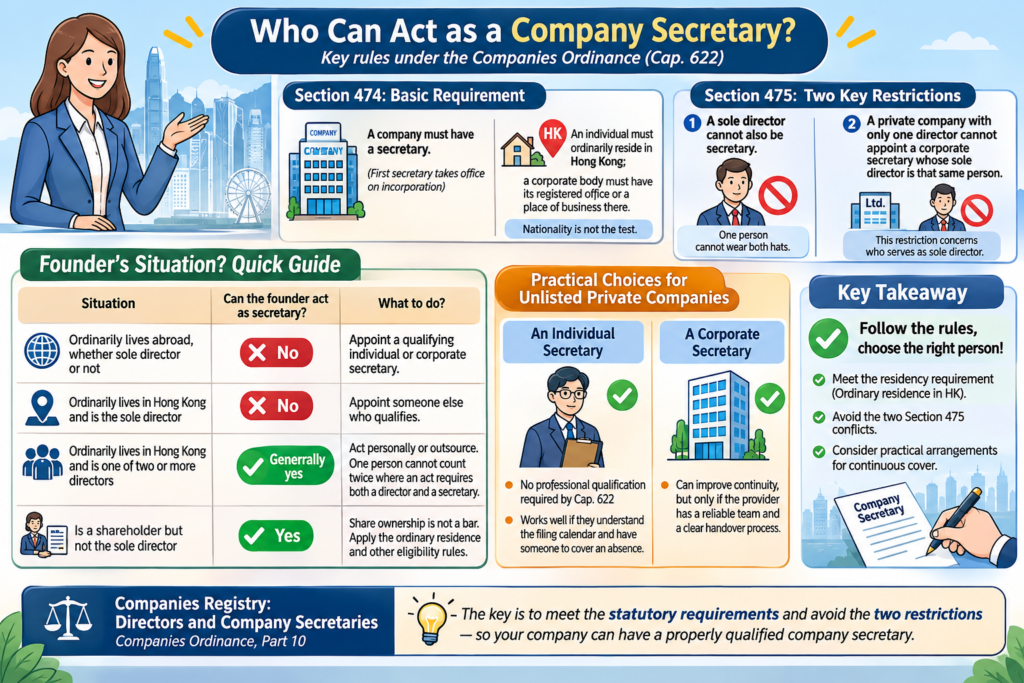
Section 474 of the Companies Ordinance (Cap. 622) requires a company to have a secretary. The first secretary takes office on incorporation. Under section 474(4), an individual must ordinarily reside in Hong Kong; a body corporate must have its registered office or a place of business there. Nationality is not the test.
Section 475 imposes two separate restrictions. A sole director cannot also be secretary of the same company. A private company with only one director also cannot appoint a corporate secretary whose sole director is that same person. The second restriction concerns who serves as sole director, not simply who owns the shares.
| Founder’s situation | Can the founder personally be secretary? | Practical choice |
| Ordinarily lives abroad, whether sole director or not | No | Appoint a qualifying individual or corporate secretary. |
| Ordinarily lives in Hong Kong and is the sole director | No | Appoint someone else who qualifies. |
| Ordinarily lives in Hong Kong and is one of two or more directors | Generally yes | Act personally or outsource. One person cannot count twice where an act requires both a director and a secretary. |
| Is a shareholder but not the sole director | Share ownership is not a bar | Apply the ordinary residence and other eligibility rules. |
For an unlisted private company, Cap. 622 does not prescribe a professional qualification for an individual secretary. An internal appointment may work well if the person understands the filing calendar and someone can cover an absence. A corporate appointment can improve continuity, but only if the provider has a reliable team and a clear handover process.
Companies Registry: directors and company secretaries · Companies Ordinance, Part 10
2. How to verify an external provider
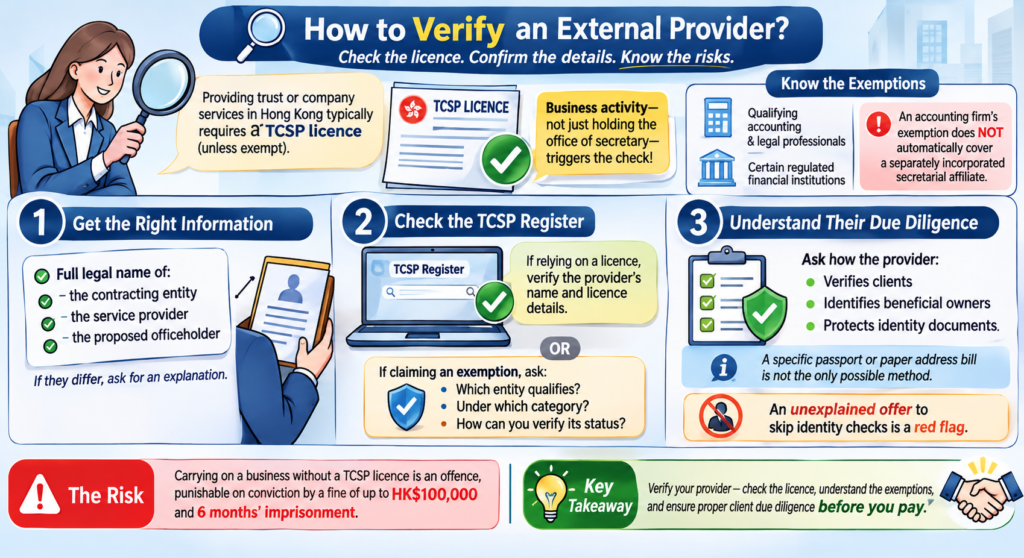
A person carrying on a trust or company service business in Hong Kong generally needs a Trust or Company Service Provider (TCSP) licence under Cap. 615 unless a statutory exemption applies. Acting as secretary for clients by way of business can fall within that regime. It is the business activity—not the mere fact of holding office as secretary—that triggers the licensing question.
Specified exemptions include qualifying accounting and legal professionals and certain regulated financial institutions. An accounting firm’s exemption does not automatically extend to a separately incorporated secretarial affiliate. Where a licence is required, carrying on the business without one is an offence punishable on conviction by a fine of up to HK$100,000 and six months’ imprisonment.
Before paying:
- Obtain the full legal names of the contracting entity, the service provider and the proposed officeholder. Ask for an explanation if they differ.
- If the provider relies on a licence, check the name and licence details in the TCSP register. If it claims an exemption, ask which entity qualifies, under which category, and how you can verify its status.
- Ask how the provider verifies clients, identifies beneficial owners and protects identity documents. A particular passport or paper address bill is not the only possible verification method. An unexplained offer to skip identity checks is a different matter.
Companies Registry: licensing requirements and exemptions
3. What the secretary handles—and what remains with the company
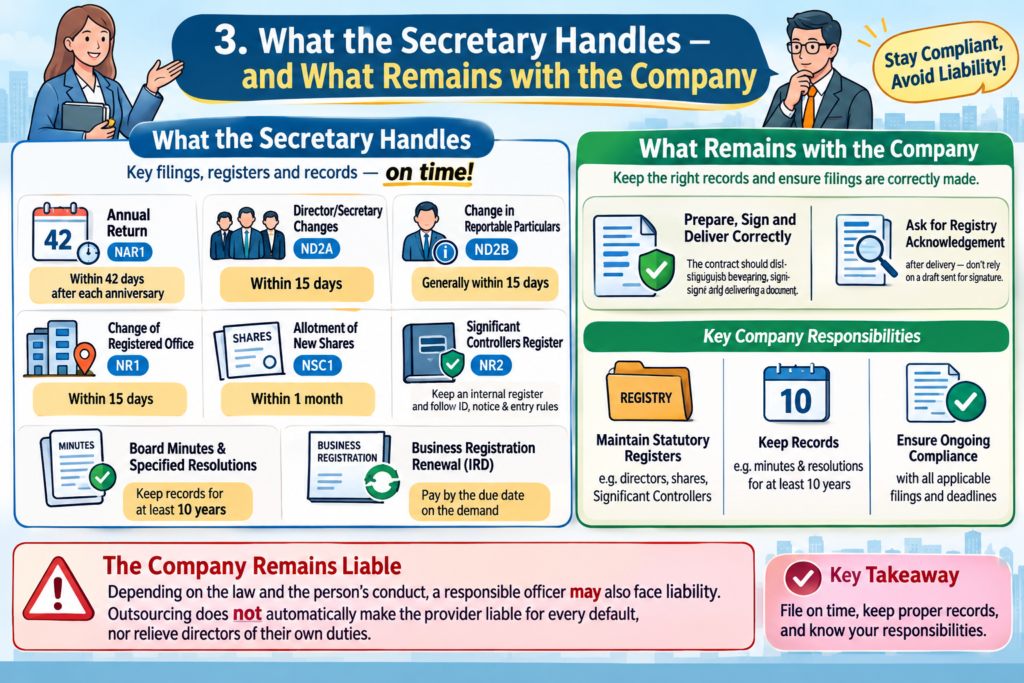
A secretarial engagement commonly covers maintaining corporate registers, preparing minutes or resolutions and coordinating Companies Registry filings. The contract should distinguish between preparing, signing and delivering a document. Ask for the Registry acknowledgement after delivery rather than treating a draft sent for signature as proof of filing.
| Event or duty | Form or record | Usual rule for a company within this guide |
| Annual return | NAR1 | Deliver within 42 days after each incorporation anniversary, starting with the first. A statutory dormant-company exemption may apply; inactivity alone is not enough. |
| Appointment or cessation of a director or secretary | ND2A | Deliver within 15 days after the appointment or cessation. |
| Change in reportable particulars of an existing director or secretary | ND2B | Generally deliver within 15 days after the change. |
| Change of registered office | NR1 | Deliver within 15 days after the change. |
| Allotment of new shares | NSC1 | Deliver within one month after allotment. A transfer of existing shares is not an allotment and follows a different process. |
| Significant Controllers Register | Internal register; NR2 may be needed for its location | Apply the identification, notice and entry rules below. Do not wait for the annual return. |
| Board minutes and specified member resolutions and meeting records | Internal records | Keep the relevant records for at least ten years. This is a retention period, not an annual filing deadline. |
| Business registration renewal | IRD renewal demand | Pay by the due date on the demand. This is separate from the NAR1 filing. |
The company remains responsible for compliance. Depending on the statutory provision and the person’s conduct, a responsible officer may also face liability. Outsourcing does not make the provider automatically liable for every default or relieve directors of their own duties.
Companies Registry: forms and fees · Annual return of a local private company
The Significant Controllers Register: when the seven-day clock starts
The SCR records significant control, not simply a list of shareholders. A person can qualify through direct or indirect ownership of more than 25% of shares or voting rights, the right to appoint or remove a majority of directors, or significant influence or control. Control through certain trusts or firms can also count. Exactly 25% does not satisfy the shareholding test by itself, but another control condition may still apply.
The company must take reasonable steps to identify its controllers and keep the register up to date:
- Registrable person: enter the required particulars within seven days after they have all been confirmed by that person.
- Registrable legal entity: enter each required particular within seven days after it comes to the company’s notice.
- Suspected change: where the company knows or has reasonable cause to believe there has been a registrable change, a separate seven-day notice obligation can arise. Confirmation is not a reason to postpone making enquiries.
Keep the SCR at the registered office or another permitted place in Hong Kong. Its contents are not routinely filed with the Registry. If it is kept elsewhere or its location changes, check whether Form NR2 must be delivered within 15 days. Appoint at least one eligible designated representative to assist law enforcement officers. Failure to keep the register can attract a fine of up to HK$25,000 and a further HK$700 for each day of a continuing offence.
Companies Registry: detailed SCR guideline · SCR quick guide
Secretary, accountant, auditor and directors: where the work divides
The secretary records decisions; the directors make them. Directors remain responsible for proper accounting records and financial statements even when an accountant prepares them. A statutory audit, where required, must be performed by an eligible auditor. A secretarial appointment alone does not qualify the provider to carry out that audit.
A profits tax return is a separate IRD obligation. Use a signatory permitted by the applicable return and filing procedure; it is inaccurate to say that only a director can sign. A secretary does not become personally responsible for the company’s tax bill merely by taking office, but may have separate obligations or liability for their own conduct.
A private company generally has nine months after the end of its accounting reference period to hold its AGM where one is required. Special rules apply to a long first accounting reference period. Single-member companies and companies that validly dispense with an AGM may not need a meeting. No AGM does not by itself mean no accounts, audit or documents for members.
Companies Ordinance, particularly sections 610–613 · IRD: profits tax
4. What does a Hong Kong company secretary cost in 2026?
There is no statutory tariff for outsourced company secretarial work. To compare two quotations, ask both providers to price the same scenario: one full year as named secretary, one NAR1, a registered office if needed, one director change and a transfer-out at year end. This reveals costs that a base annual fee can hide.
Keep government charges separate from the provider’s fees.
| Item | Amount or basis |
| Incorporation of a local company limited by shares | HK$1,545 electronically; HK$1,720 on paper, excluding business registration. |
| Business registration | Use the applicable row in the IRD fee and levy table. Check whether the quote assumes a one- or three-year certificate. |
| Annual return | HK$105 if delivered on time for a local private company with share capital. This is the Registry charge, not the provider’s preparation fee. |
| Named secretary, registered office, mail handling and event filings | Commercial charges. Ask which items are included, what triggers an extra charge and what renewal will cost. |
| Accounting, audit and tax | Separate work unless expressly included. Do not assume these costs start only in year two. |
Worked budget example: Where the applicable one-year business registration charge is HK$2,350, electronic incorporation plus that certificate totals HK$3,895 before professional fees. A later year with a HK$2,350 renewal and an on-time HK$105 annual return totals HK$2,455 before professional fees. Where the applicable three-year certificate costs HK$6,170, it is HK$880 less than three payments at the unchanged HK$2,350 rate. That comparison is not a prediction of future renewal rates.
For a new local company using the one-stop incorporation service, the amount payable for its first business registration certificate is determined by the incorporation application’s submission date; the certificate starts on incorporation. For a renewal, use the renewal certificate’s commencement date. This distinction matters when an application straddles a fee change.
Companies Registry: forms and fees · IRD: business registration charging basis
Six questions to ask before signing
- Which legal entity will be appointed, and what is its licence number or exemption basis?
- Does the price cover preparation and delivery of the NAR1, the HK$105 government fee, register maintenance and annual resolutions?
- Are the registered office, mail scanning and urgent forwarding included? Who monitors official mail?
- What would one director change, one share allotment and one share transfer each cost?
- What is the renewal price, is advance payment required, and who pays a higher registration fee if the provider misses an agreed filing?
- If we leave, what notice, handover fee and delivery time apply? In what format will we receive the registers and filing history?
5. Annual return deadlines and higher registration fees
For an ordinary non-dormant private company incorporated in Hong Kong on 10 March 2026, the first return date is 10 March 2027 and the NAR1 is due by 21 April 2027. It must reach the Registry; posting it on the last day is not enough. The Registrar cannot extend the statutory filing period or waive the prescribed higher registration fee.
| When the Registry receives the NAR1, measured from the return date | Registration fee |
| Within 42 days | HK$105 |
| After 42 days but within 3 months | HK$870 |
| After 3 months but within 6 months | HK$1,740 |
| After 6 months but within 9 months | HK$2,610 |
| After 9 months | HK$3,480 |
For the example above, delivery on 22 April 2027 already falls in the HK$870 band. There is no second 42-day grace period. The higher fee is distinct from prosecution: failure to file can also expose the company and responsible persons to a maximum fine of HK$50,000 for each breach and HK$1,000 per day for a continuing offence. Late filing does not itself automatically dissolve the company.
Keep three dates separate in the compliance calendar:
- Companies Registry: the NAR1 deadline is calculated from the incorporation anniversary.
- Business registration: use the payment due date on the IRD renewal demand. Follow up with the IRD if the expected demand does not arrive.
- Profits tax: a new company’s first return is commonly issued around 18 months after incorporation or commencement of business. That is an approximate issue date, not the filing deadline. Follow the return and any valid extension, and check whether an obligation to notify chargeability arises earlier.
The calendar starts at incorporation, not at the first anniversary. A director appointed the following week or shares allotted the following month may require a filing long before the first NAR1.
Companies Registry: private-company annual returns · Official fee bands
6. Remote incorporation and banking
An overseas founder can generally incorporate a Hong Kong private company without travelling to Hong Kong. The company needs at least one member, at least one natural-person director, a qualifying secretary and a registered office in Hong Kong. The same person may be the sole member and sole director, but not also the secretary. A serviced office can work if it provides a valid physical address for official communications; a P.O. box alone is not enough.
Distinguish Registry processing time from end-to-end provider time. An uncomplicated electronic application may be processed quickly after submission. Identity verification, document preparation, signatures and corrections can take longer. Ask when an advertised “one-day” service starts and whether it promises submission or actual incorporation.
Bank approval is separate. A bank may request identity documents, ownership charts, incorporation records, business evidence and an explanation of the source of funds. Its requirements depend on the institution and the case. Do not assume every bank requires the full SCR, accepts the same owner threshold or will open an account after a referral. A useful secretarial provider can reconcile the company’s registers with its filings before the application; it cannot guarantee the bank’s decision.
7. How to switch company secretaries
- Check the existing engagement. Identify the notice period, final charges, records held, registered-office arrangements and outstanding deadlines.
- Verify the incoming secretary. Confirm eligibility, complete onboarding and agree the effective date. Coordinate the outgoing cessation and incoming appointment to avoid a vacancy. The 15-day filing period is not permission to leave the office vacant for 15 days.
- Document the decisions and file the right notices. Record the appointment and cessation in accordance with the articles and deliver ND2A within 15 days of the relevant event. File NR1 if the registered office changes. Separately check NR2 if the location of statutory records changes.
- Obtain and reconcile the records. Collect the statutory registers, SCR, minutes, resolutions, filing acknowledgements and other company records held by the outgoing provider. Include the common seal if the company has one. Confirm who will receive mail sent to the old address.
- Verify the handover. Ask for evidence that the change was delivered and give the incoming secretary the next filing dates. Do not assume either provider has taken responsibility for an imminent NAR1 unless one confirms it in writing.
Companies Registry: changes of directors and secretaries · SCR record-location guidance
How easyCorp support company secretarial services in Hong Kong?
For an incorporation or transfer quote, it’s suggested to ask easyCorp to identify the contracting entity and proposed secretary, provide verifiable licensing or exemption details, and separate government charges, first-year service fees, renewal fees and event-based charges. If the quotation includes expedited service or bank introductions, ask for the start point, conditions and exclusions in writing.
The most useful comparison is not “Which package is cheapest?” It is: “Who is responsible for my next filing, what evidence will I receive that it was delivered, and what will the whole year cost?”
This guide provides general information, not legal or tax advice. Use the current Companies Registry forms and the IRD fee table for the dates relevant to your company.
About easyCorp
Founded in 2009, easyCorp provides Hong Kong company incorporation, company secretary, registered address, business bank account opening referral, accounting, taxation, and business consulting services to entrepreneurs and companies from Europe, the United States, the Middle East, Asia, Africa, and other markets.
Authorship
This blog article is created by the easyCorp business team and reviewed by qualified professionals before publication. We are dedicated to sharing useful information about setting up businesses and managing taxation and compliance in Hong Kong.
Founded in 2009, easyCorp provides high-quality taxation, accounting, company secretary, and business consulting services. easyCorp differentiates itself through practical problem-solving experience and the number of real-world corporate service scenarios handled across different industries and jurisdictions.