
Deregistration under sections 750–751 of the Companies Ordinance (Cap. 622) is the statutory mechanism designed for your situation: a solvent private company that has ceased business. It is simpler, faster, and far cheaper than formal liquidation. But it only works if you satisfy every eligibility condition before you apply.
Company Deregistration: Choosing the Right Closure Route
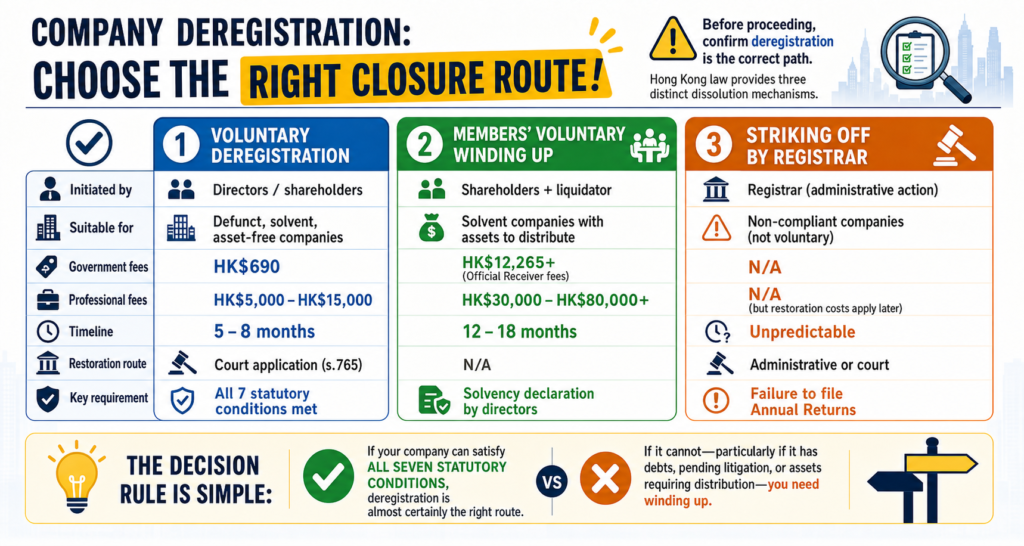
Before proceeding, confirm deregistration is the correct path. Hong Kong law provides three distinct dissolution mechanisms:
| Voluntary Deregistration | Members’ Voluntary Winding Up | Striking Off by Registrar | |
| Initiated by | Directors/shareholders | Shareholders + liquidator | Registrar (administrative action) |
| Suitable for | Defunct, solvent, asset-free companies | Solvent companies with assets to distribute | Non-compliant companies (not voluntary) |
| Government fees | HK$690 | HK$12,265+ (Official Receiver fees) | N/A |
| Professional fees | HK$5,000–HK$15,000 | HK$30,000–HK$80,000+ | N/A (but restoration costs apply later) |
| Timeline | 5–8 months | 12–18 months | Unpredictable |
| Restoration route | Court application (s.765) | N/A | Administrative or court |
| Key requirement | All 7 statutory conditions met | Solvency declaration by directors | Failure to file Annual Returns |
The decision rule is straightforward: if your company can satisfy all seven statutory conditions below, deregistration is almost certainly the right route. If it cannot—particularly if it has debts, pending litigation, or assets requiring distribution—you need winding up.
The Seven Statutory Conditions (Section 750(2))
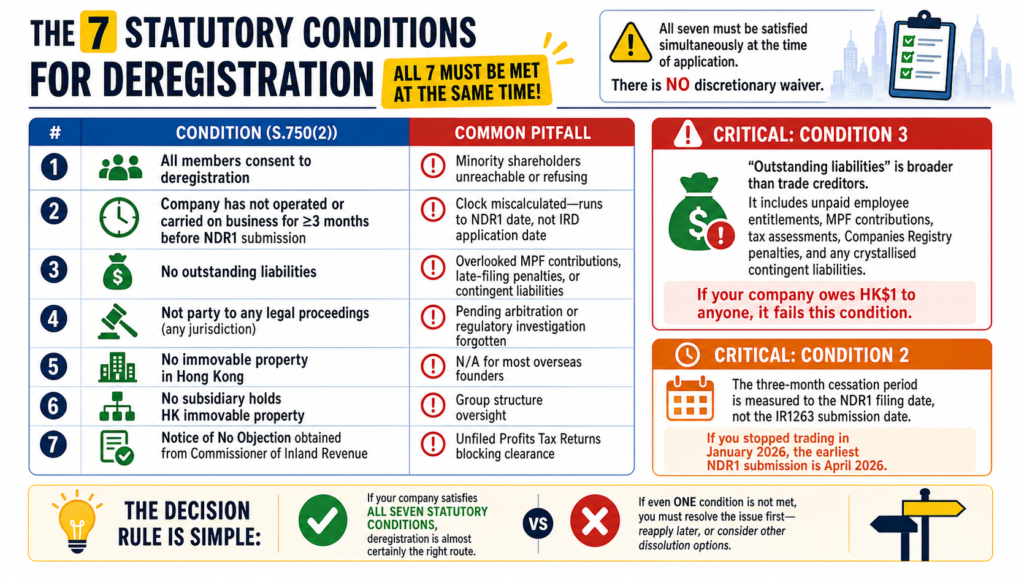
All seven must be satisfied simultaneously at the time of application. There is no discretionary waiver.
| # | Condition | Common Pitfall |
| 1 | All members consent to deregistration | Minority shareholders unreachable or refusing |
| 2 | Company has not operated or carried on business for ≥3 months before NDR1 submission | Clock miscalculated—runs to NDR1 date, not IRD application date |
| 3 | No outstanding liabilities | Overlooked MPF contributions, late-filing penalties, or contingent liabilities |
| 4 | Not party to any legal proceedings (any jurisdiction) | Pending arbitration or regulatory investigation forgotten |
| 5 | No immovable property in Hong Kong | N/A for most overseas founders |
| 6 | No subsidiary holds HK immovable property | Group structure oversight |
| 7 | Notice of No Objection obtained from Commissioner of Inland Revenue | Unfiled Profits Tax Returns blocking clearance |
Critical note on Condition 3: “Outstanding liabilities” is broader than trade creditors. It includes unpaid employee entitlements, MPF contributions, tax assessments, Companies Registry penalties, and any crystallised contingent liabilities. If your company owes HK$1 to anyone, it fails this condition.
Critical note on Condition 2: The three-month cessation period is measured to the NDR1 filing date, not the IR1263 submission date. If you stopped trading in January 2026, the earliest NDR1 submission is April 2026.
The Deregistration Process: Three Steps
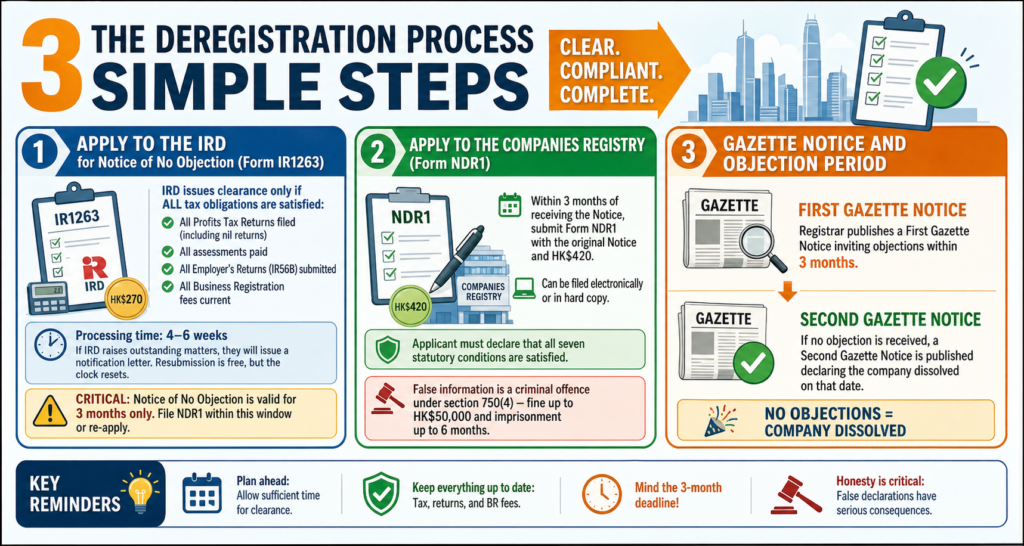
Step 1: Apply to the IRD for Notice of No Objection (Form IR1263)
Submit Form IR1263 to the Commissioner of Inland Revenue with HK$270. The IRD will only issue clearance if every tax obligation is satisfied:
All Profits Tax Returns filed (including nil returns for dormant years), all assessments paid, all Employer’s Returns (IR56B) submitted, and all Business Registration fees current. For companies that traded, this means preparing audited financial statements—a statutory requirement under Cap. 622.
Processing time: 4–6 weeks if tax affairs are clear. If the IRD identifies outstanding matters, it issues a notification letter specifying what must be resolved. No additional fee on resubmission, but the clock resets.
Critical deadline: The Notice of No Objection is valid for three months only. You must file NDR1 within this window or re-apply.
Step 2: Apply to the Companies Registry (Form NDR1)
Within three months of receiving the Notice, submit Form NDR1 with the original Notice and HK$420 to the Registrar of Companies. The form can be filed electronically or in hard copy.
The applicant must declare that all seven statutory conditions are satisfied. Providing false information is a criminal offence under section 750(4)—fine up to HK$50,000 and imprisonment up to 6 months.
Step 3: Gazette Notice and Objection Period
The Registrar publishes a First Gazette Notice inviting objections within three months. If no objection is received, a Second Gazette Notice is published declaring the company dissolved on that date.
Timeline and Cost Summary
| Phase | Duration | Cost |
| Pre-application preparation (tax clearance, asset disposal, bank closure) | 1–3 months | Professional fees vary |
| IRD Notice of No Objection | 4–6 weeks | HK$270 |
| NDR1 filing + Gazette objection period | 3–4 months | HK$420 |
| Total | 5–8 months | HK$690 (govt fees only) |
If your company has unfiled Profits Tax Returns, add time and cost for preparing backdated accounts and audited financial statements. Total professional management fees (inclusive of final accounts, government fees, and service charges) typically range from HK$8,000 to HK$20,000.
The Bona Vacantia Trap: Don’t Skip This
Upon dissolution, any property remaining in the company’s name—bank balances, intellectual property, domain names, receivables, equipment—vests automatically in the Hong Kong Government as ownerless property. This happens by operation of law the instant dissolution takes effect.
Before filing NDR1, you must:
Close all bank accounts and transfer funds to shareholders. Assign or transfer intellectual property and domain names. Collect all outstanding receivables. Cancel remaining contracts and subscriptions. Dispose of physical assets.
Do not leave even a nominal balance in the company’s bank account. Recovering bona vacantia assets requires a court application for restoration under section 765—costing HK$50,000+ in legal fees and taking months. This is the single most expensive mistake founders make.
Five Mistakes That Block or Derail Deregistration
| # | Mistake | Consequence | Prevention |
| 1 | Applying before all Profits Tax Returns are filed | IRD refuses Notice of No Objection | File all returns (including nil) before submitting IR1263 |
| 2 | Leaving money in the company bank account | Funds become Government property permanently | Close account and withdraw all funds before NDR1 |
| 3 | Missing the 3-month Notice validity window | Must re-apply to IRD (HK$270 + 4–6 weeks delay) | File NDR1 promptly upon receiving Notice |
| 4 | Failing to file Annual Returns during processing | Prosecution + escalating penalties | Continue all filings until dissolution is gazetted |
| 5 | Not notifying Business Registration Office of cessation | Criminal offence (HK$5,000 fine + up to 1 year imprisonment) | Submit written cessation notice within 1 month of stopping business |
Special Considerations for Overseas Directors
Physical presence is not required for the application itself—IR1263 can be posted and NDR1 filed electronically. However, bank account closure often requires in-person attendance or notarised instructions.
Ongoing obligations during processing: A Hong Kong company secretary must remain in place until dissolution. Annual Returns falling due during the Gazette period must still be filed. The registered office must be maintained.
Time zone risk: The three-month Notice validity window is strict. Postal delays between Hong Kong and your jurisdiction can consume weeks. Build in buffer time or appoint a local representative who can respond promptly to government queries.
Post-Dissolution Obligations
Dissolution does not end all responsibilities. Under section 751(5), the liability of former directors, managers, and members survives deregistration. Business records must be retained for seven years per section 51C of the Inland Revenue Ordinance. Any interested party can apply for court restoration within 20 years of dissolution.
When to Seek Professional Help
If your company never commenced business and all filings are current, you may manage deregistration yourself. If your company traded, has multiple years of unfiled returns, or any complexity in its affairs, professional assistance is strongly advisable—particularly for preparing backdated accounts to achieve IRD clearance, managing the sequencing of bank closure relative to application timing, and maintaining compliance during the processing period.
The economics are clear: professional management costs HK$8,000–HK$20,000, roughly equivalent to one year of maintaining a dormant company. Every year you delay adds another HK$5,000–HK$10,000 in unavoidable compliance costs.
Frequently Asked Questions
Can I deregister a company that has never traded?
Yes—and it is typically faster and cheaper because you may not need audited financial statements. If the company never commenced business, it satisfies Condition 2 automatically. You still need IRD clearance, but the process is simpler since there are no trading transactions to account for. Most “shelf companies” or dormant holding companies that never invoiced a client fall into this category.
How long does the entire process take from start to finish?
Expect 5–8 months from the point where all preparation is complete. The main variables are IRD processing time (4–6 weeks) and the mandatory 3-month Gazette objection period. If you have backdated compliance work—unfiled returns, unprepared accounts—add 1–3 months of preparation time. The total elapsed time from decision to dissolution is therefore typically 6–11 months.
What happens if someone objects during the Gazette period?
If a creditor, former employee, government body, or other interested party lodges an objection and the Registrar considers it valid, the deregistration will not proceed. You would then need to resolve the underlying issue (e.g., pay the creditor) and re-apply from scratch. This is why settling all liabilities before applying is essential—not just a formality.
Can I restore a deregistered company if I need it later?
Yes, but only through a court application under section 765 of the Companies Ordinance. This requires filing an application with the Court of First Instance, demonstrating legitimate grounds for restoration, and paying substantial legal costs (typically HK$30,000–HK$80,000). Applications can be made within 20 years of dissolution. This is not a simple administrative process—it requires legal representation.
Do I need to be in Hong Kong to complete deregistration?
No. The entire application process can be managed remotely—IR1263 by post, NDR1 electronically. However, certain practical steps may require local assistance: bank account closure (some banks require in-person instructions), receiving government correspondence promptly, and responding to IRD queries within stipulated timeframes. Most overseas founders appoint a Hong Kong-based corporate services firm to act as their local coordinator.
What if I simply stop paying fees and let the company be struck off?
This is not recommended. Administrative striking off by the Registrar occurs on the Registrar’s timeline (not yours), during which penalties and prosecution risk accumulate. Directors who fail to file Annual Returns face personal fines of up to HK$50,000. The company accumulates late filing penalties. The IRD may issue estimated assessments creating artificial tax liabilities. And assets in the company still become bona vacantia upon striking off—with the same loss risk as deregistration, but without the orderly preparation period.
Is the HK$690 government fee the only cost?
It is the only mandatory government fee, but the true cost depends on your company’s situation. If accounts need preparation, expect HK$3,000–HK$10,000 in accounting fees per year of unfiled returns. If Annual Returns are overdue, late filing penalties range from HK$870 to HK$3,480 per return. Professional service fees for managing the process end-to-end typically add HK$5,000–HK$15,000. For a company with clean records and no outstanding compliance, total all-in cost can be as low as HK$3,000–HK$5,000.
Why easyCorp for Your Deregistration
Deregistration is procedurally straightforward on paper—but the gap between theory and execution is where companies stall. A missed IRD query letter, a bank account that won’t close remotely, a forgotten MPF obligation from three years ago—these are the friction points that turn a five-month process into a twelve-month headache.
17 years of accumulated case experience. Founded in 2009, easyCorp has navigated every iteration of Hong Kong’s deregistration regime across economic cycles, policy changes, and the 2014 Companies Ordinance overhaul. The volume of non-standard scenarios we have resolved—estimated assessments, cross-border shareholder consents, multi-entity group dissolutions—is unmatched by other market participants. This depth of pattern recognition means we anticipate problems before they block your application.
Recognised by Hong Kong’s banking sector. easyCorp was awarded “Best Business Partner” by Hang Seng Bank, one of Hong Kong’s largest financial institutions. This recognition reflects the rigour of our compliance processes and the trust placed in our work by institutions with the highest due diligence standards.
Built for overseas founders. With clients across Europe, the United States, the Middle East, Asia, and Africa, our operational model is designed for cross-timezone coordination. We manage local logistics—government correspondence, bank liaison, Companies Registry filings—so you don’t need to be in Hong Kong at any stage.
24-hour response guarantee. Every email and every call receives a substantive reply within 24 hours. When you are working against a three-month Notice validity window from eight time zones away, response speed is not a courtesy—it is a critical path item.
Your interest is our interest. We treat every client as a business partner. A fast, clean deregistration saves you money and protects your directorship record. That outcome is also our best referral—which is why our incentives are fully aligned with yours.
| What you need | What easyCorp delivers |
| All tax filings prepared and submitted | In-house taxation team handles backdated Profits Tax Returns, nil returns, and Employer’s Returns |
| IRD clearance obtained efficiently | Direct experience with IRD query resolution; we know what triggers delays |
| Bank account closed without flying to HK | Liaison with major banks on remote closure procedures and documentation |
| Company secretary maintained until dissolution | Continuous statutory company secretary service included |
| Full compliance during Gazette period | Annual Returns filed, registered office maintained, BRN kept current |
| Single point of contact across the process | Dedicated case manager, 24-hour response, bilingual (English/Chinese) communication |
About easyCorp
Founded in 2009, easyCorp provides Hong Kong company incorporation, company secretary, registered address, business bank account opening referral, accounting, taxation, and business consulting services to entrepreneurs and companies from Europe, the United States, the Middle East, Asia, Africa, and other markets.
Contact us now for more details about company deregistration:
https://www.easycorp.com.hk/en/deregistration
Authorship
This blog article is created by the easyCorp business team and reviewed by qualified professionals before publication. We are dedicated to sharing useful information about setting up businesses and managing taxation and compliance in Hong Kong.
Founded in 2009, easyCorp provides high-quality taxation, accounting, company secretary, and business consulting services. easyCorp differentiates itself through practical problem-solving experience and the number of real-world corporate service scenarios handled across different industries and jurisdictions.