
This guide is general information, not tax advice. It focuses on Hong Kong-incorporated private companies. A foreign company operating through a Hong Kong branch can have different company-law and filing obligations.
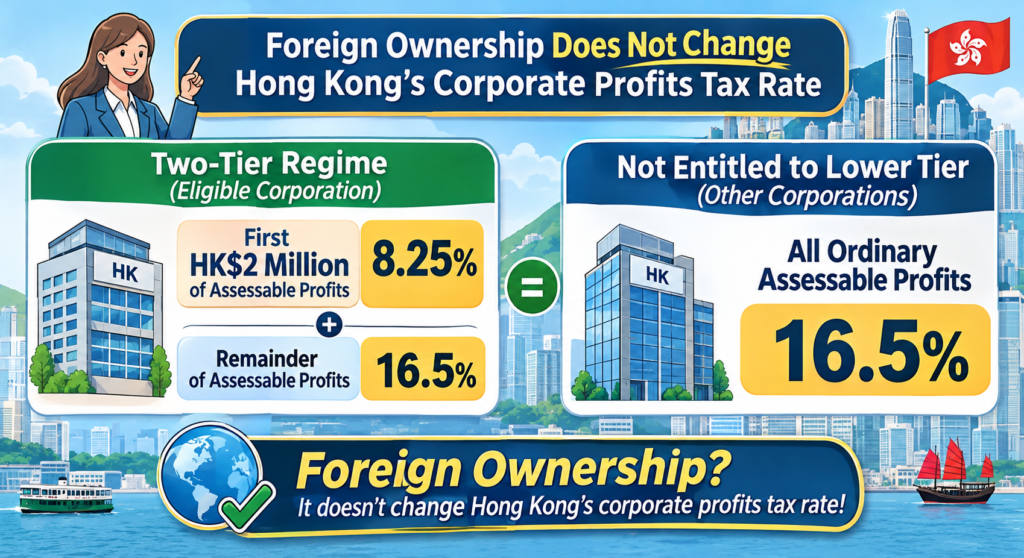
Foreign ownership does not change Hong Kong’s ordinary corporate profits tax rate. For 2026/27, a corporation eligible for the two-tier regime pays 8.25% on its first HK$2 million of assessable profits and 16.5% on the balance. A corporation not entitled to the lower tier generally pays 16.5% on all its ordinary assessable profits.
Do foreign-owned companies pay a different tax rate?
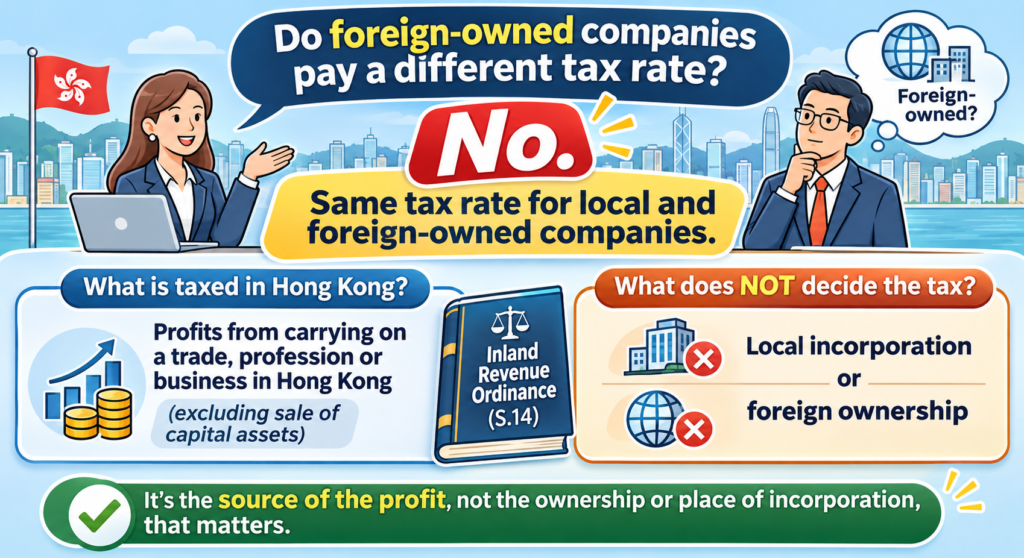
No. Section 14 of the Inland Revenue Ordinance generally charges a person carrying on a trade, profession or business in Hong Kong on profits arising in or derived from Hong Kong from that business, excluding profits from the sale of capital assets. Other provisions can deem particular receipts taxable. Neither local incorporation nor foreign ownership, by itself, determines the source of a profit.
Hong Kong tax and home-country tax are separate questions.
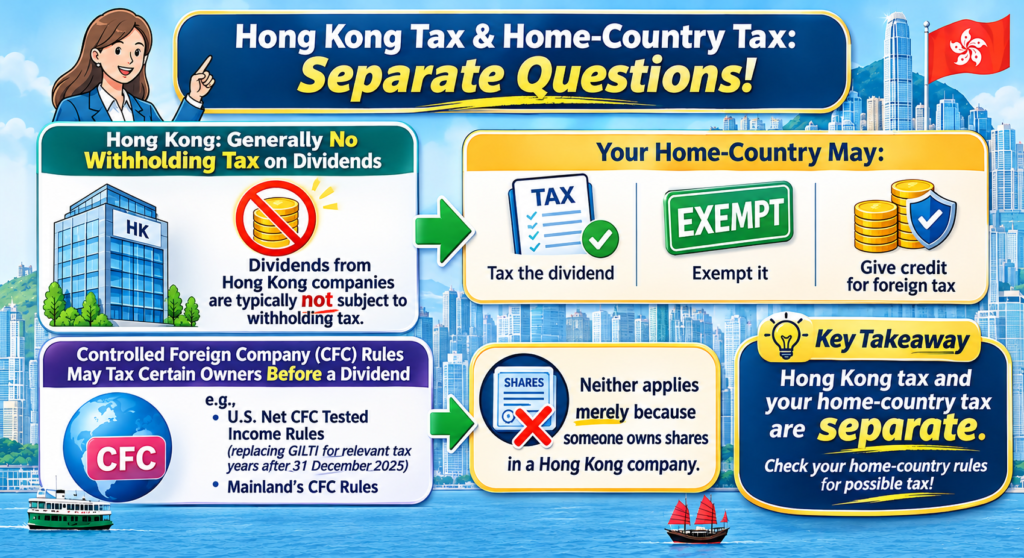
Hong Kong generally imposes no withholding tax on dividends paid to shareholders. The shareholder’s jurisdiction may tax the dividend, exempt it or give credit for foreign tax. Controlled foreign company rules can also tax certain owners before a dividend is paid. Examples include US net CFC tested income rules, which replaced GILTI for relevant tax years beginning after 31 December 2025, and the Mainland’s CFC rules. Neither applies merely because someone owns shares in a Hong Kong company.
Managing a Hong Kong company from another country can also create corporate residence, a permanent establishment, payroll obligations or filing duties there. For treaty purposes, check the residence definition and any dual-residence provision in the particular treaty; a Hong Kong certificate of residence does not decide every other condition for relief.
Hong Kong profits tax rates for 2026/27
The 2026/27 year of assessment runs from 1 April 2026 to 31 March 2027. That does not mean every company calculates tax on accounts for those exact dates. For an established business, the basis period is generally the accounting period ending in the year of assessment.
| Business type eligible for two-tier rates | First HK$2 million of assessable profits | Balance |
| Corporation | 8.25% | 16.5% |
| Unincorporated business | 7.5% | 15% |
Assessable profits are profits computed under tax law, not necessarily the profit shown in the financial statements. The following examples assume an eligible corporation, ordinary assessable profits and no credits or one-off reductions.
| Assessable profits | Calculation | Profits tax | Effective rate |
| HK$2,000,000 | HK$2m × 8.25% | HK$165,000 | 8.25% |
| HK$3,000,000 | HK$165,000 + HK$1m × 16.5% | HK$330,000 | 11.00% |
| HK$10,000,000 | HK$165,000 + HK$8m × 16.5% | HK$1,485,000 | 14.85% |
Connected entities: only one lower band
Where entities are connected, generally only one may elect to use the two-tier rates for a given year. Common control can connect two companies even if neither owns shares in the other. Certain concessionary tax regimes also restrict eligibility.
For example, a single eligible company with HK$4 million of assessable profits pays HK$495,000. If two connected corporations each earn HK$2 million and only Company A uses the lower tier, A pays HK$165,000 and B pays HK$330,000. The combined bill is still HK$495,000. See the IRD’s corporate return instructions.
Tax losses
Ordinary trading losses can generally be carried forward without a fixed expiry and used against the same company’s future assessable profits, subject to the applicable rules. Hong Kong has no general loss carry-back or group loss relief. A foreign parent therefore cannot simply transfer one Hong Kong subsidiary’s loss to another profitable subsidiary.
Territorial taxation: when is profit offshore?
The starting point is the operations test: what did the taxpayer do to earn the particular profit, and where did it do those things? Identify the operations that actually produced the profit, not merely where the company was incorporated, where the customer lives or where the money arrived. The IRD explains its approach in DIPN 21: Locality of Profits.
| Income | What to examine |
| Trading profits | Where and how the purchase and sale contracts were effected, including negotiation, conclusion and execution. The place of signature is evidence, not a stand-alone test. |
| Service fees | Where the services that earned the fee were performed. If substantial services were performed both inside and outside Hong Kong, consider whether a supported apportionment is appropriate. |
| Interest | For a simple loan, where credit was made available to the borrower. A financing or money-lending business may require a wider examination of the operations that earned the interest. |
For example, goods can move directly from a Mainland supplier to a European customer without entering Hong Kong, yet the trader’s profit can still be Hong Kong-sourced if its Hong Kong team negotiated and effected both sides of the deal. Conversely, a Hong Kong bank account does not by itself make foreign trading profits taxable.
What evidence supports an offshore position?
Show who performed each material operation, where they were and what they did. Link purchase orders, correspondence, contract versions, approvals, travel records, invoices and shipping documents to representative transactions. A passport stamp may show that a director travelled; it does not establish that the director negotiated the sale during that trip.
Report the offshore position in the profits tax filing and retain the supporting analysis. The IRD may ask for transaction records and explanations. On appeal, the taxpayer bears the burden of showing that the assessment is excessive or incorrect. Even where the source is outside Hong Kong, run a separate FSIE check if the receipt is of a specified type and the company is in scope.
Dividends, capital gains, withholding tax and sales taxes
| Item | General Hong Kong treatment |
| Ordinary dividend paid to a foreign shareholder | No Hong Kong dividend withholding tax. The shareholder’s own tax position is separate. |
| Dividend received from a corporation chargeable to Hong Kong profits tax | Generally excluded from the recipient’s assessable profits. Foreign dividends require a separate FSIE check where relevant. |
| Ordinary interest paid to a foreign lender | No general interest withholding tax. This does not settle the lender’s own profits tax position or the borrower’s interest deduction. |
| Gain on disposal of an investment | No general capital gains tax. Whether an asset was held as an investment or for trade depends on the facts, not just how long it was held. Specific charging rules, including FSIE, can apply. |
| Sales of goods and services | No Hong Kong VAT or GST. This does not remove stamp duty, excise duties or destination-country VAT obligations where applicable. |
Selling shares: what the 15% / 24-month rule actually covers
Hong Kong’s tax certainty enhancement scheme provides an elective route for treating eligible onshore equity disposal gains as capital. It applies to qualifying disposals on or after 1 January 2024, with gains accruing in a basis period for a year of assessment beginning on or after 1 April 2023.
The ordinary holding test is at least 15% of the investee’s equity interests for a continuous 24 months immediately before disposal, subject to the scheme’s detailed rules. Exclusions include trading stock and certain interests in property-related entities. Missing the threshold does not automatically make the gain taxable: the ordinary capital-versus-revenue analysis may still produce a capital result. Conversely, passing the threshold does not exempt a foreign-sourced gain under FSIE.
Royalties paid to non-residents
Hong Kong can tax specified payments to a non-resident for the use of IP in Hong Kong. Certain payments for use outside Hong Kong can also be caught where deductible in computing Hong Kong assessable profits. The payer may have to retain sufficient money to cover the non-resident’s Hong Kong tax.
For a corporate recipient, if 30% of the gross royalty is deemed assessable and the ordinary 16.5% rate applies, the tax is 4.95% of the gross royalty. Where the statutory association and prior-ownership conditions are met, 100% rather than 30% may be deemed assessable. Two-tier eligibility or treaty relief may also change the result. Do not deduct 4.95% from every overseas licence payment by default. First identify the rights licensed, where they are used and which statutory or treaty provision applies. See the IRD’s profits tax guidance.
Double tax agreements and the Mainland–Hong Kong Arrangement
Hong Kong signed its 61st comprehensive double taxation agreement, with Laos, on 29 October 2026, its sixth signing that year. The IRD’s treaty register lists the Laos agreement’s entry into force and effective date as pending. For any treaty claim, check the effective date for the relevant tax and payment, not merely the signature date. IRD signing announcement
Payments from a Mainland company to a Hong Kong company
The table gives common Mainland enterprise income tax outcomes for ordinary payments to a non-resident enterprise. It does not cover VAT, all domestic exemptions or income effectively connected with a Mainland establishment.
| Payment | Common Mainland domestic rate | Arrangement limit, if eligible |
| Dividend to a Hong Kong resident company directly holding at least 25% of the payer’s capital | 10% | 5% |
| Other ordinary dividend | 10% | 10% |
| Ordinary interest | 10% | Generally 7%; specified exemptions may apply |
| Ordinary royalty | 10% | Generally 7%; 5% for qualifying aircraft or ship leasing royalties |
For the 5% dividend rate, verify direct ownership, the applicable Mainland holding-period requirements, Hong Kong treaty residence, beneficial ownership and anti-abuse rules. Keep ownership records covering the relevant 12-month period. A Certificate of Resident Status supports residence; it does not establish beneficial ownership. Equally, renting an office or hiring one employee does not by itself turn a conduit into the beneficial owner.
Payment direction matters. The 5% example concerns a Mainland subsidiary paying its Hong Kong shareholder. It is not a 5% Hong Kong withholding tax on a Hong Kong subsidiary paying its Mainland parent. See the IRD’s Arrangement guidance and Fourth Protocol summary.
Rules for multinational businesses: FSIE and Pillar Two
FSIE: when foreign income is received in Hong Kong
The foreign-sourced income exemption regime applies to specified foreign-sourced income accruing to an MNE entity carrying on a trade, profession or business in Hong Kong and received in Hong Kong, subject to statutory exclusions and exceptions. There is no group revenue threshold. A foreign permanent establishment can bring a single legal entity within the multinational definition.
“Received in Hong Kong” is broader than a bank transfer. It can include applying the income to satisfy a debt incurred for a Hong Kong business, or using it to buy movable property subsequently brought into Hong Kong. Establish the accrual date, the receipt event and the income type separately.
| Foreign-sourced income | Relevant exception |
| Interest | Economic substance |
| Dividends | Economic substance or participation |
| Equity interest disposal gains | Economic substance or participation |
| Other non-IP disposal gains, within the expanded regime from 1 January 2024 | Economic substance |
| IP income and IP disposal gains | Nexus requirement; exemption is limited to qualifying IP and the qualifying R&D fraction |
Interest, dividends, IP income and equity interest disposal gains came within the regime from 1 January 2023; coverage of disposal gains expanded from 1 January 2024. Certain income is excluded, and qualifying intra-group asset transfers may obtain deferral rather than permanent exemption.
- Economic substance: A non-pure equity-holding entity generally needs adequate qualified employees and operating expenditure in Hong Kong for the relevant activities. A pure equity-holding entity faces a reduced test covering registration and filing obligations and adequate human resources and premises for holding and managing its equity participations. Properly monitored outsourcing in Hong Kong can qualify; there is no universal minimum headcount.
- Participation: The recipient generally must be a Hong Kong resident, or a non-resident with a Hong Kong permanent establishment to which the income is attributable. It must continuously hold at least 5% of the investee’s equity interests for at least 12 months immediately before accrual. Even then, subject-to-tax, anti-hybrid and main-purpose rules may limit relief. For example, the switch-over rule can replace exemption with a tax credit where the applicable foreign-tax condition is not met.
- Nexus: Relief is linked to qualifying R&D expenditure on qualifying IP, such as patents or copyrighted software. A trademark royalty does not qualify merely because the group employs researchers in Hong Kong.
Assess the relevant conditions for the period in which the income accrues. If the income is taxable when received in Hong Kong, check foreign tax credit relief separately. The IRD’s FSIE examples illustrate the distinction.
Pillar Two: the 15% global minimum tax
For fiscal years beginning on or after 1 January 2025, the ordinary scope test is consolidated group revenue of at least €750 million in at least two of the four immediately preceding fiscal years. Special rules apply to situations such as newly formed groups, mergers and short fiscal years.
Hong Kong’s Income Inclusion Rule can charge a qualifying Hong Kong parent in respect of low-taxed group entities. The Hong Kong Minimum Top-up Tax gives Hong Kong the first claim on qualifying top-up tax on low-taxed Hong Kong profits. The calculation generally combines relevant entities by jurisdiction and uses adjusted income and covered taxes under the GloBE rules. It is not simply 15% of each subsidiary’s accounting profit less its Hong Kong tax bill. Safe harbours, exclusions and the substance-based income exclusion can affect whether any top-up is payable.
In-scope businesses should also calendar separate notification and top-up return obligations. From 2025/26, specified entities must file their ordinary profits tax returns electronically, with supporting documents in the prescribed format. See the IRD’s Pillar Two guidance and electronic filing requirements.
Pricing between a Hong Kong subsidiary and its foreign parent is a separate matter, governed by Hong Kong’s transfer pricing rules (Part 8AA of the Inland Revenue Ordinance). Our [Hong Kong transfer pricing guide] covers those rules.
Annual tax and compliance obligations
The following calendar is for a Hong Kong-incorporated private company. Tax returns, company annual returns and business registration renewals are three separate obligations.
| Obligation | Timing or action |
| Business records | Generally retain sufficient business records for at least seven years after the transactions concerned. |
| Accounts and audit | Prepare annual financial statements and arrange an audit by an auditor eligible to act in Hong Kong, unless a statutory exemption applies. Small size or no revenue does not by itself remove the audit requirement. |
| First profits tax return | The IRD normally issues the first return about 18 months after incorporation or commencement of business. Follow the deadline on the notice. |
| Subsequent profits tax returns | Annual bulk issue is normally in April. File when a return is issued, generally within one month unless an extension applies. If no return is issued but the company is chargeable, it generally must notify the IRD in writing within four months after the end of the relevant basis period. |
| Provisional profits tax | Check the assessment and instalment dates. Provisional tax paid is credited towards the final liability for the relevant year. |
| Annual return, Form NAR1 | An ordinary local private company files within 42 days after its incorporation anniversary. The on-time registration fee is HK$105. Late fees rise in stages to HK$3,480 when delivery is more than nine months after the return date, not nine months after the filing deadline. |
| Business registration renewal | For certificates commencing from 1 April 2026 to 31 March 2027, the fee including levy is HK$2,350 for one year or HK$6,170 for three years. Use the certificate commencement date to select the applicable fee. |
| Significant Controllers Register | An applicable company keeps the register up to date at its registered office or another permitted place in Hong Kong and appoints a designated representative. Significant control includes tests other than ownership of more than 25% of shares. |
| Company secretary and registered office | Maintain a Hong Kong registered office. An individual secretary must ordinarily reside in Hong Kong; a corporate secretary must have its registered office or a place of business in Hong Kong. A sole director cannot also act as the company secretary. |
Official references: Companies Registry annual returns, business registration fee and levy table and corporate profits tax return instructions.
Provisional tax: why the first demand may cover two years
Assume a company has HK$1 million of first-year assessable profits, qualifies for the lower tier, has paid no provisional tax, and is assessed on the same HK$1 million for the following year. Before any one-off relief, its demand could show:
| Assessment item | Amount |
| First-year final profits tax: HK$1m × 8.25% | HK$82,500 |
| Following year’s provisional profits tax | HK$82,500 |
| Total before relief | HK$165,000 |
If the first year is 2025/26, the enacted one-off reduction is 100% of that year’s final profits tax, capped at HK$3,000 per business. The example becomes HK$79,500 final tax + HK$82,500 provisional tax = HK$162,000. The legislation was gazetted on 22 May 2026. The reduction does not reduce the provisional tax charge. IRD: 2026–27 Budget tax measures
This is a cash-flow illustration, not a rule that every new company owes twice its annual tax at once. Follow the instalment dates on the demand. If profits have fallen materially, check whether the statutory grounds and deadline for holding over provisional tax are met.
Our [Hong Kong company setup cost guide] breaks down the full first-year budget.
FAQ: Hong Kong corporate tax for foreign owners
Does opening a Hong Kong bank account make my company’s profits taxable?
Not by itself. For ordinary trading or service profits, identify where the operations that earned the profit took place. For an MNE entity receiving specified foreign income, however, payment into a Hong Kong account can satisfy the receipt condition under FSIE. A receipt can therefore be foreign-sourced and taxable in Hong Kong.
Can a foreigner own 100% of a Hong Kong company and run it remotely?
Generally, yes. An ordinary private company does not need a local shareholder or resident director. It must have at least one natural-person director, a qualifying company secretary and a Hong Kong registered office. Managing it abroad can create tax or registration obligations where the management is exercised.
Does a dormant company need to file tax returns?
Yes, if the IRD issues a return. Having no sales, making a loss and being legally dormant are different situations. An eligible private company obtains formal dormant status by passing a special resolution and delivering it to the Companies Registry; the effective date cannot precede delivery. A qualifying dormant company can benefit from specified accounting, audit and annual-return exemptions, but dormancy does not cancel an IRD filing notice.
Are director’s fees taxable for a non-resident director?
They can be. For fees earned as a director, the starting point is the location of the office of director, generally where the company is centrally managed and controlled. Fees from a Hong Kong office of director are generally within Hong Kong salaries tax even if the director lives abroad or attends meetings remotely. Pay for separate employment duties needs its own analysis, as does any applicable treaty.
What happens if a company fails to file a profits tax return?
The IRD may issue an estimated assessment and may prosecute failure to file without reasonable excuse under section 80(2) of the Inland Revenue Ordinance. Additional tax under section 82A can be imposed in applicable cases, up to three times the tax undercharged or that would have been undercharged. The maximum is not an automatic late-filing charge. An estimated assessment does not remove the need to file; check the objection deadline promptly.
Is a Hong Kong company suitable for Amazon or Shopify sellers?
It can be, but the platform does not determine the tax outcome. Map who selects suppliers, negotiates purchases, sets sales terms and fulfils orders, and where those activities take place. Separately check destination-country VAT, GST or sales tax, warehouse-related obligations and marketplace collection rules. Hong Kong’s lack of VAT does not make overseas sales tax-free.
How easyCorp Helps Foreign Owners Stay Tax-Compliant in Hong Kong
easyCorp Limited is a Hong Kong corporate services provider for foreign entrepreneurs, SMEs and offshore company owners. It holds a trust or company service provider (TCSP) licence, which the Companies Registry requires for anyone who provides company formation and secretarial services. easyCorp covers each annual obligation of a Hong Kong company, from incorporation and company secretary services to bookkeeping, statutory audit coordination, the NAR1 annual return and Profits Tax Return filing.
| If you are… | Where easyCorp starts |
| A foreign founder or SME owner | 1-day express incorporation, company secretary and registered address |
| A mainland Chinese business expanding overseas | Holding structure, economic substance review, Taxpayer Identification Number (TIN) support, bank account referral |
| An online seller or digital nomad | Tax and accounting review before set-up, virtual office |
| An owner of a BVI or other offshore company | New Hong Kong company, or moving the existing company’s legal home to Hong Kong under Hong Kong’s company re-domiciliation regime; offshore deregistration |
About easyCorp
Founded in 2009, easyCorp provides Hong Kong company incorporation, company secretary, registered address, business bank account opening referral, accounting, taxation, and business consulting services to entrepreneurs and companies from Europe, the United States, the Middle East, Asia, Africa, and other markets.
Authorship
This blog article is created by the easyCorp business team and reviewed by qualified professionals before publication. We are dedicated to sharing useful information about setting up businesses and managing taxation and compliance in Hong Kong.
Founded in 2009, easyCorp provides high-quality taxation, accounting, company secretary, and business consulting services. easyCorp differentiates itself through practical problem-solving experience and the number of real-world corporate service scenarios handled across different industries and jurisdictions.