
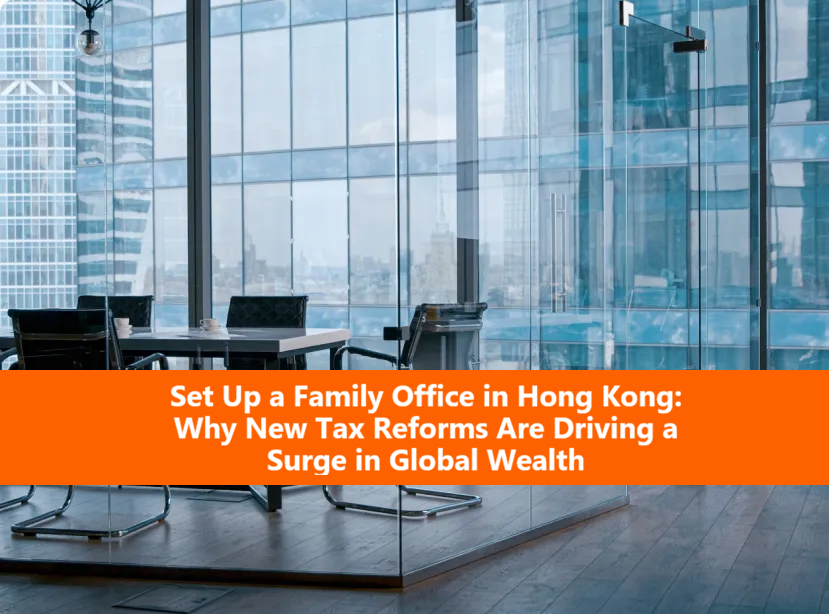
Hong Kong is rapidly reasserting itself as one of the world’s most attractive destinations for ultra-high-net-worth individuals (UHNWIs) and global families seeking to establish a family office. With major tax reforms set to take effect in 2026, growing clarity around incentives, and strong government backing, the city is entering a new phase as a premier hub for wealth management and legacy planning.
According to government-linked projections, the number of family offices in Hong Kong could rise from around 2,900 today to as many as 3,500 by 2028, driven by favorable tax policies, immigration-linked investment schemes, and expanding fund eligibility rules.
For families evaluating whether to set up a family office in Hong Kong, the current policy window presents both opportunity and urgency.
Why Hong Kong Is Doubling Down on Family Offices

Hong Kong’s strategy is clear: attract long-term, sophisticated capital by offering tax certainty, operational efficiency, and access to Asia’s deepest capital markets.
In his 2025 Policy Address, Chief Executive John Lee confirmed that the government is amending the tax regime to:
- Broaden the range of funds eligible for tax incentives
- Attract hedge funds, private credit funds, and hybrid strategies
- Encourage family offices to anchor operations in Hong Kong rather than competing jurisdictions
This policy direction is not theoretical. By September 2025, over 200 family offices had already been established with support from Invest Hong Kong, surpassing targets set just three years earlier. Importantly, this figure excludes family offices established independently, meaning the true number is significantly higher.
Key Tax Reforms That Matter When Setting Up a Family Office in Hong Kong
1. Broader Fund Eligibility for Tax Incentives

One of the most impactful changes is the expansion of qualifying fund types under Hong Kong’s tax exemption regime. Newly eligible structures include:
- Pension funds
- Endowment funds
- Private credit funds
- Hybrid and multi-asset funds
- Virtual asset–related funds
Why this matters:
Many modern family offices no longer operate as passive investment vehicles. They run complex portfolios spanning credit, alternatives, and digital assets. The updated framework better reflects how family capital is actually deployed today.
2. Removal of the “Incidental Income” Constraint on Bond Interest

Under previous rules, interest income from bonds was classified as “incidental income.” If this income exceeded a prescribed threshold, a fund risked losing its tax-exempt status.
The reform removes this restriction.
Impact on family offices:
- Credit-focused strategies become more viable
- Fixed-income and private credit allocations can scale efficiently
- Hybrid portfolios no longer face artificial tax disqualification
This change is particularly attractive to family offices seeking stable yield alongside growth.
3. Elimination of Mandatory HKMA Certification
Previously, fund structures often required certification from the Hong Kong Monetary Authority (HKMA), increasing compliance costs and time-to-launch.
With certification requirements removed:
- Application timelines are shortened
- Legal and administrative costs fall
- Smaller internal teams can manage compliance more effectively
For families setting up a family office in Hong Kong, this significantly lowers the barrier to entry.
Family Office Growth in Hong Kong: The Numbers Behind the Momentum
The policy push is translating into measurable capital inflows:
- Assets under private banking and wealth management linked to family offices reached USD 1.5 trillion by end-2024
- This represents an 88% increase since 2017
- Net inflows, which declined between 2021 and 2023, rebounded strongly in 2024
In parallel, Hong Kong’s Capital Investment Entrant Scheme (CIES)—which links residency to asset commitments—has already secured USD 10.5 billion in financial asset commitments and is projected to grow to USD 27 billion.
Key insight:
Immigration policy is acting as a powerful catalyst for family office formation, not merely a talent attraction tool.
Why High-Net-Worth Families Are Acting Now
One of the most important behavioral shifts highlighted in the article is timing.
As policy timelines become clearer, wealthy families are no longer waiting on the sidelines. Instead:
- Investment decisions are being accelerated
- Capital is deployed earlier to secure eligibility
- Families are structuring assets in advance of legislation taking effect
As one analyst put it:
“Wait and see becomes act-now.”
For families considering whether to set up a family office in Hong Kong, delaying decisions could mean missing early-mover advantages or facing tighter competition for talent and service providers.
Hong Kong vs Singapore: Choosing the Right Family Office Hub
No discussion of family offices in Asia is complete without comparing Hong Kong and Singapore.
Hong Kong’s Strengths
- Broader fund eligibility under tax incentive schemes
- Deep and liquid capital markets
- Direct access to China and North Asia
- Strong government signaling and momentum
Singapore’s Strengths
- Lower operating thresholds
- Lighter, self-administered reporting frameworks
- Lower minimum spending requirements for incentives
Hong Kong requires:
- At least two qualified employees
- USD 2 million in annual operating expenditure—almost double Singapore’s threshold
What this means for families:
Hong Kong is particularly well-suited for large, institutional-grade family offices, while Singapore may appeal more to leaner or early-stage setups.
Increasingly, many UHNW families are adopting a dual-hub strategy, using Hong Kong for investment execution and China exposure, and Singapore for regional diversification.
Structural Considerations When Setting Up a Family Office in Hong Kong
While reforms are broadly positive, families should be aware of potential constraints:
1. The 95% De Minimis Rule
This rule may complicate co-investment and syndication structures, particularly for families investing alongside third parties.
2. Reporting and Compliance Obligations
As eligibility expands, tax reporting requirements may increase. Compared with Singapore’s self-administered regime, Hong Kong’s framework is more formalized.
3. Scale Bias
Smaller family offices may struggle to meet staffing and spending thresholds, reinforcing a bias toward larger, more professionalized structures.
Operational Impact on the Financial Ecosystem
Efficiency improvements—such as tighter settlement and reconciliation timelines—may have unintended consequences:
- Increased intraday liquidity requirements
- Higher operational costs for global funds
- Pressure on smaller brokers and custodians
For family offices with complex trading or multi-custodian setups, operational readiness will be essential.
Who Benefits Most From Hong Kong’s Family Office Reforms?
Based on the reforms and market response, the biggest beneficiaries are:
- Ultra-high-net-worth families with institutional investment strategies
- Family offices allocating to private credit and alternatives
- Families seeking residency or visa benefits alongside investment returns
- Multi-generational offices focused on legacy and governance
Smaller, lightly staffed family offices may still find Singapore or hybrid structures more efficient.
The Long-Term Outlook for Family Offices in Hong Kong
Hong Kong’s advantage is not static—it is dynamic.
The city’s ability to remain competitive will depend on:
- Continuous refinement of tax rules
- Balancing compliance with flexibility
- Expanding product depth and market infrastructure
- Maintaining alignment between immigration, tax, and capital policies
As one industry observer noted, many global families operate in multiple jurisdictions. Hong Kong must continue fine-tuning its framework to remain indispensable rather than optional.
Final Thoughts: Is Now the Right Time to Set Up a Family Office in Hong Kong?
For families with sufficient scale, sophisticated investment needs, and a long-term Asia strategy, the answer is increasingly yes.
Hong Kong’s upcoming tax reforms, combined with strong government backing and deep capital markets, make it one of the most compelling family office destinations globally. However, success depends on early planning, proper structuring, and understanding both the benefits and obligations of the evolving regime.
Conclusion:
Hong Kong is not simply attracting family offices—it is reshaping how global family capital is structured, deployed, and anchored in Asia.
About easyCorp:
Founded in 2007, we were awarded as the “Best Business Partner” by HANG SENG Bank; our customers spread throughout Europe, the United States, the Middle East, Asia, Africa and etc.
Contact us now for more details: https://www.easycorp.com.hk/en/incorporations