
A Hong Kong private company usually has two separate annual obligations: prepare financial statements and have them audited under the Companies Ordinance, and respond to any Profits Tax Return issued by the Inland Revenue Department (IRD). No revenue does not necessarily mean no audit. No tax payable does not mean an issued return can be ignored.
For a corporation with gross income during the basis period, form BIR51 generally requires the applicable supporting documents, including financial statements, an auditor’s report where required, and a tax computation. The old concession allowing small corporations to omit supporting documents solely because of their size no longer applies. BIR51 and its filing instructions
1. How bookkeeping, audit and tax filing fit together?
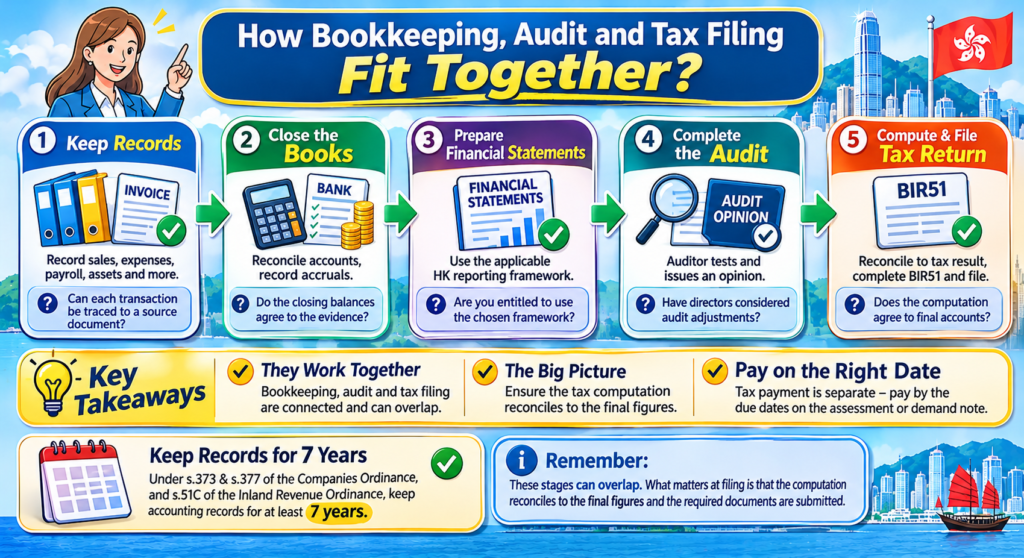
| Stage | What the company does | What to check before moving on |
| Keep records | Record sales, expenses, payroll, assets, financing and related-party transactions. Retain invoices, contracts and statements for all bank and payment accounts. | Can each material balance and transaction be traced to a source document? |
| Close the books | Reconcile bank accounts, review receivables and payables, record accruals, and agree director and group balances. | Do the closing balances agree to the evidence, including balances in foreign currencies? |
| Prepare financial statements | Management prepares statements using the applicable Hong Kong financial reporting framework. | Is the company entitled to use the framework selected, including any simplified reporting provisions? |
| Complete the audit | The independent auditor tests the statements and issues an opinion. The directors approve the financial statements. | Have the directors considered the audit adjustments and approved the final figures? |
| Compute and file | Reconcile accounting profit or loss to the tax result, complete BIR51 and submit the required documents by the applicable deadline. | Does the computation agree to the final accounts? Is there evidence that the return was validly submitted? |
These stages can overlap. An auditor can plan work before the books are closed, and a tax computation can be drafted before the audit is signed. What matters at filing is that the computation reconciles to the final figures and that the company submits the documents required for its case. Payment is a separate step: pay by the dates on the assessment or demand note, not by assuming tax is due on the BIR51 filing date.
Under sections 373 and 377 of the Companies Ordinance, a company must keep accounting records and preserve them for seven years after the end of the financial year to which the last entry or matter recorded relates. Section 51C of the Inland Revenue Ordinance separately requires sufficient business records, generally for at least seven years after the relevant transactions, acts or operations.
2. Does the company need an audit, and what must it file?
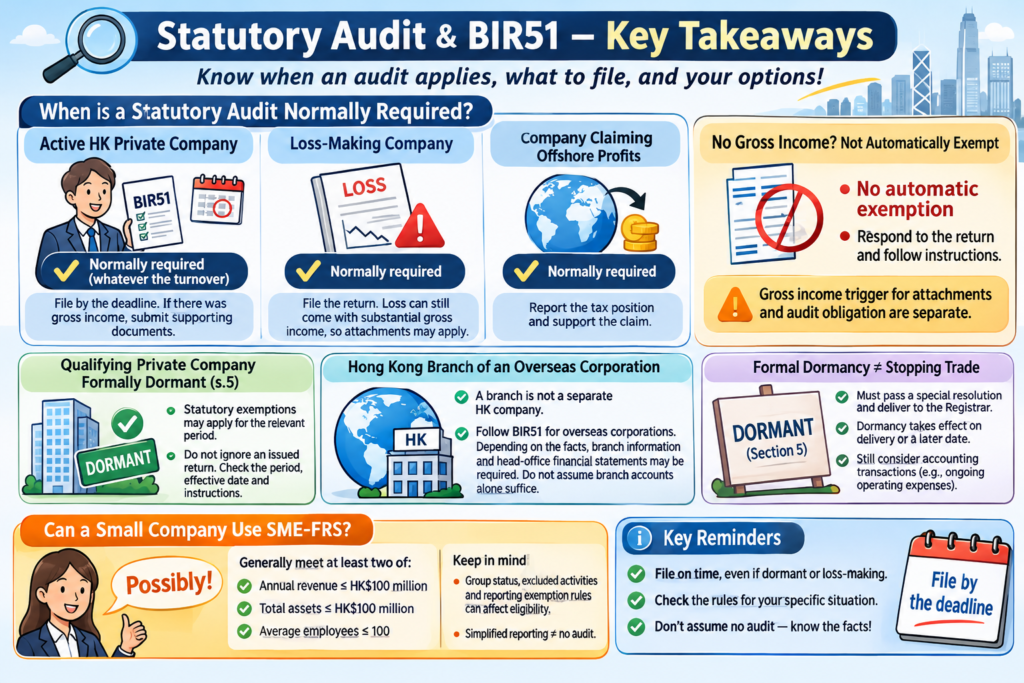
| Situation | Statutory audit | If the IRD issues BIR51 |
| Active Hong Kong private company | Normally required, regardless of turnover | File by the applicable deadline. If there was gross income, submit the required supporting documents. |
| Loss-making company | Normally required | File the return. A company can have substantial gross income despite making a loss, so the supporting-document requirement can still apply. |
| Company claiming offshore profits | Normally required | Report the tax position and support the claim. Offshore revenue is not the same as no gross income. |
| Company with no gross income that is not formally dormant | No automatic audit exemption | Respond to the return and follow its instructions. The general gross-income trigger for attachments and the statutory audit obligation are separate. |
| Qualifying private company formally dormant under section 5 | Statutory exemptions can apply for the relevant period | Do not ignore an issued return. Check the period covered, the effective date of dormancy and the instructions on the return. |
| Hong Kong branch of an overseas corporation | A branch is not a separate Hong Kong-incorporated company. Consider the overseas company’s own audit and filing obligations. | Follow the BIR51 rules for overseas corporations. Depending on the facts, branch information and head-office financial statements or audit documents may be required. Do not assume branch accounts alone suffice. |
Formal dormancy is not the same as stopping trade. An eligible private company must pass the required special resolution and deliver it to the Registrar of Companies. Dormancy takes effect on delivery or on a later date specified in the resolution. The statutory test concerns accounting transactions, subject to defined exclusions. For example, a company with no sales but continuing ordinary operating expenses should not assume it is dormant. Earlier reporting periods must be considered separately. Companies Ordinance, sections 5 and 447
Can a small company use SME-FRS?
Possibly. Under the small-private-company size test, the company generally must meet at least two of these three limits:
| Criterion | Limit |
| Annual revenue | HK$100 million or less |
| Total assets | HK$100 million or less |
| Average number of employees | 100 or fewer |
These figures are a starting point, not the whole test. Group status, excluded activities and the rules for entering or leaving the reporting exemption can affect eligibility. A separate unanimous written agreement route may be available to certain private companies that are not part of a group. Simplified reporting reduces reporting requirements; it does not dispense with the audit. Companies Ordinance, section 359 and Schedule 3
3. When is the 2025/26 Profits Tax Return due?
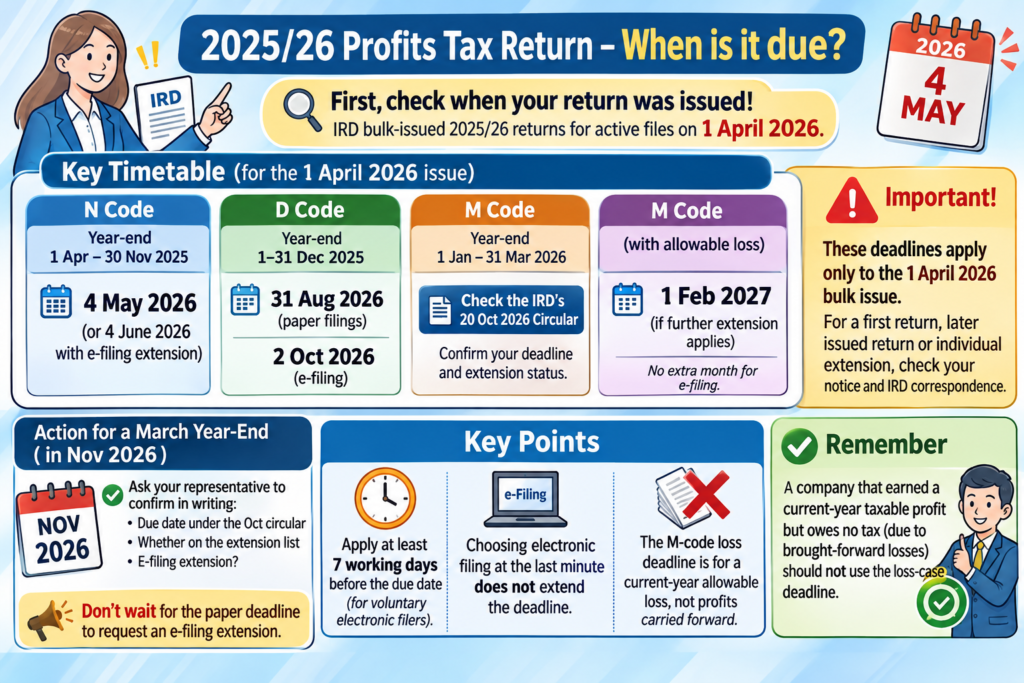
First check when the return was issued. The IRD bulk-issued 2025/26 returns for active files on 1 April 2026. The following timetable concerns that issue; it is not a universal schedule for every company with the same year-end. For a first return, a later-issued return or a company with an individual extension, check the notice and the IRD’s correspondence.
| Case | Applicable timetable |
| Bulk-issued return without an applicable extension | The ordinary filing date was 4 May 2026. |
| N code: year-end 1 April–30 November 2025 | No ordinary block extension: 4 May 2026, or 4 June 2026 where the additional electronic-filing extension applied. |
| D code: year-end 1–31 December 2025 | For covered cases, the IRD extended paper filing to 31 August 2026 and the applicable electronic deadline to 2 October 2026. |
| M code: year-end 1 January–31 March 2026, not covered by the current-year loss extension | Use the IRD’s 20 October 2026 “Extended Due Date for ‘M’ Code Returns” circular, rather than the November and December dates in the original April timetable. Confirm the deadline for the intended filing method and the company’s extension status. |
| M code: qualifying current-year allowable loss | Under the published block scheme, 1 February 2027 where the required further extension applies. Electronic filing does not add another month to that loss-case deadline. |
Action for a March year-end company in November 2026: Ask the representative to confirm in writing the due date under the October circular, whether the company is on the relevant extension list, and whether an electronic-filing extension applies. Do not wait for the paper deadline to request an electronic extension. For professionally represented voluntary electronic filers, the normal application must be made at least seven working days before the return would otherwise be due. Choosing electronic filing at the last minute does not itself extend the deadline.
The special M-code loss deadline concerns an allowable tax loss for 2025/26. A company that earned a current-year taxable profit but owes no tax because it used losses brought forward should not use the loss-case deadline on that basis.
Sources: IRD original block-extension circular · IRD D-code amendment · IRD Tax Representatives’ Corner — current M- and D-code circulars · KPMG explanation of original filing dates.
First returns and companies that have not received a return
A newly incorporated company commonly receives its first Profits Tax Return about 18 months after incorporation. A first return generally allows three months for filing; use the date on the actual notice rather than applying the bulk-issue timetable.
A company that is chargeable to tax and has not been required to file for that year should also check its duty under section 51(2) to notify the IRD in writing, generally within four months after the end of the relevant basis period. Waiting for a first return is not a substitute for notifying chargeability. Inland Revenue Ordinance, section 51
Is electronic filing mandatory?
For 2025/26, the first phase of mandatory electronic profits tax filing applies to specified persons under section 51AAB and Schedule 65 of the Inland Revenue Ordinance. This principally concerns relevant Part 4AA entities of multinational groups within the global minimum tax rules. The EUR750 million threshold is a group consolidated revenue test under those rules, not a test of the Hong Kong company’s own annual turnover.
A mandatory filer generally must file fully electronically; semi-electronic filing is not an alternative. Check the IRD’s rules for the particular return and the required format of supporting documents, including iXBRL tagging where applicable. An obligation to e-file and entitlement to an automatic filing extension are separate questions. Other eligible taxpayers may choose electronic filing. IRD BIR51 instructions · EY 2025/26 electronic-filing guidance
4. What to do if BIR51 is overdue
First establish whether an estimated assessment has already been issued. If it has, the objection deadline may be more urgent than the bookkeeping timetable.
- If there is no assessment yet: confirm the outstanding return and filing requirements, complete the accounts and any required audit, and submit the complete return promptly. Do not assume a reminder will arrive or that voluntary filing cancels a penalty.
- If an estimated assessment has arrived: check the date on the notice immediately. An objection generally must reach the IRD within one month after that date and must state the grounds precisely. Where the IRD estimated profits under section 59(3) because the return was not filed, a completed return is generally required for a valid objection. Do not rely on a letter saying only that the audit is in progress.
- Check the payment date separately: an objection does not suspend payment. Request holdover of the disputed tax where appropriate and check whether the IRD grants it and on what terms. Unless holdover is granted, the tax remains payable as demanded.
- If the deadline is imminent or has passed: contact a qualified adviser promptly. Late objections are admitted only on limited statutory grounds; do not assume that incomplete books or a delayed audit will qualify.
| Possible consequence | What it means |
| Estimated assessment, section 59(3) | The IRD can assess profits using its own estimate. The estimate need not match the eventual accounts. |
| Prosecution for failure to file without reasonable excuse, section 80(2) | A fine at level 3, currently HK$10,000, and a further fine of up to three times the tax undercharged or that would have been undercharged. |
| Additional tax, section 82A | An alternative to prosecution for the relevant conduct; the statutory maximum can be three times the tax undercharged or that would have been undercharged. |
| Failure to keep sufficient business records | Failure without reasonable excuse to comply with section 51C can result in a fine of up to HK$100,000. |
These are maximum exposures, not automatic penalties for every late return. If the company cannot pay an assessment, contact the IRD before the payment date about instalments. Overdue tax may attract a surcharge of up to 5%; a further surcharge of up to 10% may apply to the amount still unpaid, including the first surcharge, after six months. Inland Revenue Ordinance, sections 51C, 59, 64, 71, 80 and 82A
5. How profits tax is calculated: a worked example
For an eligible corporation using the ordinary two-tiered rates, the first HK$2 million of assessable profits is taxed at 8.25% and the balance at 16.5%. The corresponding rates for eligible unincorporated businesses are 7.5% and 15%. Where entities are connected, only one may benefit from the two-tiered rates for the year. Do not assume every company in a group receives its own lower-rate band.
Assume the company qualifies for the two-tiered rates, has no losses brought forward or tax credits, and the dividend below qualifies for exclusion under section 26.
| Reconciliation | HK$ |
| Audited profit before tax | 3,100,000 |
| Add: accounting depreciation | 120,000 |
| Add: provision assumed non-deductible on these facts | 30,000 |
| Less: statutory depreciation allowances | (150,000) |
| Less: qualifying dividend included in accounting profit | (100,000) |
| Assessable profits | 3,000,000 |
| First HK$2 million × 8.25% | 165,000 |
| Remaining HK$1 million × 16.5% | 165,000 |
| Tax before the one-off reduction | 330,000 |
| Less: 2025/26 final profits tax reduction | (3,000) |
| Final 2025/26 profits tax before credit for provisional tax paid | 327,000 |
The 2025/26 reduction is 100% of final profits tax, capped at HK$3,000 per business. The legislation was gazetted on 22 May 2026. The IRD applies it in the final assessment; the company does not deduct HK$3,000 from assessable profits or make a separate claim. IRD: 2026–27 Budget tax measures
Why the tax demand can differ from HK$327,000
The IRD normally credits provisional tax already paid for 2025/26 and may also charge provisional tax for 2026/27. If the next year’s provisional assessment uses the same profit and rates, the illustration gives:
HK$327,000 final tax − 2025/26 provisional tax already paid + approximately HK$330,000 provisional tax for 2026/27.
With no prior provisional payment, that is approximately HK$657,000 before other adjustments. With HK$330,000 already paid, it is approximately HK$327,000. A first substantial tax demand can therefore be large, but it is misleading to tell every new company it will pay “double tax”. Check the assessment, credits and instalment dates.
6. Offshore profits: keep evidence of how the profit was earned
Hong Kong generally taxes profits arising in or derived from Hong Kong from a trade, profession or business carried on here, subject to statutory rules that bring particular receipts into charge. An offshore claim is not established by incorporating overseas, having overseas customers or receiving payment outside Hong Kong.
Start with the particular profit: what did this company do to earn it, who did the work, and where was it done?
| Type of profit | Evidence that addresses the source question |
| Trading profit | Identify who negotiated and effected the purchase and sale contracts, where they did so, and how the transactions were carried out. Keep correspondence, orders and contracts. Shipping records help explain the transaction but do not decide its source. |
| Service income | Identify the services that earned the fee, the people who performed them and their working locations. Keep engagement terms, deliverables, timesheets and relevant travel records. |
| Mixed operations | Reconcile the claimed amounts to the ledger and explain the role of Hong Kong staff, premises and overseas operations. Separate ledger codes improve traceability but do not establish offshore source. |
The auditor expresses an opinion on the financial statements under the applicable reporting framework. That opinion is not an IRD ruling on source. IRD: Departmental Interpretation and Practice Notes No. 21
Foreign dividends, interest, intellectual property income and disposal gains need a separate check. Under the foreign-sourced income exemption (FSIE) regime, specified foreign-sourced income received in Hong Kong by an entity of a multinational group carrying on business here may be deemed taxable. The applicable exception depends on the income: economic substance, participation and the IP nexus requirement are not interchangeable. The FSIE regime is also distinct from the EUR750 million global minimum tax regime; a smaller multinational group should not disregard FSIE merely because it falls below that threshold. IRD: Foreign-sourced Income Exemption
7. Who is responsible, and what should a company ask its provider?
Directors remain responsible for the company’s accounting records and financial statements. An accountant can prepare the books and statements; an independent, appropriately qualified auditor performs the audit and signs the auditor’s report. A tax representative can prepare the computation and coordinate submission. The return must be signed or furnished by a person authorised under the applicable filing rules; a director is not the only permitted person in every case. BIR51 filing instructions
A company does not have to appoint a tax representative. If it uses one, it should still retain the filed return, supporting documents, submission acknowledgement, extension correspondence and assessment.
Can the auditor also help with tax or bookkeeping? Some tax compliance work may be permissible, subject to the professional independence rules. Bookkeeping and financial statement preparation require a separate assessment: the auditor must not assume management responsibility, and some services are prohibited rather than made acceptable by safeguards. Ask who makes accounting decisions, who prepares the statements, and which registered practice signs the audit report.
Can the accounts be presented in US dollars? Yes, where appropriate under the reporting framework. Presentation currency and functional currency are not necessarily the same. Report the required BIR51 amounts in Hong Kong dollars and document the translation basis. IRD filing tips
How easyCorp support profits tax filing, accounting and audit services in Hong Kong?
It’s suggested that clients can ask for an itemised quotation covering bookkeeping, financial statement preparation, audit, tax computation, filing and responses to IRD enquiries. Obtain the name of the audit practice and check its registration with the Accounting and Financial Reporting Council. If a deadline is close, ask for the actual filing date applicable to your company, the document or approval supporting it, and a list of records still needed. Those checks are more useful than a general promise of fast filing.
This guide provides general information. For a filing decision, use the company’s own return, the applicable IRD circular or individual extension, and the dates on any assessment or demand note.
About easyCorp
Founded in 2009, easyCorp provides Hong Kong company incorporation, company secretary, registered address, business bank account opening referral, accounting, taxation, and business consulting services to entrepreneurs and companies from Europe, the United States, the Middle East, Asia, Africa, and other markets.
Authorship
This blog article is created by the easyCorp business team and reviewed by qualified professionals before publication. We are dedicated to sharing useful information about setting up businesses and managing taxation and compliance in Hong Kong.
Founded in 2009, easyCorp provides high-quality taxation, accounting, company secretary, and business consulting services. easyCorp differentiates itself through practical problem-solving experience and the number of real-world corporate service scenarios handled across different industries and jurisdictions.